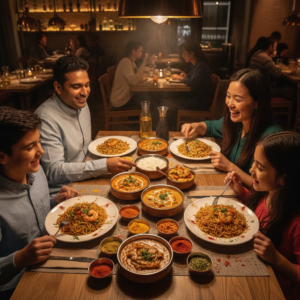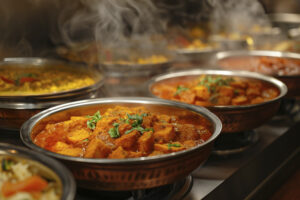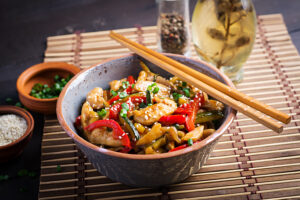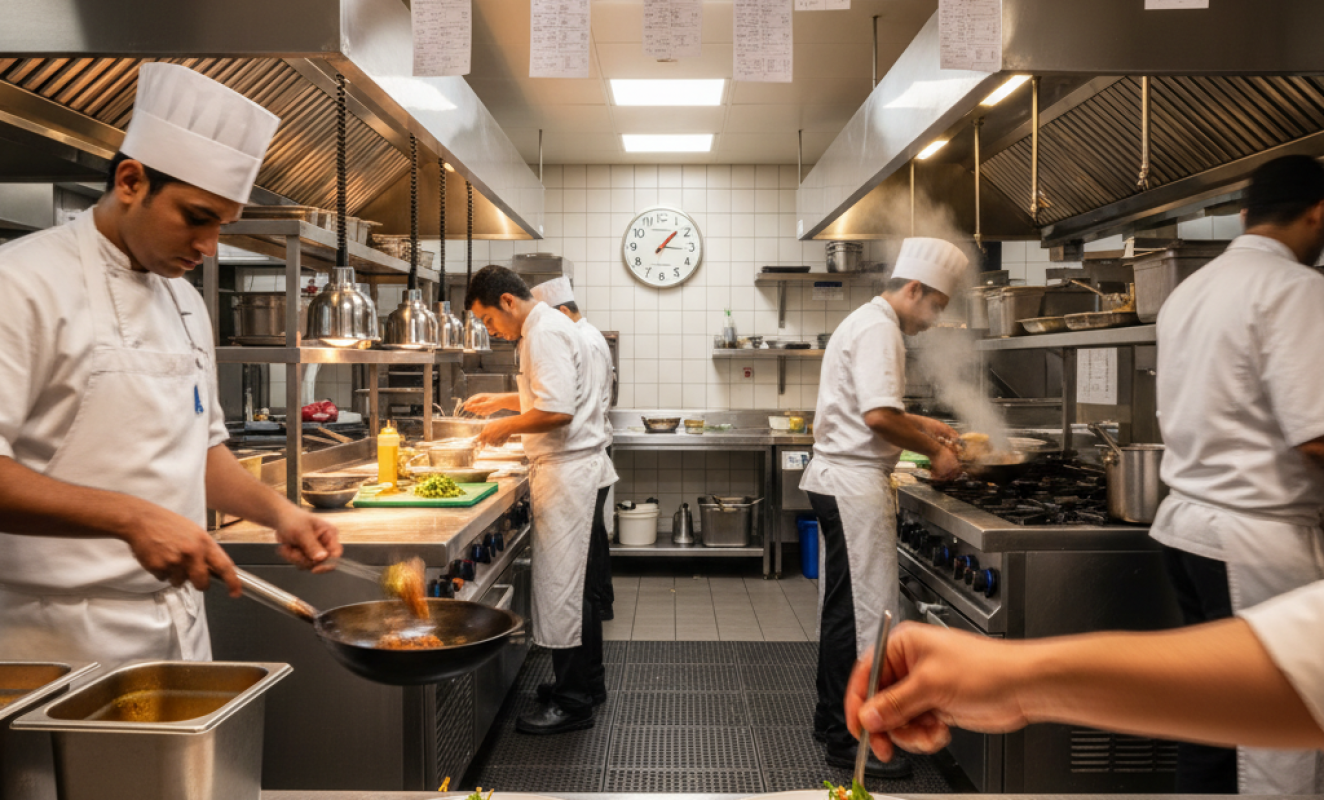
At 7 Spice Bistro, the most common compliment we hear after a busy Friday dinner rush isn’t about the butter chicken or the Hakka noodles — it’s some version of: “How do you do it so fast?” Tables filling up, families pouring in from across Brampton and Mississauga, orders flying in from both the dining room and the food truck line outside — and yet, dish after dish arrives hot, fragrant, and exactly right. In 2026, as demand for authentic Indian food in the Greater Toronto Area continues to climb, that question deserves a real answer. So we’re opening the kitchen door and letting you see exactly what happens between the moment you place your order and the moment your plate lands in front of you.
⚡ QUICK ANSWER
Our kitchen executes 40 or more orders in 15 minutes through a three-zone preparation system — mise en place, live-fire stations, and plating lines — where every team member owns a precise role. Pre-prepped spice blends, portioned proteins, and a coordinated ticket-calling system eliminate wasted motion and keep authentic flavour consistent from the first plate to the fortieth.
What Does “Mise en Place” Actually Mean in an Indian Kitchen?
Mise en place — the French phrase for “everything in its place” — is the invisible engine that powers every great kitchen. At our Indian restaurant in Brampton, it means something specific and deeply intentional: every spice, every marinated protein, every pre-reduced gravy base is ready before a single guest walks through the door.
Our prep team arrives four hours before service. That’s not an exaggeration — it’s the schedule. During those four hours, the kitchen moves through what we call the “three pillars of readiness”: spice station setup, protein prep, and base sauce production.
The Spice Station
Indian cooking is built on layered spice work — and layered spice work is built on precision. Our spice station holds pre-measured, labelled spice blends for every major dish on the 7 Spice Bistro menu. Rather than reaching for individual jars during a rush — a process that takes 30 seconds per spice, per dish — our cooks reach for a single, pre-combined blend. Multiply that time saving across 40 orders and you’ve recovered nearly 20 minutes of service time without sacrificing a single layer of flavour.
According to the Restaurant Business Online (2024), restaurants that implement structured mise en place protocols reduce ticket times by an average of 22% without any reduction in food quality — a figure that lines up closely with what we’ve experienced firsthand in our Brampton kitchen.
Protein Prep and Marination Windows
Chicken tikka doesn’t become great in 10 minutes. It becomes great over eight to twelve hours of marination in yogurt, ginger-garlic paste, and our house spice blend. Proteins are portioned the evening before, marinated overnight, and brought to cooking temperature before service. When a ticket calls for a tikka dish, the protein is already flavour-saturated — the cook’s only job is to apply heat correctly and with care.
“Great Indian food isn’t fast — it’s already done by the time you order it. The clock starts the night before, not when the ticket prints.”
How Does Our Live-Fire Station Keep Up Without Cutting Corners?
The live-fire station is where the magic becomes visible — and where the most discipline is required. It is a two-cook station by design: one cook manages the tandoor and grill proteins, and one cook manages the sauté and curry pans. These two roles never overlap, and that’s deliberate.
Our tandoor runs at approximately 480°C (900°F) throughout the entire service window. At that temperature, a marinated chicken piece finishes in four to six minutes. A naan takes ninety seconds. The tandoor cook works in rotation — loading, monitoring, and pulling — in a rhythm that becomes almost meditative during a full service rush. Meanwhile, the curry pan cook is executing sauce-based dishes, tempering aromatics in clarified butter, and finishing gravies that were 80% built during the prep window.
The key insight here: by the time a curry order hits the live-fire station, the base sauce — onion, tomato, aromatics, and spice — is already cooked and waiting in a bain-marie. The cook’s live contribution is the final 20%: the protein addition, the cream or coconut finish, the fresh herb garnish. That’s what makes a dish feel freshly made (because it is) without requiring 25 minutes of active cooking per order.
This approach is particularly important when you’re also running a food truck in Brampton simultaneously. Our food truck operates with its own prep kit — a satellite version of the kitchen’s mise en place — so the same quality standards that define the restaurant experience travel with the truck, whether we’re parked on Queen Street or across the city in Mississauga.
Why Does Ticket Coordination Make or Break a Service Rush?
Great food timing is a communication problem as much as a cooking problem. A kitchen that doesn’t talk to itself produces beautiful dishes that arrive at the table fifteen minutes apart — which is a failure regardless of how good each dish tastes individually. At 7 Spice Bistro, we solve this with a structured ticket-calling system and a dedicated expeditor role during peak service.
The expeditor — a role our team takes seriously — stands at the pass and owns the timing of every table simultaneously. When a 40-cover rush hits (which happens regularly on weekend evenings, particularly as more families from Brampton and the broader Peel Region discover us), the expeditor is calling cooking starts, coordinating hold times, and making real-time decisions about which tables fire next. This person doesn’t cook. Their entire value is sequence intelligence.
The 15-Minute Window: How It Actually Breaks Down
Here’s how a 15-minute service window actually maps out in our kitchen when 40 orders fire simultaneously:
- Minutes 0–2: Tickets print, expeditor reads and calls the sequence. Spice station confirms all blends are stocked. Sauce station pulls base gravies into position.
- Minutes 2–5: Proteins hit the tandoor and grill. Curry pans ignite. Aromatics temper in parallel across multiple burners. The kitchen is loud, focused, and completely coordinated.
- Minutes 5–9: First tandoor pulls begin. Sauce finishes — cream in, protein folded, seasoning checked. Rice is already cooked and holding at temperature; it’s portioned now.
- Minutes 9–12: Plating begins on the first wave of tickets. The plating station — a dedicated, clear counter at the pass — receives components from the grill cook and the sauce cook simultaneously. Garnish goes on. Portions are checked visually.
- Minutes 12–15: All 40 plates are on the pass. Expeditor confirms each ticket against each plate. Servers are called by table. First plates are moving to the dining room while the last ones are still being garnished.
According to the Food Service Director (2023), restaurants with a dedicated expeditor role during peak service see a 31% improvement in table-turn consistency — which directly correlates with guest satisfaction scores. We’ve seen exactly that play out in our own 7 Spice Bistro reviews, where speed and consistency are two of the most frequently cited positives.
“A kitchen that doesn’t talk to itself produces beautiful dishes that arrive fifteen minutes apart — and that’s a failure regardless of how good each dish tastes.”
How Does Authentic Flavour Stay Consistent Across Every Single Order?
Consistency is the hardest thing to maintain at volume — and it’s the thing that separates a genuinely authentic Indian dining experience from a fast-food approximation. Speed without consistency is just chaos with a clock. At 7 Spice Bistro, we maintain authenticity at scale through three non-negotiable systems: standardised recipes with gram-level spice measurements, cook-led quality checks at the plating station, and weekly tasting sessions where the full team evaluates every core dish together.
Gram-Level Spice Measurement
Traditional Indian cooking is often passed down through feel — a handful of this, a pinch of that. That’s beautiful in a home kitchen, but in a restaurant doing 200 covers on a Saturday, “feel” becomes inconsistent very quickly. Our approach honours the traditions behind every recipe while encoding them into precise, repeatable measurements. A cook who joined our team last month prepares the same butter chicken as a cook who’s been with us for three years — because both are working from the same verified recipe, measured to the gram.
This is especially meaningful when you consider that many of our guests searching for the best Indian restaurant in Brampton are comparing our dishes to what their grandmothers made at home. The bar isn’t just “good restaurant food” — it’s the deeply personal memory of a home kitchen. That’s the standard we’re chasing every service.
The Weekly Tasting Table
Every week, before service begins on one designated day, our team gathers around a table and we taste every core dish on the menu together. This isn’t a formal chef’s review — it’s a team conversation. A line cook might notice that the Hakka chili chicken has been running slightly saltier than usual. A server who knows the menu deeply might point out that the dal makhani texture has shifted since we changed suppliers. These observations feed directly into the next prep session. The tasting table is how we catch drift before guests do.
If you’re curious about how our flavour philosophy extends to specific dishes, The Butter Chicken Debate: Traditional Recipe vs. Modern Brampton Interpretations goes deep on how we balance heritage technique with the expectations of a Brampton and Mississauga audience. And if you’re wondering how we extend the same care to our seafood dishes, Seafood in Indian Cuisine: What Makes 7 Spice Bistro’s Fish & Shrimp Dishes Stand Out is worth a read.
What Happens When the Rush Exceeds the Plan?
Even the best-laid kitchen plan meets a night that exceeds expectations. Maybe a community event in Brampton sends an unexpected wave of walk-ins. Maybe a local sports game ends early and suddenly the dining room is twice as full as projected. These moments are where kitchen culture — not just kitchen systems — determines the outcome.
Our team is trained with what we call the “flex protocol.” When ticket volume spikes beyond the projected service window, the expeditor calls a station shift: the prep cook who has finished their four-hour morning work transitions into a secondary plating role. A senior cook takes over spice station restocking so the line cooks stay on their burners without interruption. The food runner, who typically just moves plates, begins verbally confirming ticket numbers with the expeditor to reduce back-and-forth communication.
None of this requires a manager to intervene or a chef to yell. It’s a trained response — practiced, drilled, and part of onboarding for every new team member at our Indian restaurant in Brampton. The kitchen adapts without chaos because everyone knows the contingency before the contingency is needed.
The same flex mentality applies to our food truck operations. When we’re running the Indian food truck near me searches that bring guests to us at events and pop-up locations across the region, the truck team operates with its own version of the flex protocol — because outdoor, mobile service has its own category of surprises, from weather delays to last-minute event schedule changes. Being adaptable isn’t an accident. It’s trained behaviour.
Whether you’re visiting us in Brampton or exploring what we serve across the river at our Mississauga location, the behind-the-scenes story is the same: every dish you receive is the product of hours of unseen preparation, a team that communicates like a single organism under pressure, and a genuine commitment to the kind of authentic Indian food that makes people drive across the city — and then come back again next week. To learn more about how we serve both communities with one consistent philosophy, visit 7 Spice Bistro Mississauga vs. Brampton: How We Serve Two Communities with One Philosophy.
Ready to Experience the Result of All That Hard Work?
Come see — and taste — what happens when a kitchen runs at its best. Whether you’re joining us in the dining room, catching the food truck, or planning a catered event for your Brampton team or family, we’re ready for you.
✍️ Written by the 7 Spice Bistro Team
We’re the crew behind the counter, the tandoor, and the food truck — proud to serve Brampton and Mississauga the authentic Indian and Hakka food we grew up loving. This article was written from the inside out, because no one knows our kitchen better than the people who live in it every day.
Frequently Asked Questions
How does 7 Spice Bistro manage to serve so many orders so quickly without losing quality?
We use a structured three-zone kitchen system — mise en place, live-fire stations, and a plating line — combined with pre-prepped spice blends, overnight-marinated proteins, and a dedicated expeditor who manages ticket sequencing during peak service. Speed and quality aren’t in conflict when the groundwork is laid hours before service begins.
What makes the food at 7 Spice Bistro taste authentic compared to other Indian restaurants in Brampton?
Authenticity at our restaurant comes from gram-level spice measurement tied to traditional recipes, overnight marination windows that can’t be rushed, and a weekly team tasting session that catches any drift in flavour before it reaches a guest’s plate. We also source ingredients with the same care a home cook would — because the memories our guests bring to the table deserve that respect.
Why does Indian food from a food truck near me taste different from restaurant Indian food?
The main differences are equipment limitations and prep logistics — a truck operates without a full tandoor or multiple burner stations, so menu items are selected specifically for mobile preparation. At 7 Spice Bistro, our food truck carries its own satellite mise en place kit, so the flavour profiles are built from the same spice blends and marinated proteins as the restaurant — only the format changes, not the quality.
Can I visit 7 Spice Bistro in both Brampton and Mississauga and get the same experience?
Yes — both locations run on the same kitchen systems, the same standardised recipes, and the same team training protocols. The communities we serve in Brampton and Mississauga are different in wonderful ways, but the food and service philosophy are consistent. You’ll recognise the flavour whether you’re walking through our Brampton dining room or visiting our 7 Spice Bistro Mississauga location.
Related Articles
- Local Legend: How 7 Spice Bistro Became Brampton's Go-To for Authentic Indian Dining
- The Journey from Traditional Indian Kitchen to Modern Brampton Bistro: Our Evolution
- 7 Spice Bistro Reviews: What Real Customers Love (And How You Can Experience It Too)
- Your First Visit to 7 Spice Bistro: A Warm Welcome Checklist That Removes All Anxiety