Why Searching “Tandoori Chicken Near Me” Led You to a Much Bigger Question
If you’ve ever typed tandoori chicken near me into your phone on a hungry Tuesday night, you already know the disappointing truth: not all tandoori is created equal. Some plates arrive pale, dry, and vaguely smoky. Others — the ones worth remembering — arrive with that deep brick-red char, a crust that crackles at the fork, and a tenderness that seems almost impossible given that the protein spent time in a 900°F clay oven. The difference, almost every single time, comes down to what happened before the oven was ever lit. In 2026, as Indian cuisine continues its meteoric rise across North America, our team at 7 Spice Bistro wants to pull back the curtain on the science and craft that separates a truly transcendent tandoori from a forgettable one. Spoiler: yogurt is at the centre of everything.
⚡ QUICK ANSWER
Yogurt marinades transform tandoori proteins because lactic acid gently denatures surface proteins, opening the muscle fibres so that spices, salt, and fat penetrate deeply — rather than sitting on the surface. The result is meat that is seasoned all the way through, stays moist at extreme oven temperatures, and develops a caramelised crust that home cooking almost never replicates. At 7 Spice Bistro, every tandoori item on our menu goes through a minimum two-stage marinade process before it ever sees the clay oven.
What Does Yogurt Actually Do to Meat at a Molecular Level?
Yogurt is not just a carrier for spices — it is an active biochemical agent. The short answer: yogurt’s lactic acid lowers the pH of the meat’s surface to around 5.0–5.5, unwinding tightly coiled protein strands without the aggressive breakdown caused by citrus or vinegar. This gentle denaturation is what makes the difference between tender and mushy.
When muscle fibres relax and open, two important things happen simultaneously. First, fat-soluble spice compounds — particularly the curcuminoids in turmeric, the capsaicinoids in Kashmiri chilli, and the volatile terpenes in cumin — travel into the meat rather than resting on its exterior. Second, water-soluble salt ions redistribute moisture more evenly across the protein, which is why properly marinated tandoori chicken remains juicy even after spending several minutes at temperatures that would turn an unmarinated breast into shoe leather.
According to the journal Food Chemistry, lactic acid fermentation in dairy-based marinades significantly improves water-holding capacity in poultry proteins — which directly correlates with the succulence you experience in a well-made tandoori dish. This isn’t cooking folklore; it’s demonstrable food science that our kitchen team at 7 Spice Bistro has built into every recipe we serve across Brampton and Mississauga.
“A yogurt marinade is not a shortcut — it is the most important investment of time in the entire tandoori process. Without it, no amount of spice blending or oven skill can save the dish.”
— 7 Spice Bistro Kitchen Team
The Role of Proteolytic Enzymes in Full-Fat Yogurt
Full-fat yogurt contains naturally occurring proteolytic enzymes — primarily from the bacterial cultures Lactobacillus bulgaricus and Streptococcus thermophilus — that continue to break down surface proteins during the marination period. This enzymatic activity is subtle but cumulative. Given enough time (and at 7 Spice Bistro, we never rush this), those enzymes soften the meat’s connective tissue without turning the exterior to paste, leaving behind a surface that crisps beautifully against the radiant heat of a tandoor clay wall.
This is one of the core reasons why our 7 Spice Bistro tandoori consistently draws guests from across the Greater Toronto Area — including families driving in from Mississauga specifically for our weekend specials. The science is invisible on the plate, but it is absolutely present in every single bite.
How Does a Two-Stage Marinade Work — and Why Does It Beat a Single Soak?
A two-stage marinade beats a single soak because each stage targets a different penetration depth and serves a distinct chemical purpose — the first stage prepares the protein surface, and the second stage delivers layered flavour complexity that a single marinade cannot achieve alone.
At 7 Spice Bistro, here is how that process works in practice:
Stage One — The Opening Marinade: We begin with a simple mixture of lemon juice, salt, ginger-garlic paste, and a touch of raw papaya paste (a natural source of papain, a powerful proteolytic enzyme). This stage lasts between 30 and 45 minutes and is entirely about preparation. Its job is to begin opening the muscle fibres, draw out surface moisture, and create a slightly tacky exterior that the second marinade can adhere to more effectively.
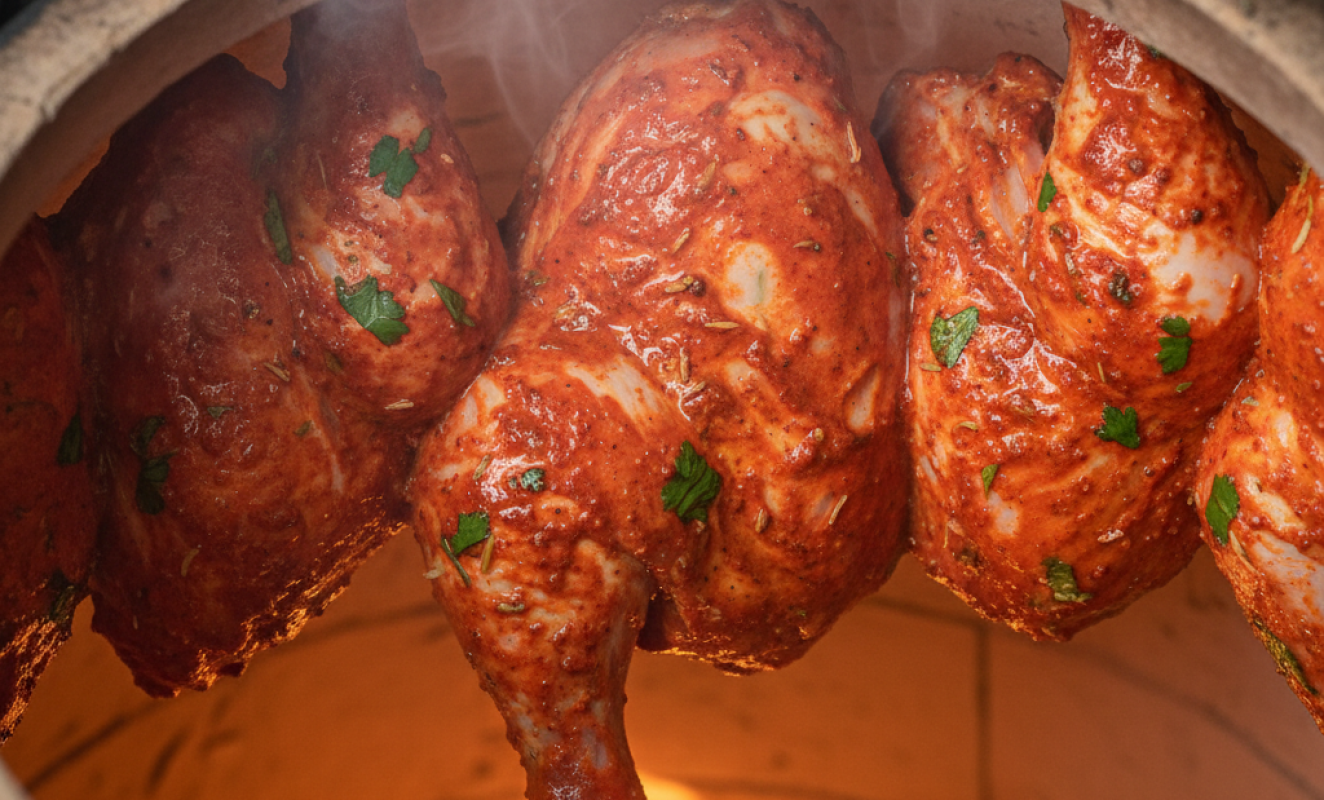
Stage Two — The Spiced Yogurt Marinade: This is where character is built. Full-fat strained yogurt is combined with Kashmiri chilli powder (for that unmistakable crimson colour and mild fruity heat), roasted cumin, garam masala, mustard oil, fenugreek leaves (kasuri methi), and our own proprietary spice blend. The protein rests in this marinade overnight — a minimum of eight hours, though we prefer twelve. This extended rest allows fat-soluble spice compounds to migrate deep into the fibres, guaranteeing that flavour is present throughout the cut rather than just at the surface.
The result is what you experience when you visit us as one of the most consistently praised authentic Indian restaurant destinations in Brampton. That depth of flavour is not accidental — it is a product of process, patience, and genuine respect for traditional technique.
Why Mustard Oil Is Not Optional
Many home cooks substitute vegetable oil or even olive oil in their tandoori marinades and then wonder why the result tastes flat. Mustard oil carries allyl isothiocyanate — the same pungent compound responsible for the heat in horseradish and wasabi — which adds a background sharpness that interacts with yogurt’s acidity to create complexity. When mustard oil hits the extreme heat of the tandoor, it also generates distinctive Maillard reaction products that you simply cannot replicate with a neutral oil. In Brampton’s South Asian culinary community, this is considered foundational knowledge, not a secret.
Why Does the Tandoor Oven Make Marination Even More Critical?
The tandoor oven demands proper marination because its cooking environment is extraordinarily unforgiving — proteins exposed to 800–900°F radiant heat without adequate protection will dehydrate within minutes. A well-executed yogurt marinade acts as both a flavour delivery system and a thermal buffer that buys precious time.
A traditional clay tandoor oven operates through three simultaneous heat transfer mechanisms: radiant heat from the fired clay walls, convective heat from the hot air column rising through the oven, and conducted heat from the metal skewer itself. No other cooking vessel combines all three in this way. According to research cited by the BBC Good Food culinary guides, tandoor cooking can achieve internal protein temperatures of 165°F in under eight minutes — roughly four times faster than a conventional oven operating at 400°F. That speed is precisely what creates the iconic char-and-tender contrast. But it also means there is almost no margin for error in the preparation stage.
The yogurt layer on the exterior of the protein insulates it during the first critical minutes of cooking. As moisture evaporates from the yogurt’s surface, it creates a brief cooling effect — similar to the way sweat cools skin — that prevents the outermost layer of meat from cooking faster than the interior. By the time the yogurt coating has fully charred and crisped, the interior has had just enough time to reach the ideal temperature without overcooking. This is culinary physics, and it is one of the key reasons why our Indian food in Brampton consistently earns five-star reviews.
The Char Is Not Burnt — It Is Intentional
First-time tandoori diners sometimes mistake the blackened edges on tandoori chicken or seekh kebab for burning. This is a misconception worth correcting. The dark edges result from the Maillard reaction — the same browning process responsible for the crust on a perfectly seared steak — occurring at extreme temperatures in the presence of the sugars naturally present in yogurt and the ginger-garlic paste used in the marinade. Those caramelised edges carry intensely concentrated flavour compounds that the interior of the protein cannot develop. A tandoori dish without char is, technically speaking, undercooked.
Families visiting us from Mississauga for the first time are often surprised to discover that the slightly smoky, slightly bitter edge notes they taste in our tandoori are a feature, not a flaw — and that this complexity is entirely absent from the oven-roasted or pan-seared imitations they may have tried elsewhere in the Greater Toronto Area.
How 7 Spice Bistro Applies These Principles Across the Full Tandoori Menu
At 7 Spice Bistro, the yogurt marination philosophy extends beyond chicken to every tandoori protein on our menu — and each protein requires its own calibrated approach because the science changes with the density, fat content, and texture of the cut.
Lamb chops, for example, benefit from a longer Stage One due to the density of lamb’s connective tissue, and we incorporate green papaya paste more heavily to assist with the breakdown of tough collagen fibres. Paneer — which does not contain muscle fibres and therefore does not require the same denaturation — is marinated primarily for flavour absorption and surface preparation, with a shorter overall marination time to prevent the yogurt acids from breaking down the cheese’s delicate structure.
Prawns require the most careful calibration. Shellfish proteins are dramatically more delicate than poultry or red meat, and over-marination — even with yogurt’s gentle acid — will result in a mushy texture. Our kitchen team limits prawn marination to 45–60 minutes maximum and adjusts the yogurt ratio downward, relying more on spice oil suspensions to deliver flavour. The goal is always the same: every bite of every tandoori dish on the 7 Spice Bistro menu should taste like it was cooked specifically for you, not like a batch item pulled from a tray.
This commitment to protein-specific technique is one of the reasons that 7 Spice Bistro reviews consistently highlight not just flavour, but texture — guests noticing that nothing is ever overcooked, rubbery, or dry. That consistency is engineered, not lucky. If you enjoy exploring how these same principles apply to our richer, sauce-based dishes, we recommend reading The Butter Chicken Debate: Traditional Recipe vs. Modern Brampton Interpretations, which explores how pre-cooking techniques influence even the most beloved Indian comfort foods.
Extending the Philosophy to Seafood
The same marination science that elevates our tandoori chicken and lamb applies — with precise adjustments — to our seafood offerings as well. If you haven’t yet explored how our kitchen handles fish and shrimp with the same level of technical respect, we invite you to read Seafood in Indian Cuisine: What Makes 7 Spice Bistro’s Fish & Shrimp Dishes Stand Out. The principles are the same; the execution is entirely different — and deliciously so.
What Makes 7 Spice Bistro Different From Other Indian Restaurants Near Me?
What separates 7 Spice Bistro from other Indian restaurants in the area is the combination of traditional technique, ingredient integrity, and technical discipline — applied consistently across both our Brampton and Mississauga locations for every dish, every service.
When guests search for an authentic Indian restaurant in the Greater Toronto Area, the word “authentic” tends to mean different things to different people. For some, it means regional recipes unchanged from grandmother’s kitchen. For others, it means sourcing practices — using whole spices toasted and ground in-house rather than pre-blended powders that may have been sitting in a warehouse for months. For our team at 7 Spice Bistro, authenticity means all of the above, plus a rigorous commitment to the underlying science that makes traditional Indian cooking so remarkably effective.
Our Kashmiri chilli is sourced specifically for its low heat and high colour yield — not every red chilli delivers the same pigment intensity, and the difference between authentic tandoori red and “restaurant orange” comes down to chilli variety, not food colouring. Our yogurt is full-fat, strained in-house overnight to remove excess whey, which concentrates the lactic acid content and creates a thicker coating that adheres more effectively to the protein surface during marination and oven cooking.
These details matter. They are the reason that guests from both Brampton and Mississauga return consistently, and the reason our reputation as a destination indian restaurant brampton families trust has grown year over year. Whether you are visiting us for the first time or planning a large event — our catering team can bring this same level of care to your occasion, as outlined in Catering Your Brampton Event: Why Indian Food Impresses Corporate Teams and Family Reunions.
Ready to Taste the Science?
Every technique described in this article is at work right now in our kitchen in Brampton. Come experience what properly marinated, authentic tandoori tastes like — whether you’re dining in, ordering takeout, or planning a catered event for your family or corporate team across Brampton or Mississauga.
✍️ Written by the 7 Spice Bistro Kitchen & Content Team
Our team of chefs and culinary writers has spent years perfecting traditional Indian and Hakka cuisine across our Brampton and Mississauga kitchens. We write what we cook — and we cook with intention, every single day.
Frequently Asked Questions
How long should you marinate chicken for tandoori?
For genuinely great tandoori chicken, a minimum of eight hours in the spiced yogurt marinade is required — twelve hours is ideal. Anything under four hours will result in surface seasoning only, with the interior remaining largely flavourless. At 7 Spice Bistro, we marinate overnight as a standard practice, not as a premium upgrade. The time investment is the single most important factor in achieving the depth of flavour that separates professional tandoori from home attempts.
What makes an Indian restaurant’s tandoori authentic?
Authentic tandoori requires three non-negotiable elements: a genuine clay tandoor oven (not a conventional oven or grill), a two-stage marination process using full-fat yogurt and whole-spice-derived powders, and protein-specific technique that accounts for the fat content and density of each cut. Restaurants that skip any of these elements will produce a dish that looks similar but tastes fundamentally different. When guests describe 7 Spice Bistro as the best Indian restaurant Brampton has to offer, these are the specific practices they are, knowingly or unknowingly, responding to.
Why does restaurant tandoori taste better than homemade?
Restaurant tandoori consistently outperforms home cooking for three reasons: professional kitchens use genuine clay tandoor ovens that reach 800–900°F (home ovens max out at roughly 500°F), chefs apply a two-stage marination process developed over years of refinement, and ingredient quality — particularly the variety of Kashmiri chilli and the fat content of the yogurt — is sourced specifically for tandoori performance rather than general use. The good news is that understanding this science helps you appreciate what you’re eating, even if it confirms that some things are best left to the professionals.
Can I request customised spice levels for tandoori dishes at 7 Spice Bistro?
Yes — and we genuinely encourage it. Because the spice blend is introduced during the marination stage rather than at service, adjustments are made at the recipe level for your order when possible, particularly for dine-in guests who give advance notice. For families dining with younger children or guests with specific dietary sensitivities across our Brampton and Mississauga locations, our front-of-house team will always connect you directly with the kitchen to ensure your experience is calibrated to your preferences without compromising the integrity of the dish.
Related Articles
- The Tandoori Chicken Question: Why Temperature Control Changes Everything
- The Butter Chicken Debate: Traditional Recipe vs. Modern Brampton Interpretations
- What Makes a Biryani Worth the Wait? The Science of Patient Cooking
- Brampton vs. Mississauga: Is 7 Spice Bistro's Menu Different Across Locations?