Why Your Search for “Chicken Biryani Near Me” Deserves a Better Answer
Typing “chicken biryani near me” into your phone should feel exciting — and yet, if you’ve ever lifted the lid on a container of biryani that turned out to be little more than yellow rice and dry chicken, you know how deflating that moment can be. In 2026, Brampton’s food scene has grown remarkably diverse, and authentic Indian cuisine is more accessible than ever. But “accessible” doesn’t always mean “authentic,” and knowing the difference can save you both money and disappointment.
This guide is our honest attempt to help you — whether you’re a lifelong biryani lover or someone exploring Indian food for the first time — understand exactly what separates a truly great chicken biryani from a forgettable imitation. We’ll walk you through aroma, rice quality, layering technique, spice balance, and more. And yes, we’ll use our own kitchen at 7 Spice Bistro as the benchmark, because we genuinely believe our team’s approach to biryani reflects decades of collective culinary tradition.
⚡ QUICK ANSWER
Authentic chicken biryani has three non-negotiable hallmarks: long-grain basmati rice with each grain separate and intact, a layered construction (not mixed), and a fragrance built from whole spices like cardamom, bay leaf, and cloves — not just turmeric powder. If the rice is clumped, the chicken is on top rather than woven between layers, or the aroma is flat, what you’re eating likely isn’t the real thing.
What Does Authentic Chicken Biryani Actually Smell Like?
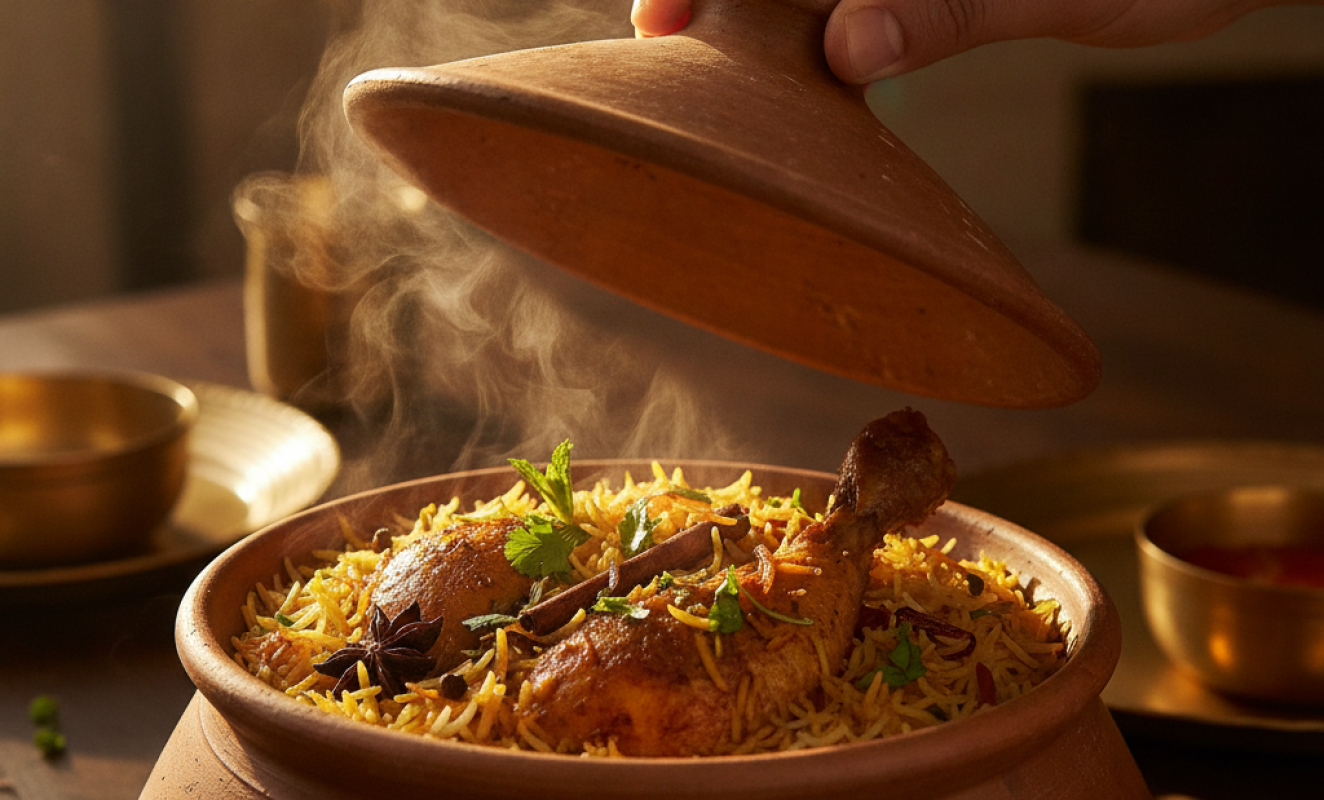
Authentic chicken biryani announces itself before you even pick up a fork — a wave of warm whole spices, caramelized onions, and slow-cooked chicken should reach you the moment the lid is lifted. The aroma is your first quality signal, and it’s one of the most reliable ones.
A properly made biryani uses whole spices — star anise, green cardamom, black cardamom, cloves, cinnamon sticks, and bay leaves — rather than pre-ground spice blends. When these are bloomed in oil or ghee and then slow-cooked under a sealed lid (a technique called dum cooking), they release essential oils that perfume the rice from the inside out. The result is a complex, layered fragrance: floral notes from cardamom, warmth from cinnamon, earthiness from cloves, and a subtle smokiness from the sealed pot.
What you shouldn’t smell is raw flour, a sharp chemical turmeric note, or the kind of one-dimensional “curry smell” that comes from powder shortcuts. If the fragrance fades within seconds of opening the container, the biryani likely wasn’t cooked with whole aromatics. At 7 Spice Bistro, we use whole spices in every batch — not because it’s faster, but because the aroma profile simply cannot be replicated any other way.
“The fragrance of a biryani is its autobiography — it tells you exactly how it was made, what shortcuts were taken, and whether the cook respected the dish.”
A great biryani should also carry the scent of caramelized onions — not raw onion, but deeply golden, slow-fried onions (called birista) that add sweetness and body to the overall fragrance. This is a time-consuming step that budget-cut kitchens often skip, replacing it with onion powder or pre-fried onion flakes. Your nose will know.
How Does Rice Quality Separate Good Biryani from Great Biryani?
The rice in a great biryani should be long, separate, and fluffy — each grain distinct, never clumped or mushy. This is achieved through the choice of basmati variety, proper soaking time, and precise partial cooking before the dum layering begins.
Aged basmati rice is the gold standard for biryani. Ageing — typically one to two years after harvest — reduces moisture content, making the grains less likely to stick together during cooking. Aged basmati also elongates beautifully when cooked, sometimes nearly doubling in length. A visually impressive plate of biryani will show grains that are slender and long, glistening slightly from ghee, and holding their shape even after being scooped.
According to the Agricultural and Processed Food Products Export Development Authority (APEDA), India exports over four million metric tonnes of basmati rice annually, making it the world’s leading supplier of this variety — a reflection of how central quality rice sourcing is to dishes like biryani. When a restaurant takes shortcuts on the rice, it shows immediately in texture and mouthfeel.
For a deeper dive into why the choice of rice base matters so much in Indian cooking, we’d recommend reading our post on The Rice Situation: Basmati, Jasmine & Brown — Which Base Matters Most for Your Curry. It lays out in plain terms why basmati is non-negotiable for biryani specifically.
The rice should also carry colour variation — patches of white, pale gold, and saffron-orange — which is the visual signature of a properly layered pot. Uniformly yellow rice is a sign that the dish was mixed or cooked as a single mass, rather than assembled in distinct layers.
| Quality Indicator | Authentic Biryani | Common Shortcut Version |
|---|---|---|
| Rice grain appearance | Long, separate, slightly elongated | Clumped, short, or broken |
| Rice colour | Multi-toned: white, gold, saffron orange | Uniform yellow throughout |
| Aroma source | Whole spices, birista onions, saffron | Pre-ground powder blends |
| Chicken placement | Woven between rice layers | Sitting on top or stirred in |
| Cooking method | Dum (sealed pot, slow steam) | Open pot boiling or microwave finish |
| Spice balance | Complex: warm, floral, slightly smoky | One-note heat or artificial flavour |
Why Layering Technique Is the True Test of a Serious Kitchen
Layering is what distinguishes biryani from pulao — and it’s the step that shortcuts are most tempted to skip. True biryani is built in distinct, alternating strata: marinated chicken on the bottom, partially cooked rice on top, then aromatics, then another layer of rice, finished with saffron milk and sealed for dum cooking.
This isn’t just a visual presentation choice — it’s functional. The bottom layer of chicken releases juices and steam during dum cooking, which rises upward through the rice, infusing every grain with flavour from below. The saffron-milk drizzled from above colours the top layer golden-orange while leaving the middle strata white. When you scoop into a properly layered biryani, you get a cross-section of three distinct flavour zones in every serving.
According to a 2023 consumer survey by Zomato India, biryani was the single most ordered dish on their platform for the seventh consecutive year, with over 43 million orders placed annually — a statistic that underscores both the dish’s cultural centrality and the commercial pressure kitchens face to produce it quickly at scale. Speed and authenticity are often in direct tension, which is why understanding what a kitchen has likely done — or skipped — matters to you as a diner. Source: Zomato Year in Review, 2023.
Our team at 7 Spice Bistro has spent seven years refining this exact process in Brampton. We don’t rush the layering, and we don’t seal the pot until each component is at precisely the right temperature for the steam to do its work. That patience is what you taste in the final dish.
The Dum Technique: Why a Sealed Pot Changes Everything
Dum cooking — sealing the pot with dough or a tight-fitting lid and cooking over low heat — is the final, irreplaceable step. It creates a pressurized environment inside the pot where steam circulates continuously, cooking the rice to perfection while keeping the chicken moist. A kitchen that skips dum will produce biryani that is either overcooked on top or undercooked at the base, and the flavours will never fully meld.
You can also read our piece on The Tandoori Chicken Question: Why Temperature Control Changes Everything to understand more broadly how heat management defines the quality of traditional Indian cooking. The principle applies equally to biryani: temperature control isn’t a technical detail, it’s the whole ballgame.
Where Is the Best Biryani Near Me in Brampton and Mississauga?
If you’re searching for the best biryani near you in Brampton or nearby Mississauga, the honest answer is: look for a restaurant that talks openly about its technique, sources quality basmati, and has been doing this long enough to have refined a consistent process. Longevity and transparency are two strong signals of authenticity.
We’ve been serving the Brampton community for seven years, and our chicken biryani has remained one of the most requested dishes on our menu throughout that time. When diners search for the best biryani in Mississauga or Brampton, we want them to find a restaurant that can actually explain why their biryani tastes the way it does — and back it up in the bowl.
Our chefs bring diverse regional backgrounds to the kitchen, which means our biryani doesn’t follow just one school of thought. We draw on Hyderabadi dum technique, Lucknawi layering traditions, and our own seven years of refinement in a Brampton kitchen that serves real families, food enthusiasts, and event planners week after week. That cross-pollination of regional expertise is genuinely rare at this price point.
For those searching “indian food near me” in the Peel Region, our dine-in experience is designed to be as welcoming as the food itself — a quiet, peaceful environment where you can actually taste what’s in front of you without being rushed. That matters more with biryani than almost any other dish, because biryani rewards slow eating. The flavours at the bottom of the bowl are different from those at the top, and a calm dining space lets you notice that.
“Finding the best biryani in Mississauga or Brampton isn’t just about proximity — it’s about finding a kitchen that treats the dish with the patience it deserves.”
We also offer catering services for events and private dining, which means if you’ve discovered a biryani you love at our restaurant, you can bring that same dish — prepared fresh and in volume — to your family gathering, office event, or milestone celebration right here in Brampton. Large-format biryani is one of our most popular catering requests, and we’re proud of how consistently it arrives.
Is Budget-Friendly Biryani Always a Red Flag?
No — budget-friendly biryani is absolutely achievable without sacrificing authenticity, but only when a kitchen has optimized its sourcing and workflow over years of practice. Price alone is not a reliable quality indicator for biryani.
The misconception that authentic biryani must be expensive comes from assuming that premium pricing equals premium technique. In reality, a well-run kitchen with strong supplier relationships and experienced cooks can produce genuinely excellent biryani at accessible prices. What drives up cost in some restaurants isn’t better ingredients — it’s location rent, décor, and margin padding.
At 7 Spice Bistro, our commitment has always been to offer Indian restaurant Brampton families can afford to visit regularly — not just on special occasions. We believe that authentic Indian food near me shouldn’t require a special-occasion budget. Our pricing reflects seven years of operational efficiency, not corners cut in the kitchen.
According to Statistics Canada’s 2023 Food Service Industry Report, the average Canadian household spends approximately $2,900 annually on restaurant meals — yet satisfaction rates are highest not at the most expensive establishments, but at mid-range restaurants where perceived value aligns with quality. Source: Statistics Canada, Food Service Sector Overview. That’s the space we operate in: genuine quality at a price point that respects your household budget.
The red flags to watch for with budget biryani aren’t the price itself — they’re the shortcuts we described earlier: clumped rice, uniform yellow colour, no whole-spice fragrance, and chicken that tastes boiled rather than marinated and slow-cooked. Those are signs of cost-cutting in the wrong places. A responsible kitchen finds efficiency in operations, not in the bowl.
Whether you’re a family looking for a reliable weekly dinner spot, a food enthusiast wanting to compare regional biryani styles, or an event planner sourcing catering for a Brampton celebration, we’d love to show you what seven years of practice actually tastes like. Visit us for dine-in, explore our full menu including our Hakka and Indo-Chinese offerings, or get in touch about catering. The biryani will speak for itself.
Ready to Taste the Real Thing?
Come visit us in Brampton for dine-in, explore our full menu online, or ask about our catering services for your next event. Our chicken biryani — and the whole kitchen behind it — is waiting for you.
✍️ Written by the 7 Spice Bistro Team
We’re the cooks, hosts, and food enthusiasts behind 7 Spice Bistro in Brampton, ON — a team with diverse regional Indian culinary backgrounds and seven years of experience feeding this community. We write what we cook, and we cook what we believe in.
Frequently Asked Questions
How can I tell if chicken biryani is authentic before I order it?
Ask how it’s cooked: authentic biryani is always made using the dum method — a sealed pot on low heat. You can also look at photos of the dish online before ordering; genuine biryani will show multi-coloured rice (white, gold, and saffron-orange tones), not uniformly yellow grains. A kitchen that can describe its technique clearly is usually one that actually uses it.
What makes 7 Spice Bistro’s biryani different from other Indian restaurants in Brampton?
Our chefs bring regional diversity to the dish — drawing on Hyderabadi, Lucknawi, and other regional traditions rather than a single house recipe. Seven years of cooking for the Brampton community has also given us the practice to be consistently excellent, not just occasionally impressive. We use aged basmati rice, whole spices, and the full dum layering process every time — not just for special orders.
Why does biryani from some restaurants taste so different from others, even when it’s the same dish?
Biryani has enormous regional variation across India — Hyderabadi, Kolkata, Lucknawi, Malabar, and Sindhi styles all differ significantly in spice profiles, rice-to-meat ratios, and marination techniques. Beyond regional style, the quality of basmati, the freshness of whole spices, and the care taken during dum cooking all produce dramatically different results. It’s one of those dishes where technique accounts for the majority of the final flavour.
Can I order chicken biryani from 7 Spice Bistro for a catering event in Brampton?
Absolutely — catering is one of our most popular services, and large-format chicken biryani is among our most requested catering items for family gatherings, corporate events, and private celebrations throughout Brampton. We prepare it fresh for your event and can accommodate a range of guest counts. Reach out through our website at 7 Spice Bistro to discuss your event details and get a quote.