If you’ve ever typed “bhel puri near me” into your phone and stared at a list of results that felt deeply unsatisfying, you’re not alone — and you’re asking exactly the right question. Indian chaat culture is one of the most vibrant, layered, and misunderstood corners of South Asian cuisine, and in 2026, Brampton’s dining scene is finally starting to give it the respect it deserves. At 7 Spice Bistro, we’ve spent seven years watching guests discover these dishes for the first time — eyes wide, a little confused, and then completely hooked. This guide is our love letter to chaat: what it is, why it matters, and why the experience of eating it properly changes everything.
⚡ QUICK ANSWER
Indian chaat is a family of savoury street snacks — including bhel puri, pani puri, samosa chaat, and momos — defined by the interplay of sweet, sour, spicy, and crunchy flavours. These dishes originated on the streets of cities like Mumbai, Delhi, and Kolkata, and have become beloved staples for families and food enthusiasts across Brampton and the Greater Toronto Area. At 7 Spice Bistro, we bring this authentic street food tradition indoors, served fresh with all the boldness of the original.
What Exactly Is Indian Chaat — and Why Is Everyone Talking About It?
Chaat is not a single dish. It’s a philosophy of flavour. The word itself comes from the Hindi verb chātna, meaning “to lick” — a deeply accurate description of the instinct these snacks trigger the moment they hit your tongue. Every great chaat dish is built around a deliberate collision of opposites: crunch against softness, heat against tang, sweetness against salt. It is street food elevated to an art form, and it has been feeding India’s cities for centuries.
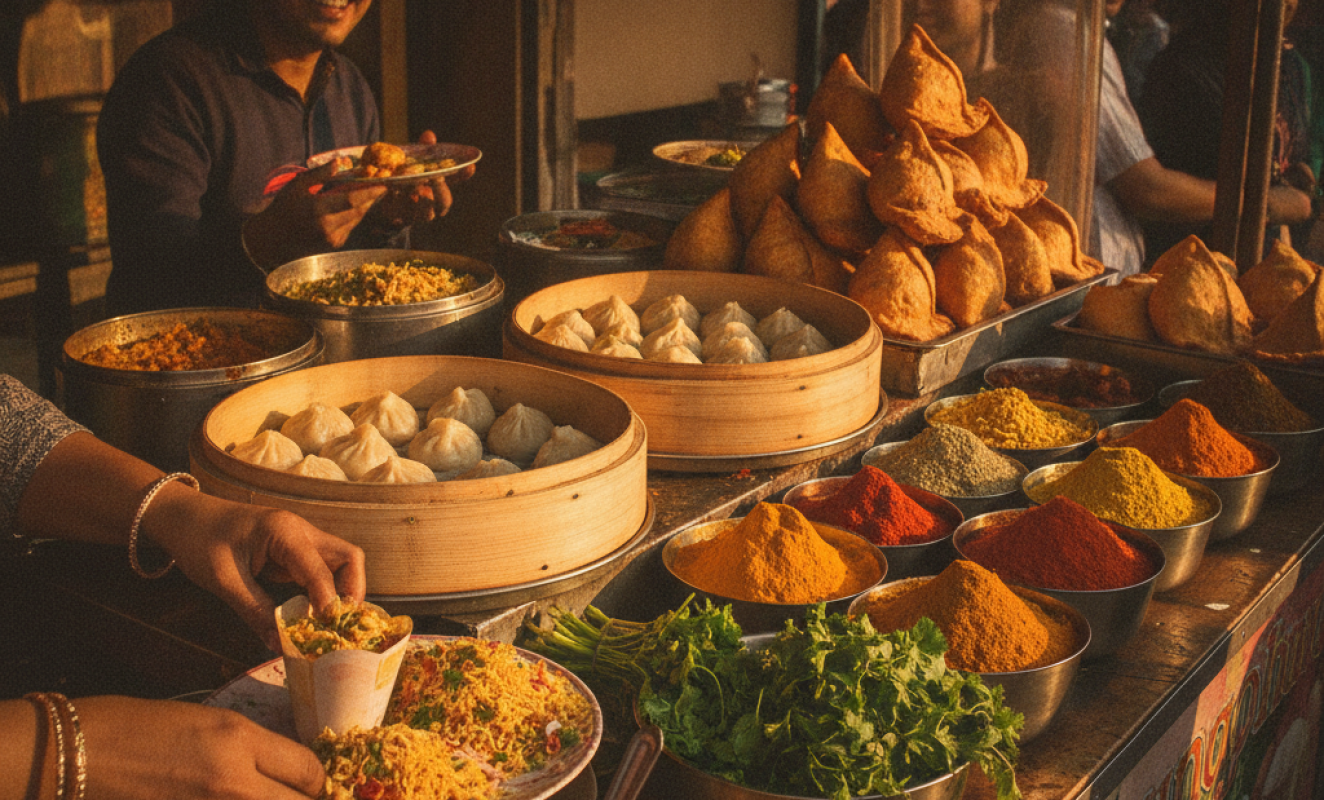
The chaat family is large and wonderfully diverse. At its heart, you’ll find dishes built on a foundation of puffed rice, fried dough, chickpeas, potatoes, fresh chutneys, and yogurt — all layered together with surgical precision right before serving, because chaat waits for no one. The moment it sits too long, the textures shift, and the magic dims. This is why the best chaat has always been made fresh to order, whether on a Mumbai footpath or in a Brampton kitchen.
For many families searching for authentic Indian food near me, chaat represents something more than a snack — it’s a memory. It’s the smell of a street corner after school, the vendor’s practiced hands, the newspaper cone. Recreating that authenticity in a restaurant setting requires genuine commitment to ingredients, technique, and timing. That’s a commitment our team at 7 Spice Bistro takes seriously every single day.
The Core Chutneys That Make or Break a Chaat Dish
No chaat is complete without its chutneys, and understanding them is the key to understanding why chaat tastes the way it does. The two essential ones are tamarind chutney (imli ki chutney) — dark, sticky, sweet-sour, and deeply complex — and green chutney (hari chutney), made from fresh coriander, mint, green chilli, and lemon. These two sauces are never interchangeable; they’re deliberately contrasting, and the ratio in which they’re applied is what gives each vendor, and each kitchen, its signature.
A third element, sev — thin, crunchy chickpea flour noodles — appears across almost every chaat dish as a textural punctuation mark. Without it, the dish feels incomplete. With it, every spoonful has something to offer. These details are not trivial. They’re the difference between chaat that tastes authentic and chaat that tastes like an approximation.
Bhel Puri Explained: The Most Iconic Indian Street Snack
Bhel puri is arguably the most recognisable chaat dish in the world, and its simplicity is deceptive. At its core, bhel puri is puffed rice tossed with diced onion, tomato, boiled potato, both chutneys, a squeeze of fresh lemon, and a generous fistful of sev — all mixed together in seconds and served immediately. The window between perfectly crunchy bhel and soggy bhel is narrow, which is why eating it fresh is non-negotiable.
Bhel puri originated in Mumbai (then Bombay), where it was sold on Chowpatty Beach as an affordable, filling, and deeply satisfying snack for everyone from schoolchildren to office workers. Today, regional variations exist across India — Kolkata’s jhalmuri, for example, swaps some ingredients for mustard oil and green chilli paste — but the Mumbai original remains the benchmark. When guests tell us they’ve been searching specifically for food near me that actually delivers this dish the right way, we understand completely. Most versions in North America cut corners on the chutney, the sev, or both. We don’t.
“Great bhel puri is assembled, not cooked — which means the quality of every individual ingredient is fully exposed. There’s nowhere to hide, and that’s exactly what we love about it.”
Other Chaat Staples Every New Diner Should Know
Pani Puri (also called golgappa in Delhi or puchka in Kolkata) is perhaps the most theatrical chaat experience. A small, hollow, crispy sphere — about the size of a golf ball — is pierced open, filled with a mixture of spiced mashed potato and chickpea, and then flooded with ice-cold, fiercely spiced tamarind-mint water. The entire thing must be eaten in a single bite. There is no polite way to eat pani puri, and that’s part of its charm.
Samosa Chaat takes an already-beloved snack — the fried, spiced potato samosa — and elevates it into a full chaat experience. The samosa is crushed, topped with chickpea curry (chole), both chutneys, yogurt, and sev. It’s rich, warming, and deeply satisfying. It’s the dish that converts samosa sceptics into believers.
Dahi Puri is the gentler cousin of pani puri — the same crispy spheres, but filled with potato, sweet tamarind chutney, and a generous dollop of cool, creamy yogurt. Where pani puri is bold and punchy, dahi puri is balanced and soothing. It’s often the chaat that families recommend to guests who are nervous about heat levels.
What Are Momos, and How Did They Become Part of India’s Street Food Story?
Momos are steamed or fried dumplings that originated in the Himalayan regions — Tibet, Nepal, and Sikkim — but have become one of the most popular street snacks across India’s northern cities and beyond. Their journey into Indian street food culture is a story of geography, migration, and irresistible flavour. Anyone searching for momos Brampton is tapping into a culinary tradition that crosses borders as naturally as the Himalayan trade routes that helped spread it.
A momo is, at its most basic, a thin dough wrapper folded around a seasoned filling and then steamed until just cooked through. The filling varies — spiced vegetables, paneer, chicken — and the dipping sauce is typically a fiery tomato-chilli condiment that cuts through the momo’s delicate wrapper. What makes momos addictive is the contrast: a soft, almost silky exterior giving way to a hot, juicy, intensely seasoned interior, finished with a sauce that brings everything into sharp focus.
In Indian cities like Delhi and Kolkata, momo carts have become fixtures of the street food landscape — steaming baskets stacked high, long queues forming even on cold evenings. The dish crossed cultures and kept its integrity, which is precisely what makes it so compelling. At 7 Spice Bistro, we approach momos with that same respect for origin, using seasoning profiles that honour the Himalayan tradition while making them feel immediately at home here in Brampton.
The Connection Between Momos and Indo-Chinese Cuisine
Momos sit comfortably at the intersection of South Asian and East Asian food traditions, which makes them a natural fit alongside Hakka Chinese cuisine — a fusion culinary tradition born from the Chinese community that settled in Kolkata over generations. At 7 Spice Bistro, our menu reflects this cultural overlap. Our Hakka Chinese offerings — from chilli garlic noodles to Manchurian dishes — share the same boldness and communal spirit as the chaat dishes we serve. They belong on the same table, and our guests in Brampton and Mississauga understand this instinctively.
Why Chaat Tastes Different at a Restaurant Than on the Street — and How We Bridge That Gap
Authentic chaat in a restaurant setting is harder to execute than it looks, and most places that attempt it fall short for the same reasons. Street chaat gets its character from open-air assembly, made-to-order immediacy, and chutneys that have been simmering or fermenting for hours. A restaurant that prepares chaat in bulk and lets it sit destroys the dish before it reaches the table.
Our approach at 7 Spice Bistro is to treat chaat dishes with the same made-to-order discipline you’d expect from a skilled street vendor. Chutneys are prepared fresh in our kitchen daily. Sev is applied at the moment of plating. Pani puri water is kept cold and seasoned to a precise balance of tart, spicy, and herbal. These aren’t small details — they’re the entire point.
For families and food lovers exploring the places to eat in Brampton, the ability to enjoy authentic chaat in a comfortable, seated environment — without the unpredictability of a street stall — is a genuine value proposition. You get the full experience: the flavour, the freshness, and the warmth of our dining room. Our dine-in service is designed to let you slow down, share dishes, and eat the way chaat is meant to be eaten — communally, generously, and with a little bit of mess.
Chaat as a Catering Option: Bringing the Street Food Experience to Your Event
One of the most exciting things we do at 7 Spice Bistro is bring chaat and Indian street food to events through our catering service. Imagine a live chaat station at your wedding reception, corporate gathering, or family celebration — fresh pani puri assembled on the spot, bhel puri tossed to order, momos steaming in their bamboo baskets. It creates an experience that guests talk about long after the event ends.
Our catering team has served events across Brampton and Mississauga, and we’ve found that chaat stations consistently become the most visited table at any gathering. There’s something about the interactive, made-to-order nature of chaat that invites conversation and draws people together. It’s not just food — it’s an activity. If you’re planning an event and looking for food Brampton residents will genuinely remember, a chaat catering package from our menu is worth serious consideration.
How to Order Chaat Like a Local: A First-Timer’s Guide to the 7 Spice Bistro Experience
If you’re new to chaat, the menu can feel overwhelming — and that’s completely understandable. These dishes have unfamiliar names, unusual textures, and flavour combinations that don’t map neatly onto Western dining expectations. The best approach is to start with two or three dishes and share them across the table, which is exactly how chaat is eaten on the streets of India.
For first-timers, we typically recommend beginning with bhel puri — it’s the most approachable in terms of texture and heat level, and it gives you an immediate education in how chutney interplay works. Follow it with samosa chaat, which builds on familiar ground (the samosa) while introducing the richer, saucier side of chaat culture. Then, if you’re feeling adventurous, the pani puri is waiting. Our team is always happy to walk you through the experience and adjust spice levels to suit your preference.
Whether you’re a seasoned South Asian food lover or someone who’s just beginning to explore this cuisine, you’ll find that 7 Spice Bistro offers the kind of authentic, welcoming environment that makes the discovery feel genuinely exciting. We’ve been part of this community for seven years, and nothing gives our team more satisfaction than introducing a new diner to a dish they’ll crave for the rest of their life.
“Chaat isn’t a course in a meal — it’s a conversation. Each dish asks a question about your palate, and the next dish answers it. That’s why you can never eat just one.”
Brampton is home to one of the most culinarily adventurous communities in Canada, and it deserves restaurants that honour that appetite with real craft and real ingredients. The next time you find yourself searching for an Indian restaurant near me that goes beyond the standard curry-and-naan offering, we hope you’ll find your way to our door. The bhel puri is ready. The momos are steaming. And our team is genuinely excited to share this food with you.
Ready to Experience Authentic Indian Street Food in Brampton?
From freshly assembled bhel puri to steaming momos and our full Indian and Hakka Chinese menu, 7 Spice Bistro brings the best of India’s street food culture to your table. Join us for dine-in, order for delivery, or book our catering team for your next event.
✍️ Written by the 7 Spice Bistro Team
The team at 7 Spice Bistro has been crafting authentic Indian and Hakka cuisine in Brampton for over seven years, drawing on deep culinary roots and a genuine passion for sharing South Asian food culture with the wider community. Every article we write comes from the same place as every dish we cook — a commitment to authenticity, quality, and the belief that great food brings people together.
Frequently Asked Questions
What is the difference between bhel puri and pani puri?
Bhel puri and pani puri are both beloved Indian chaat dishes, but they are quite different in form and experience. Bhel puri is a dry, tossed mixture of puffed rice, vegetables, and chutneys — eaten with a spoon or from a cone. Pani puri, on the other hand, is a hollow, crispy sphere that is filled with spiced potato and then flooded with cold, tangy spiced water, and eaten whole in a single bite. Bhel puri is generally milder and more approachable for first-timers, while pani puri is the more immersive and theatrical experience.
How spicy is chaat, and can I request a milder version?
Chaat dishes vary in heat level depending on the dish and the cook’s hand with the green chilli chutney and spice powders. Bhel puri and dahi puri tend to be on the milder end, while pani puri water can be quite fiery. At 7 Spice Bistro, our team is always happy to adjust spice levels to your preference — just let your server know. We want every guest to enjoy the full flavour experience of chaat without being overwhelmed by heat.
Why do momos pair so well with Indian street food dishes?
Momos pair naturally with Indian street food because they share the same culinary DNA — bold seasoning, communal eating, and a focus on freshness and texture. Originating in the Himalayan regions and adopted enthusiastically into Indian street food culture, momos bring a different kind of satisfaction: soft, steamed, and juicy against the crispy, tangy character of most chaat. Together, they create a complete street food spread that covers every texture and flavour note your palate could want.
Can I order chaat and street food dishes for a catered event in Brampton?
Absolutely. Our catering service at 7 Spice Bistro is fully equipped to bring Indian street food and chaat experiences to events across Brampton and Mississauga. We can set up live chaat stations for weddings, corporate events, birthday celebrations, and community gatherings — with freshly assembled dishes prepared on-site for the best possible taste and presentation. Contact our team through our website to discuss your event size, date, and menu preferences, and we’ll build a catering package that fits your needs and your budget.