The question of best biryani: six things that separate a layered, slow-cooked biryani from a dressed-up rice bowl comes up more often than you might think — and honestly, it should come up more. In 2026, with so many restaurants competing for the title of “authentic,” it has never been more important to know what you’re actually eating before you sit down and order. A real biryani is one of the most technically demanding dishes in Indian cooking. A rice bowl with curry poured on top is not. The gap between the two is enormous, and once you learn to spot the difference, you will never settle for the imitation again.
At 7 Spice Bistro, we have spent seven years perfecting our biryani in Brampton, and the conversations our team has with first-time guests are almost always the same: “I didn’t know biryani was supposed to taste like this.” That reaction is exactly what we cook for. So let us walk you through the six things that genuinely separate a masterpiece from a mediocre plate — and why each one matters on the fork, not just on paper.
⚡ QUICK ANSWER
A genuine slow-cooked biryani is defined by six core qualities: whole spice layering, the dum (sealed steam) cooking method, aged long-grain basmati rice, a marinated protein or vegetable base cooked separately, caramelised onions (birista), and intentional seasoning at every layer — not just at the end. If a restaurant skips even two or three of these steps, what they are serving is technically a pulao or a spiced rice dish, not a biryani.
What Exactly Is Dum Cooking, and Why Does It Define a Real Biryani?
Dum cooking is the sealed, slow-steam method that transforms a biryani from a stew-and-rice combo into something architecturally layered and deeply aromatic. The word dum comes from the Persian dam, meaning breath — the pot is sealed with dough or a tight lid and placed over a low flame so that the ingredients finish cooking in their own fragrant steam. Without this step, you are not making biryani.
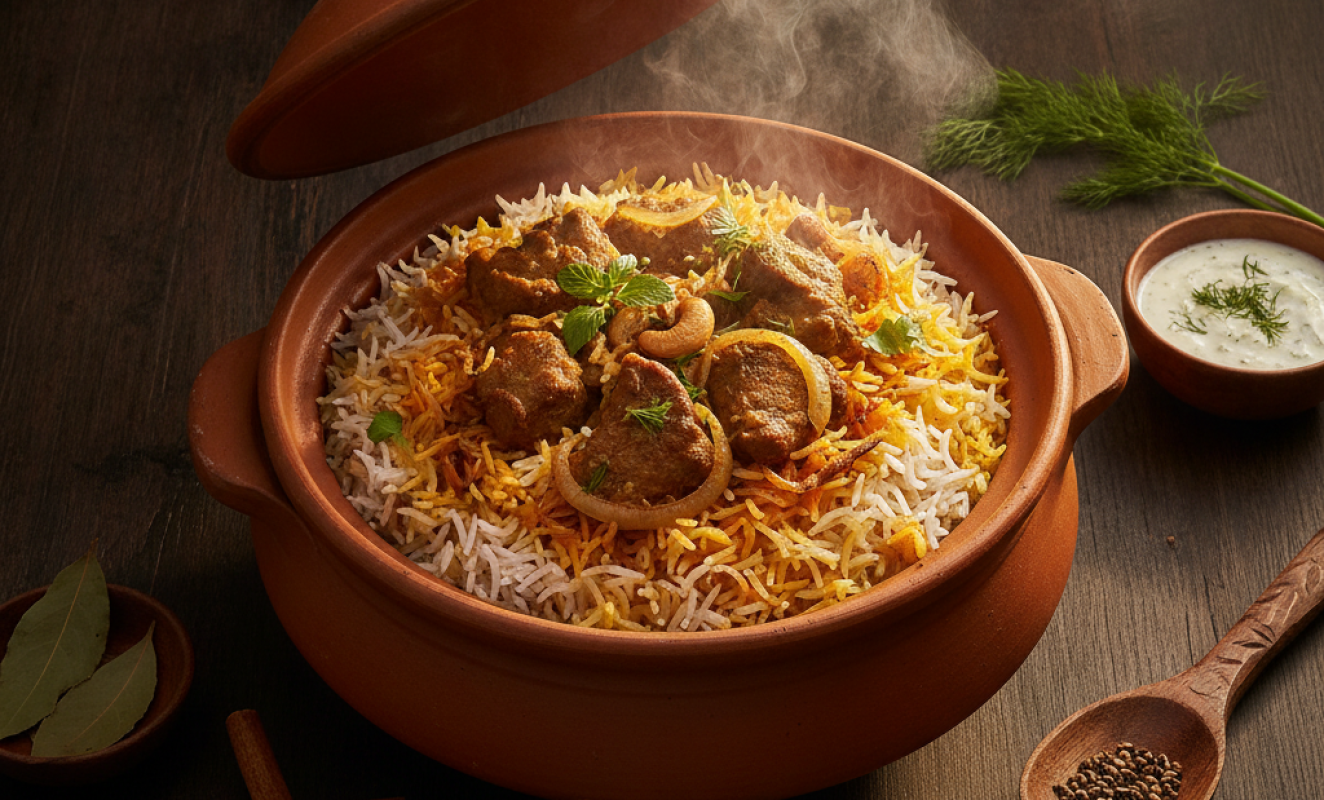
Here is why it matters so much: the dum process forces every grain of rice to absorb the moisture and flavour rising up from the marinated base below. The spices do not sit on the surface — they travel upward through steam and settle into the rice itself. When you lift the lid of a properly sealed dum pot, the rush of saffron-scented steam is an experience on its own. That is not theatre. That is chemistry.
The shortcut that many busy kitchens take is to cook the rice and the gravy completely separately, then combine them just before plating. The result looks similar in a photograph. In the mouth, it tastes like two different dishes awkwardly sharing a bowl. Our team at 7 Spice Bistro uses the traditional dum method because there is no honest substitute, and our guests in Brampton have come to expect that depth of flavour on every visit.
“A biryani sealed with dum is a promise — every grain of rice carries the flavour of everything beneath it. That is impossible to achieve any other way.”
Why Does the Rice Itself Matter So Much in Biryani?
The rice is not a neutral carrier in biryani — it is a co-star. A proper biryani uses aged, long-grain basmati rice, and the difference between aged and fresh basmati is the difference between grains that stay separate and fluffy through cooking versus grains that clump, break, and turn mushy. Aged basmati has a lower moisture content, which means it withstands the dum steam without dissolving into the layers below.
There is a sensory marker that every experienced biryani eater knows: when you press a perfectly cooked grain between your fingers, it should hold its shape, feel slightly firm, and release a faint nutty fragrance. Short-grain rice, parboiled rice, or rice that was simply cooked in spiced water will not behave this way. It collapses. The layered visual effect — white grains threaded through with golden saffron streaks and flecks of fried onion — is only possible with rice that was prepared correctly.
Before the rice ever meets the pot, it should be soaked for at least thirty minutes and par-boiled to roughly seventy percent doneness. The remaining cooking happens inside the sealed vessel. Skipping the soak or fully cooking the rice before layering are two of the most common corners cut in restaurant kitchens that are producing volume over quality. When you search for indian food near me or indian restaurant near me and you want to know if a place takes biryani seriously, simply ask how they prepare their rice. The answer will tell you almost everything.
How Do Whole Spices and Layering Technique Create That Signature Complexity?
Whole spices layered directly into the biryani pot — not ground, not pre-mixed, but whole — are the foundation of aromatic complexity. A well-constructed biryani uses spices like bay leaves, green cardamom, black cardamom, cinnamon bark, cloves, star anise, and mace at multiple stages of the cooking process. Each whole spice releases its oils at a different rate and temperature, which means the finished dish has a flavour profile that evolves as you eat it.
The layering itself follows a deliberate sequence: a base of marinated protein or vegetables, a layer of partially cooked rice, whole spices scattered across, fried onions, fresh herbs, a drizzle of saffron milk, then more rice, more spices, more herbs — and the process repeats. Each layer is seasoned independently. This is not extra work for the sake of tradition; it is the mechanical reason why a single forkful of biryani can taste warm, floral, savoury, and slightly smoky all at once.
Contrast this with a dressed-up rice bowl, where a spice blend is stirred into cooked rice and the protein is placed on top. That method produces one flat flavour note from the first bite to the last. Real biryani should surprise you. The third spoonful should taste different from the first, because you are digging through a new layer with a different spice ratio. That unpredictability is not an accident — it is the entire point of the layering technique.
For those exploring Indian cuisine more broadly, our article on Authentic Indian Cuisine: 8 Hallmarks That Tell You a Restaurant Is the Real Deal covers how spice layering extends far beyond biryani and into the heart of what makes Indian cooking distinct from every other culinary tradition on earth.
What Role Does Marinade Play, and Is It Really Non-Negotiable?
The marinade is completely non-negotiable — and it is the step most often eliminated by restaurants that are optimising for speed over flavour. In a traditional biryani, the protein (or vegetables, in a vegetarian version) is marinated for a minimum of several hours, often overnight, in a mixture of yoghurt, ginger-garlic paste, whole and ground spices, fresh herbs, and sometimes a souring agent like lemon juice or raw papaya. The yoghurt tenderises the meat and creates a coating that chars beautifully during the initial cooking stage.
When the marinated base hits a hot pan or tandoor-influenced heat before layering, it develops a slightly caramelised crust that does not dissolve during the dum process. That crust is the flavour anchor of the entire dish. Every spoonful of rice that touches it picks up those concentrated, roasted notes. Without the marinade step, the protein is essentially boiled inside the pot with the rice — which produces a softer, blander result with none of the textural contrast that defines a great biryani experience.
This principle of marinade-then-sear applies to both meat and vegetable biryanis. A good paneer biryani, for example, involves marinating paneer cubes until they are deeply spiced and golden before they ever see the pot. If you are curious about how paneer works across Indian cooking — not just in biryani — take a look at our detailed guide on Paneer 101: Every Dish, Every Style, and Why Indian Cheese Deserves a Spot on Your Table.
The Birista Factor: Why Caramelised Onions Are More Than a Garnish
Birista — the slow-fried, deeply caramelised onion that is scattered between the layers and across the top of a finished biryani — is one of the most overlooked markers of quality. These are not quickly sautéed onions. They are thinly sliced and cooked in oil over a patient, low-to-medium heat until they turn a deep mahogany brown and become almost crispy. The natural sugars caramelise fully, producing a sweet, almost jammy intensity that balances the heat of the spices and the richness of the marinated base.
A biryani served without birista, or with raw fried onions substituted in, tastes noticeably flat. The caramelised version dissolves slightly into the rice layers during the dum process, releasing its concentrated sweetness throughout. The few pieces that remain on top add textural contrast — soft and lightly crunchy at the same time. It is a small detail that takes significant time to do correctly, and it is exactly the kind of detail that separates a kitchen that cares from one that does not.
Is Saffron Just for Show, or Does It Actually Change the Biryani?
Saffron is functional, not decorative. In a properly made biryani, a few strands of genuine saffron are bloomed in warm milk and drizzled across the top rice layer just before the pot is sealed. During the dum process, those golden threads colour individual grains unevenly — which is exactly what you want. The visual result is a biryani that shows white, cream, and deep gold grains all within the same serving, indicating that real saffron was used and that the dum process worked correctly.
Saffron also contributes a faint floral, almost honey-like aroma that sits on top of the spice complexity rather than competing with it. It is subtle, but its absence is noticeable to anyone who has eaten authentic biryani regularly. Restaurants that skip real saffron sometimes use turmeric or artificial food colouring to achieve the yellow colour without the cost. A uniformly yellow biryani — where every grain is identically stained — is often a sign that the colour came from a powder, not from bloom-infused saffron strands.
When Brampton food lovers search for the best chicken balti near me or tandoori chicken near me, they are often already thinking about Indian food in the right way — they know what they want, and they are looking for a kitchen that will deliver it without compromise. At 7 Spice Bistro, our approach to saffron, birista, dum cooking, and every other step in the process is the same: no shortcuts, because our guests notice every single one.
Where to Find a Biryani Worth Eating in Brampton — and What to Look For on the Menu
Finding great biryani in Brampton means knowing what to look for before you order. A menu that simply says “biryani” without any further description is a yellow flag. A menu that specifies the rice variety, the marinade style, or uses regional terminology — Hyderabadi, Lucknowi, Kolkata-style — is a restaurant that has thought seriously about the dish. Regional styles exist because biryani was developed across different royal courts and trading routes over centuries, and each region’s version carries its own distinct technique and spice signature.
The 7 Spice Bistro menu has earned strong 7 spice bistro reviews in Brampton specifically because our biryani section reflects genuine regional knowledge. Guests who have searched for indian restaurant brampton or simply typed restaurants near me into their phones and found us often tell us that our biryani was the dish that turned them from first-time visitors into regulars. That is not a claim we make lightly — it is a pattern we have seen consistently over seven years of service in this city.
If you are exploring the broader dining landscape and want to compare your options across Brampton neighbourhoods, our guide on Top Restaurants in Brampton Right Now: A Neighbourhood-by-Neighbourhood Breakdown gives you a comprehensive look at where to eat and what each area does best. And when you are ready to experience a slow-cooked, properly layered biryani for yourself — whether for a weeknight dinner, a family gathering, or a catered event — we would love to be the kitchen that earns your trust.
We also serve guests from across the region, including those searching for an indian restaurant near me in Mississauga. Our location in Brampton is easily accessible, and the 7 spice bistro mississauga searches we see regularly confirm that our reputation has travelled well beyond our immediate neighbourhood. Whether you are a longtime fan of Indian food or someone just beginning to explore it, biryani is always the best place to start — and we are here to make sure your first proper one is unforgettable.
Ready to Taste the Difference?
Come experience a slow-cooked, properly layered biryani — and everything else on our diverse Indian and Hakka menu — right here in Brampton. Dine in, order for delivery, or let us cater your next event. Seven years of authentic cooking is waiting for you.
✍️ Written by the 7 Spice Bistro Team
The culinary and content team at 7 Spice Bistro brings over seven years of hands-on experience crafting authentic Indian and Hakka cuisine in Brampton. We write from the kitchen outward — every article reflects techniques we actually use, dishes we genuinely make, and flavours our guests come back for week after week.
Frequently Asked Questions
How do I tell if a restaurant is serving real biryani or just spiced rice?
The clearest signs of a real biryani are uneven grain colouring (indicating saffron layers), visible whole spices throughout, textural contrast between the rice layers and the base, and a fragrant steam release when the dish is uncovered. If every grain of rice is the same colour and the dish smells primarily of a single spice blend rather than a complex combination, it is almost certainly a spiced rice dish rather than a true dum-cooked biryani.
What makes 7 Spice Bistro’s biryani different from other Indian restaurants in Brampton?
At 7 Spice Bistro, we follow the traditional dum method without shortcuts, use aged long-grain basmati rice, and marinate our proteins and vegetables overnight before layering. Our birista is slow-caramelised to the correct depth of colour, and we use genuine saffron bloomed in warm milk. Seven years of cooking in Brampton has taught us that our guests always notice when these steps are taken seriously — and the 7 spice bistro reviews we receive consistently reflect that commitment.
Why does biryani taste different in different Indian regions?
Regional biryani styles differ because the dish evolved across different royal courts and local spice trade routes over centuries. Hyderabadi biryani uses a kacchi (raw) method where uncooked marinated meat is layered directly with rice. Lucknowi biryani uses a pakki (pre-cooked) method for a softer, more delicate result. Kolkata-style biryani incorporates subtle sweetness and often includes a whole potato. Each regional version is a legitimate expression of the same technique adapted to local ingredients, palates, and culinary histories.
Can I order biryani through 7 Spice Bistro for a large catering event?
Yes — catering is one of our most popular services, and biryani is consistently one of the top-requested dishes for family celebrations, corporate gatherings, and community events across Brampton and the surrounding area. Our catering service is designed to bring the same quality you experience in our dining room directly to your venue. Reach out through 7 Spice Bistro to discuss your event size, menu preferences, and scheduling — our team will handle everything from planning to presentation.