Why Coconut Milk Is the Quiet Genius Behind Every Great Curry
If you love indian food the way we do, you already know that a curry’s soul lives somewhere beyond the spice blend—it lives in the body of the sauce. And in 2026, as diners across Brampton and Mississauga grow more curious about what actually goes into their favourite dishes, one ingredient keeps surfacing in every serious kitchen conversation: coconut milk. Not as a trend, not as a shortcut, but as a spectrum—a living range of textures and fat concentrations that quietly decides whether your curry feels light and refreshing or deep, coating, and unforgettably rich.
At 7 Spice Bistro, we have been perfecting the art of coconut-based curries for years, drawing on southern Indian traditions while serving the vibrant, food-loving communities of Brampton and Mississauga. The question we get more than almost any other? “Why does your curry taste different from what I make at home—even when I use the same recipe?” The answer, almost always, comes back to coconut milk consistency. This guide is our honest, kitchen-tested answer to that question.
⚡ Quick Answer
Coconut milk comes in three functional consistencies—light, medium, and rich (full-fat)—and each one behaves differently in heat, carries spices differently, and digests differently in the body. Choosing the right consistency for the right dish is not optional technique; it is the technique. Using full-fat coconut milk in a dish designed for light coconut milk will make the curry feel heavy and mask delicate spice notes, while the reverse will leave your sauce thin, flat, and unsatisfying.
What Exactly Is the Difference Between Light, Medium, and Rich Coconut Milk?
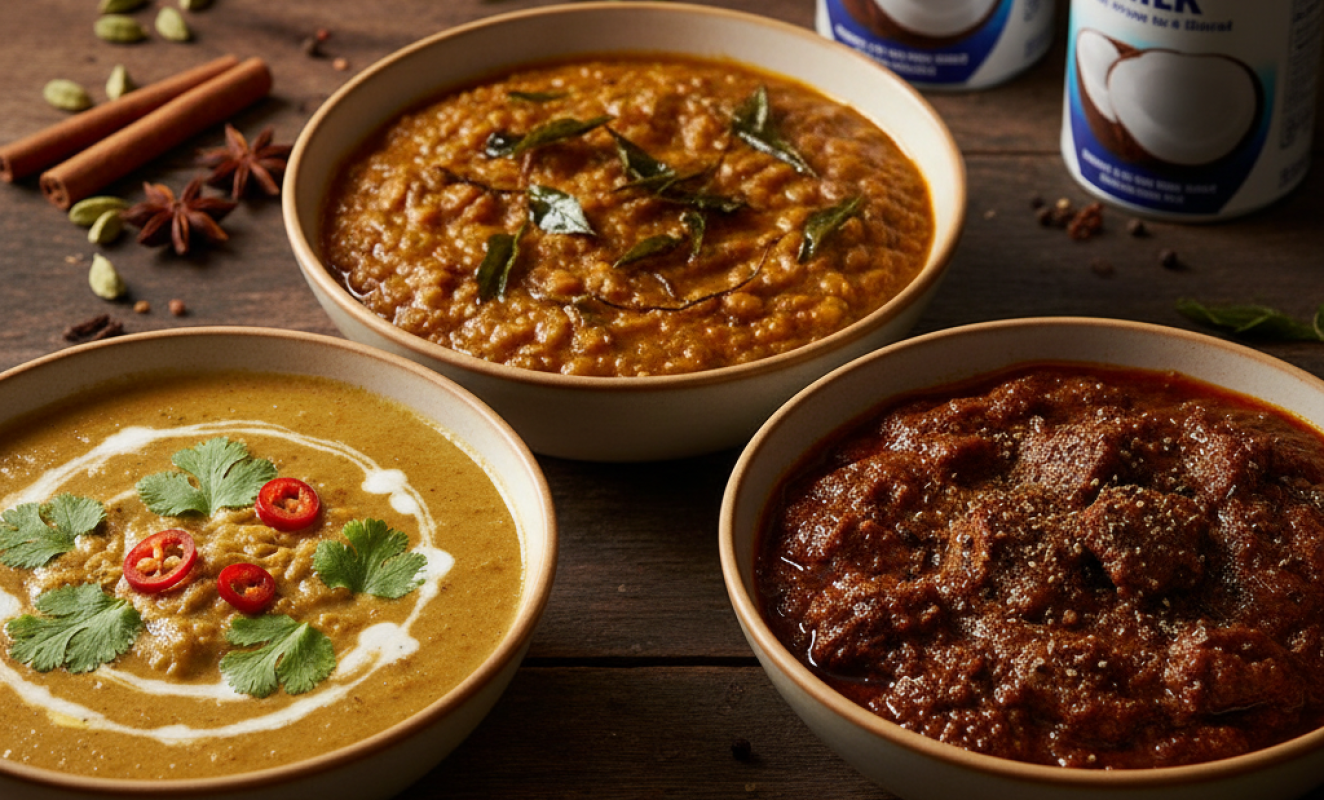
Light, medium, and rich coconut milk are simply different fat-to-water ratios extracted from the same grated coconut flesh—and that ratio changes everything about how the ingredient behaves in your pot. Light coconut milk (the first or second press diluted with water, or a commercially thinned product) contains roughly 5–9% fat. Medium-consistency coconut milk sits around 14–17% fat. Full-fat or rich coconut milk—the kind we use most deliberately at 7 Spice Bistro—clocks in at 20–25% fat, with a thick cream layer that rises to the top of the can when undisturbed.
According to the USDA National Nutrient Database, a 100-gram serving of canned full-fat coconut milk provides approximately 230 calories and 24 grams of total fat, compared to roughly 80 calories and 5 grams of fat in the light version. That gap is not just a number on a label—it represents a completely different cooking medium, emulsification behaviour, and mouthfeel outcome.
The fat in coconut milk is predominantly medium-chain triglycerides (MCTs), particularly lauric acid—and these MCTs emulsify, carry volatile aromatic compounds, and coat the palate in ways that water-based liquids simply cannot replicate. When you smell a deep, lingering cardamom or curry leaf note in a dish, you are often smelling a fat-soluble aroma that full-fat coconut milk has captured and held long after the cooking process. Light coconut milk simply cannot carry those aromatics with the same intensity.
| Consistency | Approx. Fat Content | Best Used For | Flavour Profile Impact |
|---|---|---|---|
| Light | 5–9% | Soups, rasam, thin broths, rice dishes | Delicate, lets spices lead, clean finish |
| Medium | 14–17% | Everyday curries, vegetable stews, lentils | Balanced body, moderate creaminess, versatile |
| Rich / Full-Fat | 20–25% | Korma, prawn curry, rich meat dishes, desserts | Deep, coating, sweet-savoury, aroma-amplifying |
How Does Curry Thickness Actually Change Flavour Perception?
Curry thickness changes flavour perception by controlling how long aromatic compounds stay in contact with your taste receptors and how evenly heat distributes across your palate. A thicker, fat-rich sauce coats the tongue and slows down the release of volatile aromatics—meaning you continue tasting the dish seconds after swallowing. A thin, watery curry releases its flavour in a single, fast wave that dissipates quickly.
This is not just poetic description—it is food science. According to research published by the journal Food Quality and Preference, sauce viscosity significantly modulates perceived flavour intensity and aftertaste duration, with higher-viscosity emulsions retaining volatile flavour compounds for measurably longer periods on the palate. In plain terms: a properly thick curry does not just taste richer—it literally tastes longer.
At our kitchen, this principle guides decisions like when to add the coconut milk, at what heat, and whether to reduce the sauce before or after the protein is introduced. Adding full-fat coconut milk over high heat causes it to split—the fat separates from the water solids, producing a greasy, broken sauce with a grainy texture. Our team always introduces rich coconut milk at medium-low heat, stirring gently, to maintain that perfect emulsion that keeps the sauce silky and cohesive from first bite to last.
The Heat and Timing Variables Most Home Cooks Miss
There are two moments when coconut milk is most vulnerable: the second it hits the pan and the last five minutes of cooking. In both windows, temperature control determines whether your curry stays glossy and unified or turns grainy and separated. Our team at 7 Spice Bistro treats coconut milk with the same respect we give to cream or eggs—as a fragile emulsion that needs a steady, patient hand.
A technique we rely on for dishes like our prawn coconut curry and vegetable korma is the two-stage addition: we add roughly two-thirds of the coconut milk early in the cooking process to build the body of the sauce, then add the final third off the heat (or on very low heat) right before serving to restore the fresh, creamy sweetness that long cooking tends to cook away. The result is a sauce that has both depth from the cooked-down base and brightness from the late addition—a complexity that takes the dish from good to genuinely memorable.
“The coconut milk you add at the end of cooking is doing entirely different work than the coconut milk you added at the beginning—one builds the foundation, the other restores the soul. Both are necessary.”
Why Does Coconut Milk Consistency Affect Digestion?
Coconut milk consistency affects digestion primarily through its fat content and the type of fatty acids involved—medium-chain triglycerides (MCTs) are metabolised differently from long-chain fats, making full-fat coconut milk easier to digest for many people than a comparable amount of heavy dairy cream. The richness you feel after a coconut curry is real, but for most diners it passes more quickly and gently than the richness from a dairy-heavy dish because of how the body processes MCTs.
This is one reason why families across Brampton and Mississauga who are lactose intolerant or who follow dairy-free diets often find authentic Indian coconut curries more comfortable than cream-based alternatives. The MCTs in coconut fat are absorbed directly through the intestinal wall and transported to the liver for rapid energy conversion, bypassing the longer digestive pathway that long-chain fatty acids require. For diners sensitive to heavy meals, choosing a medium-consistency coconut curry over a full-fat one can make the difference between feeling satisfied and feeling sluggish.
At 7 Spice Bistro, we take dietary comfort seriously. When guests ask our team for lighter options, we do not simply reduce portion sizes—we consider whether adjusting the coconut milk consistency in a dish can preserve the flavour experience while giving the digestive system a gentler time. It is the kind of thoughtful kitchen decision that does not appear on a menu but absolutely appears in how you feel two hours after your meal.
Coconut Milk and Spice Interaction: What Your Body Is Actually Experiencing
Fat does not just carry flavour—it also moderates heat. The capsaicin in chilli peppers, the compound responsible for the burning sensation that spice-lovers in Brampton and Mississauga chase and the uninitiated occasionally regret, is fat-soluble. This means that a richer coconut milk curry will carry more heat into each bite, but it will also coat and protect the mucous membranes of your mouth more effectively, often producing a gentler, more manageable burn than a thin, watery hot curry where the capsaicin hits the mouth undiluted.
This is why the same chilli quantity can feel dramatically different in a light soup versus a rich korma. Our team calibrates spice levels with this in mind—when a dish is built on a rich coconut base, we can afford to be slightly more generous with heat-producing spices because the fat matrix will modulate their intensity. When we are working with a thinner, more broth-like consistency, we are more precise and conservative with anything capsaicin-based.
If you are exploring our menu and you love big, bold spice but also want the comfort of a creamy finish, dishes built on a rich coconut milk foundation—like our coconut prawn curry—are your best starting point. You can read more about how we think about fish and seafood preparation in the context of Indian sauces in our detailed guide: Seafood in Indian Cuisine: What Makes 7 Spice Bistro’s Fish & Shrimp Dishes Stand Out.
How the Best Indian Restaurant in Brampton Uses Coconut Milk Across the Menu
Being recognised as the best indian restaurant brampton families turn to means every dish on the menu has to earn its place—and coconut milk consistency is one of the invisible quality signals that regulars pick up on over time, even if they cannot always name what they are noticing. Here is how our kitchen team thinks about the spectrum across different dish categories on the 7 Spice Bistro Mississauga vs. Brampton: How We Serve Two Communities with One Philosophy.
For our lighter South Indian–inspired soups and rasam-style broths, we work with a thin coconut milk—barely enriched, almost translucent—that lets the tamarind, black pepper, and curry leaf base shine without interference. The coconut presence is there as a whisper, rounding out acidity without adding weight. These are dishes designed for the beginning of a meal or for someone who wants comfort without commitment.
For everyday vegetable and lentil curries—the kind that families in Brampton have grown up eating and that our guests return to week after week—we work in the medium range. Enough body to carry the spice blend and coat the vegetables generously, but light enough that you can eat a full plate of rice alongside without feeling overloaded. This is the workhorse consistency of the Indian family kitchen, and it is one we respect deeply.
For our celebration dishes—rich korma-style preparations, slow-cooked meat curries, indulgent prawn dishes, and our Indo-Chinese-influenced hakka food preparations that have their own sauce logic—full-fat coconut milk is non-negotiable. These are dishes where the coconut cream is not a background note; it is a lead voice. Reducing it gently in the pan before adding other liquids concentrates the natural sweetness of the coconut and creates that signature caramelised depth that diners describe in 7 spice bistro reviews again and again.
If you are curious about how butter chicken—one of the most coconut-adjacent sauces in the North Indian tradition—compares to coconut-based southern preparations, we explore exactly that conversation in our related feature: The Butter Chicken Debate: Traditional Recipe vs. Modern Brampton Interpretations.
What This Means for You as a Diner—and as a Home Cook
Understanding the coconut milk spectrum makes you a better diner and a more confident cook. As a diner, it gives you language to describe what you are actually experiencing when one curry feels weightless and another feels like a warm hug you never want to end. When you sit down at 7 Spice Bistro—whether at our Brampton location or when you find us serving the Mississauga community—you can ask our team about the base of a dish with genuine curiosity, and we will always be happy to talk through it.
As a home cook, the single most impactful upgrade you can make to your curry game is to stop treating all coconut milk cans as interchangeable. Before you open a can, ask yourself: what role do I need this ingredient to play? If the answer is background support and lightness, reach for the light version or dilute full-fat with water. If the answer is the star of the show, open the full-fat can, do not shake it, scoop the cream off the top and fry it gently in the pan first until it begins to look oily and slightly golden—that step alone will transform your curry in a way no spice blend can replicate.
This frying technique, called “letting the oil split” in many South Indian kitchens, is one of the foundational steps in authentic indian coconut curry preparation. It concentrates the coconut flavour, develops a subtle nuttiness, and creates a natural frying medium for your aromatics—garlic, ginger, green chilli—before the rest of the liquid is added. It takes an extra three minutes and it changes everything.
Whether you are a longtime regular at our Brampton dining room, a new guest searching for indian food near me for the very first time, or a curious home cook in Mississauga who wants to level up your Sunday curry, we hope this guide gives you something real to take into the kitchen. The 7 Spice team is always here—through our menu, our catering services, and conversations exactly like this one.
Ready to Taste the Difference Coconut Milk Makes?
Come experience the full coconut milk spectrum on our menu—from delicate broths to rich, celebration-worthy curries. Our team in Brampton is ready to walk you through every dish, every consistency, and every flavour note. Dine in, take out, or let us cater your next family or corporate event in the Brampton and Mississauga area.
✍️ Written by the 7 Spice Bistro Kitchen & Content Team
We are the team behind Brampton’s most-talked-about authentic Indian and Hakka dining experience, passionate about sharing the culinary traditions and kitchen science that make every dish on our menu worth returning for. When we are not cooking, we are writing—because great food deserves a great story.
Frequently Asked Questions
How do I know which coconut milk consistency to use in a curry recipe?
Match the coconut milk consistency to the role it needs to play in the dish. If the sauce is meant to be a light, brothy backdrop that lets individual spices shine—think rasam or thin vegetable broths—use light coconut milk. If you are making a celebratory, protein-forward curry like a korma or a rich prawn dish where the sauce is the centrepiece, use full-fat coconut milk and consider frying the cream layer first. For everyday family curries, medium-fat coconut milk gives you versatile, crowd-pleasing results without overwhelming richness.
What makes coconut milk different from coconut cream in Indian cooking?
Coconut cream is essentially the undiluted first press of grated coconut flesh and contains 30–35% fat, making it richer and thicker than even full-fat coconut milk. In Indian cooking, coconut cream is used sparingly—often as a finishing drizzle or in confectionery—because its intensity can overpower a curry sauce if used as the primary liquid. Full-fat coconut milk strikes the right balance between richness and workability for most savoury applications, which is why it is the standard choice in professional Indian kitchens including ours at 7 Spice Bistro.
Why does my coconut curry sometimes turn grainy or separated?
Coconut curry separates when the fat-and-water emulsion breaks—usually because of too-high heat, boiling too vigorously for too long, or adding cold coconut milk directly into a very hot pan. To prevent separation, always add coconut milk over medium-low heat, stir gently rather than aggressively, and avoid a rolling boil once the coconut milk is in the pot. If your sauce has already split, a quick off-heat stir combined with a small splash of fresh coconut milk will often bring it back together.
Can I substitute dairy cream for coconut milk in an Indian curry?
You can substitute dairy cream for coconut milk in many North Indian curry styles—the fat content is comparable and the creaminess translates—but you will lose the distinctive sweetness and the specific aromatic qualities that coconut fat brings to southern Indian and Keralan preparations. For dishes where coconut milk is a defining regional ingredient (prawn curry, aviyal, fish molee), a dairy substitution changes the character of the dish significantly. If you are dairy-free or looking for an authentic experience, stick with quality coconut milk—your taste buds and your digestion will both thank you.
Related Articles
- What Makes a Biryani Worth the Wait? The Science of Patient Cooking
- The Rice Situation: Basmati, Jasmine & Brown—Which Base Matters Most for Your Curry
- The Biryani Renaissance: Why Brampton Foodies Are Finally Getting It
- The Naan-to-Paratha Progression: Building Your Bread Education One Bite at a Time