Every indian restaurant mississauga and Brampton local has heard someone say, “I had Hakka food once and it was just greasy noodles.” That’s not Hakka food — that’s a bad version of it. In 2026, Indo-Chinese cuisine has never been more popular across the GTA, yet it remains one of the most misunderstood food traditions on Canadian menus. At 7 Spice Bistro, we’ve spent seven years cooking and serving authentic Hakka dishes alongside our Indian menu, and we’ve seen exactly where the category goes wrong — and what it looks like when it goes brilliantly right. This guide is our honest, insider take on what to look for, what to skip, and how to know whether the Hakka food you’re ordering is the real thing.
QUICK ANSWER
Authentic Hakka food balances bold soy-chili heat with a clean, non-greasy finish — hallmarks include wok-kissed noodles, crispy starters that aren’t oil-logged, and sauces that layer sweet, sour, and spicy rather than relying on one note. Red flags include overloaded MSG masking poor-quality ingredients, soggy Manchurian, and menus that list ten “Hakka” dishes but don’t actually list Hakka noodles. When searching for hakka food near me, look for kitchens with real Indo-Chinese experience, not just an add-on section tacked onto an unrelated menu.
What Actually Is Hakka Food? (And Why Most People Get It Wrong)
Hakka cuisine is a distinct Indo-Chinese cooking tradition born from the Chinese Hakka community that settled in Kolkata in the 18th and 19th centuries. Over generations, they fused Chinese cooking techniques — particularly wok cooking, fermented sauces, and braising — with Indian spices, chilies, and aromatics. The result is something genuinely unique: food that is neither traditionally Chinese nor traditionally Indian, but entirely its own thing.
The most common misconception is that Hakka food is simply “Chinese food made spicy.” That’s like saying butter chicken is just French cream sauce with turmeric. The spice profile in genuine Hakka cooking is built from the ground up — green chilies, ginger, garlic, and dark soy work together in a way that reflects an entirely different culinary logic than either Indian or mainland Chinese cooking.
When people search for an indo chinese restaurant near me, they’re often looking for this specific experience: the crackle of a wok, the heat of a Manchurian sauce, the chew of properly cooked Hakka noodles. What they sometimes get instead is a watered-down version that neither honours the Indian side nor the Chinese side of the tradition. Our team believes you deserve better than that, which is why understanding what authentic looks like is the first step.
“Hakka food is not fusion as a trend — it is fusion as a lived history. When it’s done right, you taste generations of adaptation in every bite.”
— The Kitchen Team at 7 Spice Bistro, Brampton
What to Look For in a Genuinely Good Hakka Dish
Good Hakka food has three non-negotiable qualities: wok heat, balance, and texture. Each of those deserves a closer look.
Wok Heat — The Signature You Can Taste
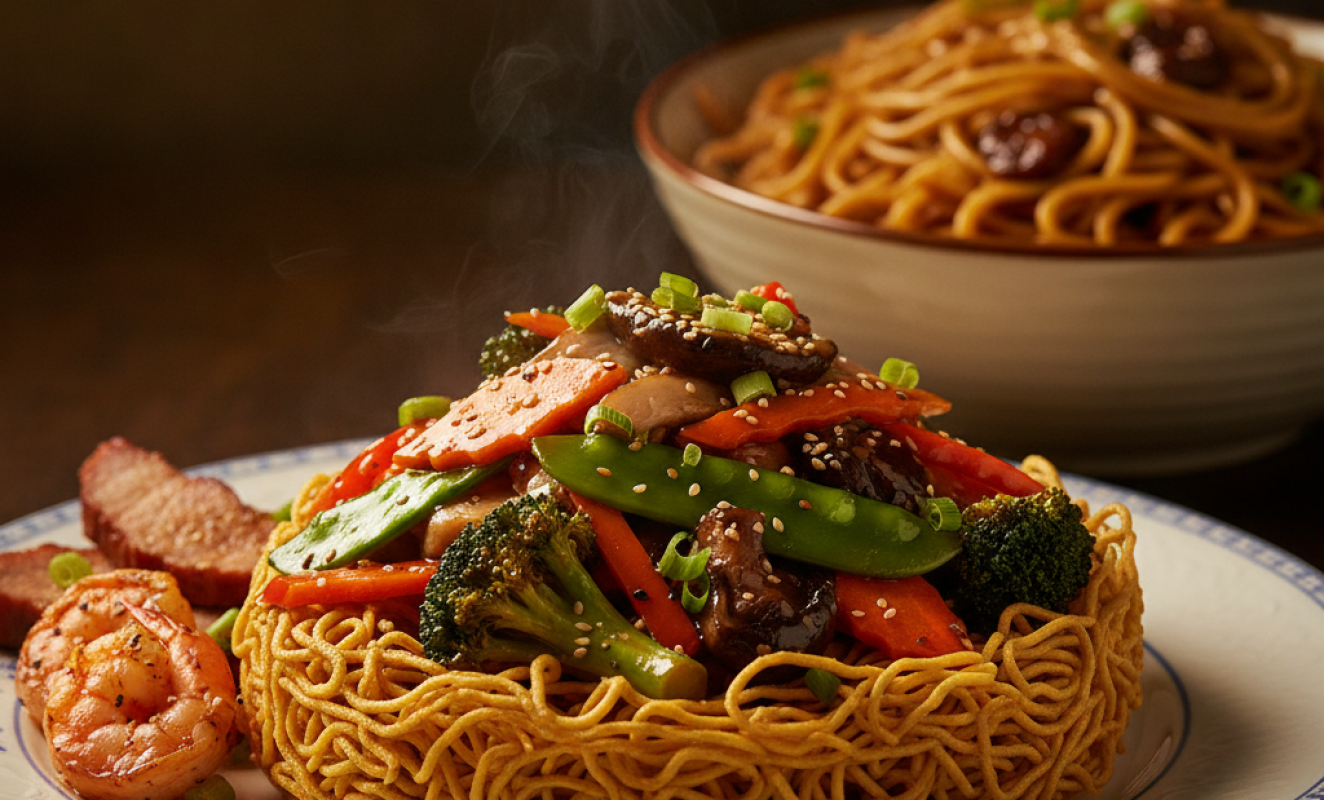
Professional Hakka kitchens cook over intensely high heat in a seasoned wok. This creates what Chinese culinary culture calls “wok hei” — a smoky, slightly charred depth of flavour that you simply cannot replicate on a standard home or even restaurant flat-top. If your Hakka noodles taste like they were boiled and sauced rather than tossed in a ripping-hot wok, something has gone wrong. The noodles should have a slight toastiness. The vegetables should be cooked through but retain a snap. Nothing should be limp.
Balance — Heat, Sour, Sweet, and Savour Working Together
One of the clearest markers of quality is whether the sauces are one-dimensional. A Gobi Manchurian or Chilli Paneer worth ordering should hit multiple notes in sequence: first the savouriness of soy, then the punch of chili, then a faint vinegar brightness, and finally a subtle sweetness that ties it all together. If you only taste heat, or only taste sweet-and-sour syrup, the balance isn’t there. At 7 Spice Bistro, our sauces are built fresh from base ingredients — not from pre-mixed commercial sauces that flatten every dish into the same flavour profile.
Texture — Crispy Where It Should Be, Tender Where It Shouldn’t
The batter on a Hakka starter — whether it’s a crispy corn Manchurian, a paneer fritter, or a gobi floret — should shatter lightly when you bite it. The moment it becomes a thick, doughy shell soaked in oil, you’re dealing with a kitchen that either fries at too low a temperature or uses too heavy a batter. Crispy should mean crispy, not crunchy-doughy. The inside, by contrast, should be fully cooked and yielding. Texture contrast is a pillar of the tradition.
What to Avoid When Ordering Hakka Food
The red flags in Hakka food are surprisingly consistent across restaurants — once you know them, you’ll spot them every time.
Red Flag #1: A Sauce That Tastes Identical Across Every Dish
When the sauce on your Chilli Tofu tastes exactly like the sauce on your Hakka noodles and exactly like the sauce that came with your spring rolls, there’s a strong chance the kitchen is working from a single pre-made base and not building dishes individually. Each preparation in a proper Hakka menu should have its own character — the noodles should taste like noodles, the Manchurian should have a thicker, clingy sauce, and the soup should have a clear, properly seasoned broth.
Red Flag #2: Oil Pooling at the Bottom of the Plate
A small sheen of oil is normal in wok cooking. A visible puddle is not. When oil pools beneath your noodles or collects on your Manchurian plate, it typically means one of two things: the oil temperature was too low when frying (causing absorption rather than crisping), or the dish was precooked and left sitting. Neither is acceptable. When families in Brampton tell us they’ve been burned by oily Hakka food before, this is almost always what they mean. Fresh, high-heat cooking produces a dish that feels light even when it’s satisfying.
Red Flag #3: Soggy Manchurian
Manchurian — whether paneer, gobi, or mixed vegetable — is one of the signature dishes of Indo-Chinese cooking. It should arrive at your table with a crust that still has integrity. If the batter has collapsed and the pieces are sitting in a thick pool of sauce looking defeated, the kitchen either sauced them too far in advance or fried them at the wrong temperature. Ask for your Manchurian dry or semi-dry if you want to protect the texture; a kitchen that does it properly will accommodate the request without hesitation.
Red Flag #4: MSG as a Crutch, Not a Complement
MSG itself is not a villain — it is a naturally occurring compound found in tomatoes, cheese, and many fermented foods. Used thoughtfully, it enhances the savouriness of a dish. The problem arises when it becomes a substitute for actual flavour development. If your Hakka food leaves you reaching desperately for water mid-meal and the thirst continues hours later, the kitchen is likely using MSG at volumes that mask the absence of real stock, quality aromatics, and proper technique. Balanced Hakka cooking should satisfy, not dehydrate.
How Do You Find Authentic Hakka Food Near You?
Finding genuinely good Hakka food near you comes down to looking for restaurants that treat their Indo-Chinese menu as a real commitment — not an afterthought. Here’s what our team recommends when you’re evaluating options.
First, look at how many dishes are on the Hakka section of the menu versus how many are described in any real detail. A restaurant that cares about its Hakka food will tell you something about how the dishes are made — the sauce style, the preparation method, whether items are dry or wet. Generic bullet-point menus with no descriptions are a signal that the category wasn’t given serious thought.
Second, check whether the kitchen has both Indian and Hakka experience — not just an Indian menu with a couple of noodle dishes appended. The techniques are genuinely different, and doing both well requires specific knowledge and practice. When families and food enthusiasts search for indian takeout near me or for Hakka food specifically, the best answer is often a restaurant that has mastered both traditions and treats them with equal respect.
Third, read recent reviews with an eye for specifics. If reviewers mention “the Hakka noodles were perfectly cooked” or “the Manchurian was still crispy when it arrived,” that’s useful signal. Vague praise (“great food, good service”) tells you very little about execution. You can browse the 7 Spice Bistro menu and recent guest experiences to see what our regulars consistently highlight about our Hakka offerings.
If you’re in Brampton or searching for an indian restaurant open near me that genuinely delivers on Indo-Chinese cooking, proximity alone shouldn’t be the deciding factor. A restaurant that’s slightly further but consistently excellent is worth the extra few minutes. Our guests in Brampton, Mississauga, and across the west GTA have told us this repeatedly — quality travel is worth it for food that’s actually done right.
For a broader view of where Brampton’s dining scene excels — including Indian and Indo-Chinese options — take a look at our guide to the Best Restaurants in Brampton, Ontario: A Neighbourhood-by-Neighbourhood Dining Guide for 2026, which covers the full landscape across the city’s diverse neighbourhoods.
Why 7 Spice Bistro Takes Hakka Food Seriously
At 7 Spice Bistro, Hakka food is not a menu filler. It is a deliberate part of what we offer, and it reflects the same philosophy we apply to our Indian cuisine: respect the tradition, use quality ingredients, and never cut corners on technique just to improve margins.
Our Hakka menu covers the full range of what the cuisine does best — noodles, rice preparations, Manchurian variations, chilli dishes, and soups — and every item is cooked to order over high heat. We don’t pre-batch our sauces for the week. We don’t use generic commercial stir-fry bases. Each dish is built from fresh aromatics, properly seasoned, and finished to the texture it’s supposed to have. That’s the standard we hold ourselves to after seven years of cooking for Brampton families and food enthusiasts who notice the difference.
We also understand that for many of our guests, a Hakka meal might be part of a larger shared table that includes Indian dishes — a dal, a curry, a bread basket. This is actually a very natural combination, and our menu is designed with that in mind. The flavours across our Indian and Hakka sections complement rather than compete. It’s the kind of menu diversity that only comes from genuinely loving both cuisines, not just listing them side by side.
If you’re also curious about how we approach our vegetarian menu across both Indian and Hakka categories, our dedicated resource on Best Vegetarian Restaurants in Brampton: What to Look For When Plant-Based Is Non-Negotiable walks through exactly what serious vegetarian cooking looks like — and how to spot a restaurant that treats it as a priority rather than an obligation.
Our catering service also extends to Hakka cuisine — ideal for events where you want a menu that offers something beyond the standard Indian banquet spread. Guests who might not reach for the biryani often light up when they see Hakka noodles and Manchurian on the catering table. It creates variety, sparks conversation, and frankly, it tends to disappear first.
Ready to Try Hakka Food Done Properly?
Join the Brampton and Mississauga families who’ve made 7 Spice Bistro their go-to for authentic Hakka Chinese food and Indian cuisine. Dine in, order takeout, or ask us about catering your next event.
✍️ Written by the Team at 7 Spice Bistro
The kitchen and front-of-house team at 7 Spice Bistro in Brampton brings over seven years of hands-on experience cooking and serving authentic Indian and Hakka Chinese cuisine. We write from the stove, not from a marketing brief — because we believe the people making the food should be the ones talking about it.
Frequently Asked Questions
What is the difference between Hakka food and regular Chinese food?
Hakka food is an Indo-Chinese tradition that blends Chinese wok techniques with Indian spices, chilies, and aromatics — it is not the same as the Chinese-Canadian or Cantonese food most North Americans are familiar with. Regular Chinese-Canadian takeout typically uses soy, oyster sauce, and ginger in mild preparations. Hakka food uses those same base ingredients but builds in green chili heat, vinegar brightness, and Indian-influenced seasoning that creates a sharply different flavour profile. The two traditions share a wok but not a palate.
How can I tell if a restaurant is using fresh ingredients in its Hakka dishes?
The clearest indicators are colour, aroma, and texture. Fresh garlic and ginger — rather than jarred paste — produce a sharper, more vibrant flavour that you can actually smell when the dish arrives at the table. Vegetables cooked from fresh retain a natural brightness and resist the grey-green collapse that pre-cooked or frozen produce takes on. Sauces built from fresh aromatics have depth and variation across the meal; pre-made commercial sauces flatten everything into the same base note. A kitchen that’s proud of its ingredients will usually tell you — and the food will confirm it.
Why does Hakka food from some restaurants feel heavy and greasy while others feel light?
The primary cause is frying temperature. When oil is not hot enough, food absorbs it rather than crisping in contact with it — this is the main reason dishes feel greasy and heavy. Secondary causes include overly thick batter (which traps moisture inside while absorbing oil outside), pre-cooking dishes and leaving them to sit, and oversaucing to compensate for flavour that wasn’t developed during cooking. Proper Hakka cooking at high wok heat produces a dish that is satisfying and flavourful without that heavy, oily aftermath. If you consistently feel better after Hakka food at one restaurant than another, technique is almost certainly the reason.
Can I order Hakka food as part of a catered event at 7 Spice Bistro?
Yes — our catering service at 7 Spice Bistro includes Hakka Chinese dishes alongside our full Indian menu, making it an excellent choice for events where you want genuine variety on the table. Hakka noodles, Manchurian, and chilli preparations travel well in bulk format and consistently draw strong response from guests who may not have expected Indo-Chinese food at an Indian catered event. We work with clients across Brampton and Mississauga to build custom catering menus that reflect the scale, dietary mix, and occasion of the event. Reach out through our website to discuss your requirements and we’ll put together options that suit your group.