The Secret Behind Every Plate That Leaves Our Kitchen
7 Spice Bistro has never believed that consistency is the enemy of creativity — and in 2026, after years of refining our kitchen systems across both our Brampton and Mississauga locations, we’re more certain of that than ever. Every dish that travels from our prep stations to your table carries the same depth of flavour, the same balance of heat and warmth, the same unmistakable identity. That doesn’t happen by accident. It happens because of decisions made long before the first onion hits the pan.
People often ask us how a menu stretching beyond 200 dishes — spanning regional Indian classics, Indo-Chinese Hakka specialties, and everything in between — can taste this deliberate every single time. The honest answer involves spice science, kitchen architecture, and a culture of discipline that runs through every member of our culinary team. This is that story.
QUICK ANSWER
How does 7 Spice Bistro maintain consistency across 200+ dishes? We rely on a layered system of pre-blended spice masalas, standardised base gravies, measured preparation protocols, and team-wide tasting checkpoints — so every dish delivers the same authentic experience whether it’s your first visit or your fiftieth.
How Does a Spice Blend Actually Create Consistency?
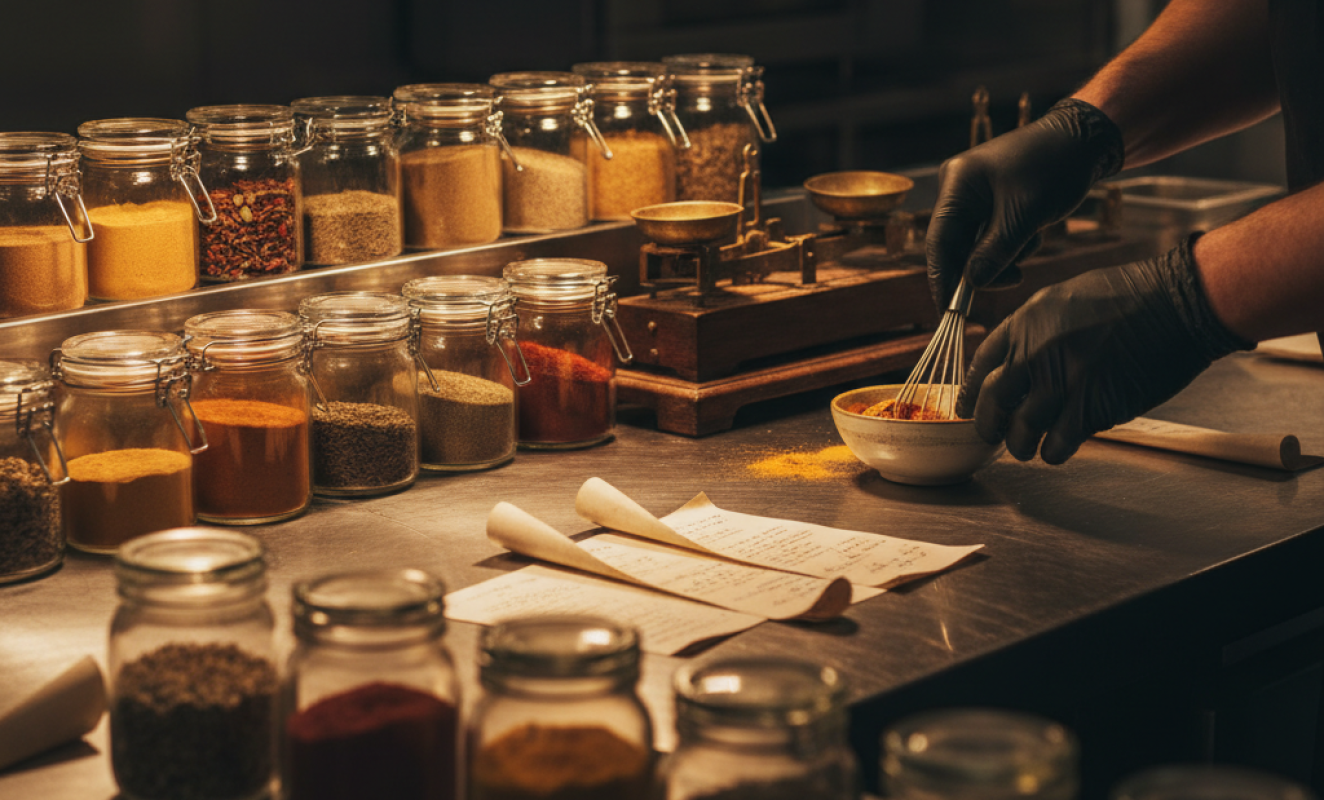
A consistent spice blend is the single most powerful tool in a high-volume authentic kitchen — it eliminates guesswork before a chef even picks up a ladle. At the heart of our approach is a set of house masalas that our team develops, proportions, and prepares in controlled batches. Each blend is built from whole spices — cumin seeds, coriander, cardamom pods, dried chilies, black pepper, cloves, and more — that are sourced consistently and toasted in-house to a precise colour and aroma before grinding.
According to the journal Food Chemistry, the volatile aromatic compounds responsible for spice flavour — including terpenes and phenolics — degrade significantly within weeks of grinding if not stored correctly. That’s why we grind in smaller, scheduled batches and store blends in sealed, labelled containers that are dated and rotated on a strict schedule. The result is that the masala going into a Butter Chicken on a Tuesday evening smells and tastes identical to the one prepared on a Saturday afternoon rush.
We maintain separate spice profiles for different cuisine families on our menu. Our North Indian blends lean on warming spices — mace, nutmeg, and long pepper — while our Indo-Chinese Hakka food preparations use a distinctly different aromatic base involving white pepper, star anise, and fermented elements. Keeping these profiles distinct and documented means our chefs aren’t improvising; they’re executing a craft.
“A spice blend is not a recipe shortcut — it is the foundation on which every authentic dish stands. When the foundation is solid, the structure never wobbles.” — Our Head of Culinary Development, 7 Spice Bistro
The Role of Whole Spice Versus Ground in Layered Cooking
One of the most misunderstood techniques in Indian cuisine is the strategic use of whole spices alongside ground blends in the same dish. Whole spices — tempering in hot oil at the very start — release fat-soluble compounds that coat the cooking medium with flavour. Ground spices added mid-cook release water-soluble compounds into the sauce body. This isn’t tradition for tradition’s sake; it’s layered chemistry that builds a flavour profile no shortcut can replicate.
At our Brampton kitchen, every dish has a documented “spice moment map” — a sequence identifying exactly when whole spices enter the pan, when ground masalas are added, and when finishing spices like kasuri methi or garam masala are stirred in at the very end. This map is as important to us as the ingredient list itself.
What Are Base Gravies and Why Do They Matter for Quality Control?
Base gravies are the unsung heroes of consistent Indian restaurant cooking — a set of pre-cooked, deeply flavoured foundations that allow a kitchen to deliver complex dishes with speed and repeatability. Our team prepares several distinct base gravies daily: a slow-caramelised onion-tomato masala base, a cashew-cream korma base, a spinach-based saag foundation, and a tangy tamarind-forward base for southern-style dishes, among others.
The onion-tomato masala base alone takes close to two hours to develop properly. Onions are cooked slowly until their natural sugars caramelise — not just softened, but genuinely transformed — before tomatoes are added and reduced until the oil visibly separates from the mixture. This stage, called “bhunao” in traditional kitchen language, is the moment flavour stops being raw and becomes rounded. Rushing it produces a noticeably thinner, more acidic result. We never rush it.
According to FoodNavigator, consumer expectations around flavour consistency rank among the top three reasons diners choose to return to the same restaurant — ahead of ambience and pricing in repeat-visit surveys. For an Indian restaurant serving a community as food-savvy as Brampton and Mississauga, where guests often grew up eating home-cooked Indian food made by skilled family members, there is simply no margin for a dish that tastes different from visit to visit.
Scaling Without Compromising: The Batch Discipline
Scaling up a recipe is one of the most technically demanding challenges in any kitchen — and in Indian cooking, it’s particularly unforgiving. Spice ratios don’t always scale linearly. A masala that works perfectly at a four-portion scale can become overwhelming or flat at forty portions if the chef simply multiplies every quantity. Our culinary team has spent years calibrating our base recipes at different batch sizes, testing and tasting at each stage to establish the precise adjustments needed.
This investment in batch science means our food truck service — which brings the same 7 Spice Bistro experience to events across the Brampton and Mississauga area — delivers food with the same depth as our sit-down locations. Whether you’re encountering us at a community event or dining inside our restaurant, the spice architecture is identical.
Why Does Tasting Culture Matter as Much as the Recipe?
Written recipes and documented spice maps only work if the people executing them are trained to taste critically — and that tasting culture is arguably the most important quality control system in our entire kitchen. A recipe can tell a chef to add one teaspoon of chili powder, but it can’t account for the natural variance in heat between different chili batches, seasonal changes in tomato acidity, or the subtle differences between a gas flame and an induction surface.
Our chefs taste at every critical stage of preparation: after the base gravy is built, after protein is added and simmered, and again before plating. We use a structured tasting vocabulary — balance, depth, heat level, finish — so that feedback between team members is precise and actionable rather than vague. “It needs something” is not a useful note in our kitchen. “The finish is too sharp; it needs a touch more cream and a pinch of sugar to round it” is.
This approach pays particular dividends across a menu as broad as ours. From a delicate Malai Kofta to a boldly spiced Lamb Vindaloo, from a refined Hakka Chili Paneer to a coastal-inspired fish preparation, each dish has its own flavour personality — and our tasting culture ensures each one expresses that personality fully, every time. If you’ve left a note in the 7 Spice Bistro reviews mentioning that your favourite dish always tastes exactly as you remember it, this is the reason.
Cross-Training Across Cuisine Families
Because our menu spans both Indian and Hakka food traditions, we invest heavily in cross-training our kitchen team. A chef who only understands one cuisine family cannot effectively taste-check dishes from the other. Our training programme ensures every team member can identify the flavour benchmarks for both cuisine streams — the warm, aromatic depth of traditional Indian gravies and the bright, punchy, umami-forward character of Indo-Chinese preparations.
This cross-training is one of the quiet reasons that guests searching for the best Indian restaurant in Brampton and Mississauga consistently return to us. A kitchen team that understands the full flavour spectrum it’s working across is simply better equipped to catch when something is slightly off — and to correct it before it ever reaches a guest.
You can read more about how our culinary philosophy shapes specific menu items in our deep-dive on The Butter Chicken Debate: Traditional Recipe vs. Modern Brampton Interpretations, and if you’re curious about how we apply the same standards to our seafood offerings, Seafood in Indian Cuisine: What Makes 7 Spice Bistro’s Fish & Shrimp Dishes Stand Out walks through the approach in full.
How Does This System Show Up on the 7 Spice Bistro Menu?
Every section of the 7 Spice Bistro menu reflects the layered consistency system described above — and guests who explore beyond their usual order often discover just how cohesive the full experience is. The spice architecture across our starters, mains, and rice dishes is deliberately interconnected. Our house masala blends appear across multiple dishes in evolved forms, creating a family resemblance that makes the menu feel like a curated collection rather than a random assembly of recipes.
Our Brampton location draws guests from across the region — families seeking a reliable Friday night dinner, professionals looking for Indian food near me that doesn’t require a long drive, and groups celebrating milestones who want the reassurance that a large order will be consistently great from the first plate to the last. Our Mississauga guests bring the same expectations, which is precisely why our two-location philosophy is built on a unified spice and base-building system rather than two separate kitchen cultures. For a closer look at how we serve both communities, 7 Spice Bistro Mississauga vs. Brampton: How We Serve Two Communities with One Philosophy covers the full story.
Planning an Event? Consistency Matters Even More at Scale
Everything we’ve described above becomes even more critical when cooking for large groups. A catered corporate lunch or a family reunion spread involving dozens of guests has zero tolerance for the kind of batch-to-batch variance that can slip through in a less disciplined kitchen. Our catering operation draws directly on the same spice systems, base gravies, and tasting checkpoints that govern our restaurant service — scaled up without cutting corners.
If you’re planning an event in Brampton or Mississauga and want to understand exactly how we approach large-format Indian food service, Catering Your Brampton Event: Why Indian Food Impresses Corporate Teams and Family Reunions is the right starting point.
Consistency, in the end, is our most sincere expression of hospitality. It’s our promise that the dish you fell in love with on your first visit will be waiting for you exactly as you remember it on every visit that follows. That promise is built into every spice blend we grind, every base we slow-cook, and every tasting note our team exchanges across a busy service. It is, quite simply, what being an authentic Indian restaurant means to us.
Taste the Consistency for Yourself
Whether you’re dining in Brampton, visiting our Mississauga location, or planning a catered event, every dish that leaves our kitchen carries the full weight of our spice philosophy. Come see — and taste — what deliberate cooking feels like.
✍️ Written by the 7 Spice Bistro Culinary Team, Brampton. Our team of chefs and food storytellers brings decades of combined experience in authentic Indian and Hakka cuisine preparation. We write from the kitchen outward — sharing the techniques, philosophies, and small daily decisions that make every plate at 7 Spice Bistro exactly what it should be.
Frequently Asked Questions
How does 7 Spice Bistro keep dishes tasting the same every visit?
We maintain consistency through a three-layer system: pre-blended house masalas prepared in controlled batches, standardised base gravies slow-cooked fresh daily, and mandatory tasting checkpoints at every stage of preparation. This system applies equally across our Brampton and Mississauga kitchens, ensuring that no matter where or when you visit, the flavour benchmark remains unchanged.
What makes Indian restaurant spice blending different from using store-bought spices?
Freshly toasted and ground whole spices contain significantly higher concentrations of volatile aromatic compounds than pre-ground commercial alternatives, which begin losing potency immediately after grinding. At 7 Spice Bistro, we source whole spices and grind them in-house on a scheduled rotation, which means the masalas going into your dish are at peak aromatic intensity — a difference that is immediately perceptible in the depth and brightness of every plate.
Why does authentic Indian food require such a precise cooking sequence?
Traditional Indian cooking is built on layered flavour extraction — different compounds release at different temperatures and in different cooking mediums (fat versus water). Whole spices tempered in oil release fat-soluble aromatics early in cooking; ground spices added mid-process build the sauce body; finishing spices added at the end preserve delicate volatile notes that would otherwise cook off. Disrupting this sequence produces a flatter, less complex result, which is why our documented spice moment maps are treated as non-negotiable in our kitchen.
Can I experience the same food quality from the 7 Spice Bistro food truck as I would dining in the restaurant?
Yes — the same spice blends, base gravies, and tasting protocols that govern our Brampton and Mississauga restaurant kitchens are applied to our food truck service. Our batch science was specifically developed to scale recipes without compromising flavour, which means the dish you enjoy at a community event in the Brampton area is prepared with the exact same culinary standards as a sit-down dinner at our restaurant. Consistency isn’t a restaurant-only commitment; it travels with us.
Related Articles
- How Fresh Spices Change Everything: Quality You Can Taste at 7 Spice Bistro
- Behind the Scenes: How 7 Spice Bistro Sources Fresh Spices Weekly
- The June Spice Calendar: What's Fresh, What's Peak, and Why Your Timing Matters
- The Cooling Curry Effect: Why Certain Indian Dishes Keep You Refreshed in June Heat