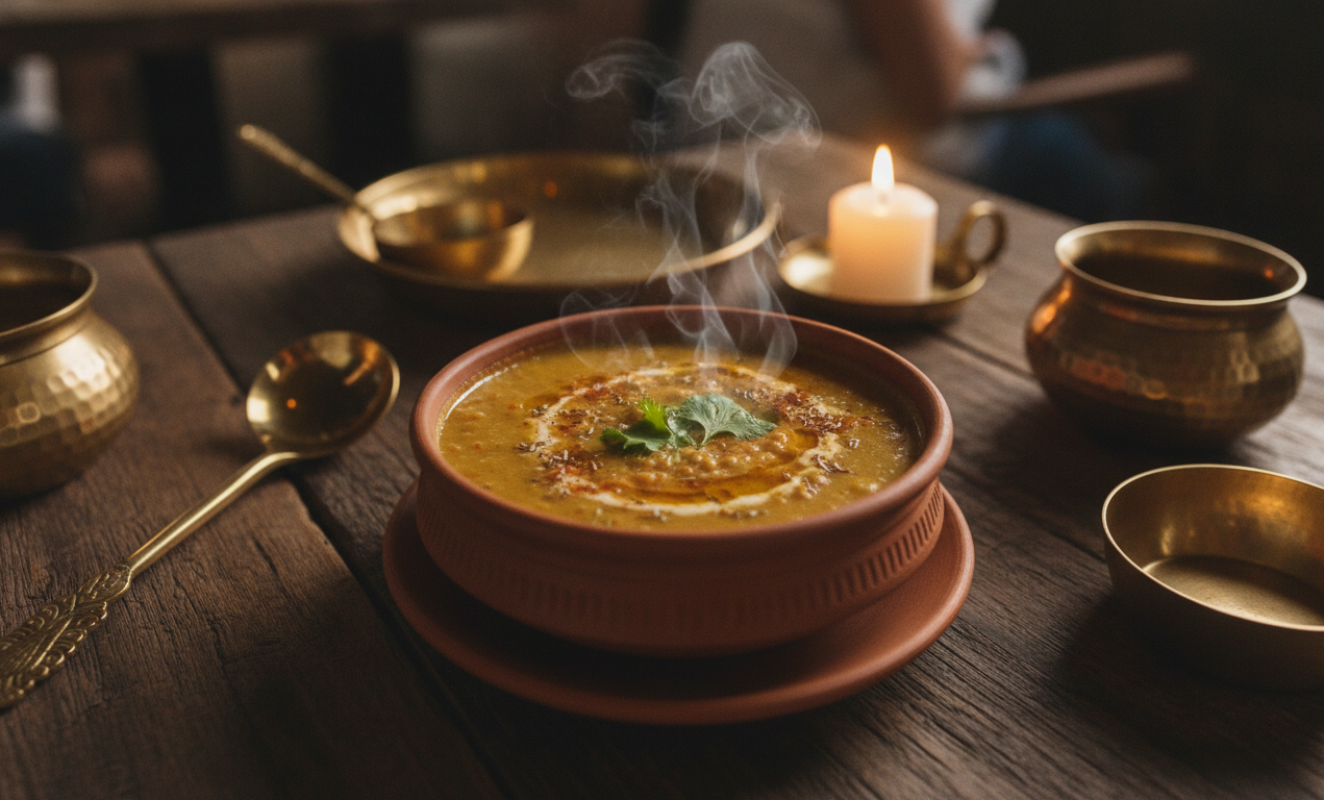
When someone types “best soup near me” into a search bar, they are rarely picturing a bowl of dal shorba. They are probably thinking of a creamy tomato bisque or a bowl of pho. That is a missed opportunity, because Indian soups and lentil-based broths are among the most complex, carefully seasoned dishes in any Indian kitchen — and they are almost always the most underrated items on the menu. At 7 Spice Bistro, we have watched guests walk past the shorba and the dal on our menu for years, only to come back later and say the same thing: “Why didn’t anyone tell me about this?”
This article is that conversation. We are going to walk through the broths, dals, and shorba preparations that define serious Indian cooking — and explain why a kitchen’s approach to these dishes tells you more about its standards than almost anything else on the menu.
Quick Answer
Indian restaurant menus feature several soup-style dishes — including shorba, rasam, mulligatawny, and slow-cooked dal — that most diners skip in favour of more familiar items. These preparations are worth ordering because they are built on long-simmered stocks and carefully balanced spice blends that reveal the true skill level of the kitchen behind them.
What Exactly Is Shorba, and Why Does It Matter?
Shorba is a thin, spiced broth that sits at the intersection of Persian and South Asian cooking traditions. It is not a thick gravy and it is not a plain stock — it is a deliberately seasoned, slow-extracted liquid that is meant to be consumed at the beginning of a meal to warm the stomach and prepare the palate.
The word itself comes from the Arabic “shurba,” meaning something that is sipped, and it travelled into the Indian subcontinent through Mughal culinary influence. What remained consistent across that journey was the principle: good shorba requires patience. You cannot rush a broth. The aromatics — whole spices, ginger, garlic, sometimes charred onion — need time to give up their flavour into the liquid. A shortcut produces a flat, watery result that tastes like spiced water rather than a finished dish.
When a kitchen takes shorba seriously, it usually means they take everything else seriously too. The discipline required to build a proper broth from scratch, every day, without cutting corners is the same discipline that shows up in a well-made curry base or a properly rested tandoor bread. Shorba is, in a sense, a kitchen’s character revealed in a bowl.
Common shorba preparations include murgh (chicken) shorba, vegetable shorba, and tomato-based versions with whole peppercorns and bay leaf. Each has a distinct profile, but all share that defining quality: depth without heaviness.
How Dal Becomes a Soup — and Why the Line Is Intentionally Blurred
Dal is not just a side dish. At its thinner end, a well-made dal is functionally a soup — a protein-dense, legume-based broth seasoned with a tarka (tempered spice oil) that is poured over the cooked lentils at the last moment. The sizzle of that final tarka hitting the dal is one of the most satisfying sounds in any Indian kitchen.
Understanding indian cuisine foods means understanding that categories like “soup,” “stew,” and “sauce” do not map cleanly onto Indian cooking. Dal exists in that fluid space between all three. A dal that is cooked thin and served in a small bowl before a meal is a soup. The same recipe cooked thicker and served alongside rice is a main course accompaniment. The difference is intention, not ingredients.
The most commonly encountered dals that function as soups include:
- Dal tadka: Yellow lentils cooked until soft, finished with a tarka of cumin, dried red chilli, garlic, and ghee. The flavour is direct and satisfying, with a mild heat that builds slowly.
- Masoor dal: Red lentils that dissolve almost completely when cooked, producing a naturally creamy, copper-coloured broth. Often seasoned with turmeric and finished with a squeeze of lemon.
- Dal palak: Lentils cooked with spinach, which adds body and an earthy green note. A common choice for anyone looking for veg food near me that actually delivers on nutrition without sacrificing flavour.
- Chana dal: Split chickpeas that hold their shape longer than red lentils, producing a chunkier, heartier broth with a nuttier flavour profile.
Each of these is a legitimate soup option that most diners at an Indian restaurant walk past without a second thought. They should not.
What Is Rasam, and Why Do South Indian Kitchens Treat It as Sacred?
Rasam is a thin, peppery South Indian broth that is functionally the opposite of a cream-based soup — it is sharp, sour, and intensely aromatic. Where a shorba soothes, a rasam stimulates. It is built on a base of tamarind water, tomato, and black pepper, and it is seasoned with mustard seeds, curry leaves, and dried red chilli tempered in oil.
In traditional South Indian households, rasam is consumed as a digestive aid, often served between courses to reset the palate. Its sourness comes from tamarind — a tangy, pulpy fruit that is a cornerstone ingredient across South and Southeast Asian cooking. The pepper heat is different from chilli heat; it sits at the back of the throat and lingers in a way that is warming rather than sharp.
Rasam represents a different philosophy from north Indian shorba. Where shorba is built on extraction — drawing flavour out of aromatics over time — rasam is built on assembly, layering acidity, heat, and spice in a sequence that rewards careful attention to timing. A kitchen that makes rasam well understands acidity, and that understanding shows up everywhere else on the menu.
“A kitchen’s approach to its simplest dishes — the broths, the dals, the foundational preparations — tells you everything about how it handles the complex ones.”
Why Mulligatawny Deserves Its Place Back on Modern Menus
Mulligatawny is a dish with a complicated history, but its flavour is unambiguous. The name comes from the Tamil “milagu-tannir,” meaning pepper water — a direct descendant of rasam that was adapted during the colonial period into a richer, more substantial soup. Modern versions vary considerably, but the best ones retain that South Indian backbone of pepper, lentil, and tamarind, while adding body from coconut milk or cooked rice.
What makes mulligatawny interesting from a culinary standpoint is precisely that hybrid quality. It sits between rasam and a Western-style cream soup, and it does so without fully belonging to either tradition. That in-between quality is what makes it so approachable for diners who are curious about Indian cooking but not yet confident ordering unfamiliar dishes.
For anyone searching for an indian restaurant near me that goes beyond the standard menu — the dishes everyone already knows — mulligatawny is a good litmus test. If a kitchen offers it and makes it properly (not from a base, not from a tin), it is a signal that the team behind the food has genuine range.
How to Read a Menu for Soup Quality Before You Order
The way a restaurant describes its soups and dals tells you a great deal about the kitchen’s confidence in those dishes. Menus that list “dal soup” with no further description are usually not making it from scratch. Menus that specify the type of lentil, the tempering style, or the regional origin are signalling that the dish has been thought about.
Here is a practical comparison of the main Indian soup-style dishes you are likely to encounter, and the key attributes that distinguish them:
| Dish | Base | Flavour Profile | Regional Origin |
|---|---|---|---|
| Shorba | Spiced broth (vegetable or protein) | Warm, aromatic, lightly spiced | Mughal / North Indian |
| Dal Tadka | Yellow lentils with ghee tarka | Rich, smoky, mildly spiced | Pan-Indian |
| Rasam | Tamarind and tomato water | Sharp, sour, peppery | South Indian (Tamil Nadu) |
| Mulligatawny | Lentil and spice with coconut or rice | Complex, slightly sweet-sour | South Indian (adapted) |
| Masoor Dal | Red lentils, turmeric, lemon | Creamy, earthy, bright | Pan-Indian |
Beyond the description, the second thing to pay attention to is sequencing. In traditional Indian meal structure, a soup or thin dal comes early. If a restaurant organises its menu that way — grouping shorba and soup-style dals as a distinct first course — it is a sign that the kitchen understands meal flow, not just individual recipes.
For diners in Brampton navigating a range of indian restaurant brampton options, this kind of menu literacy is genuinely useful. The best indian restaurant brampton has to offer will not just be the one with the longest menu — it will be the one where the foundational dishes are made with as much care as the showpieces.
If you want to go deeper on other dishes that reveal kitchen quality, our piece on Amritsari Kulcha: What Makes This Punjabi Bread a Must-Try and How to Order It Like a Local covers similar ground from the bread side of the menu. And if you are curious about how Indo-Chinese cooking fits into the broader picture of diverse dining in this region, our guide to Best Noodles in Brampton: Why Indo-Chinese Beats Every Other Version on the Menu is worth reading alongside this one.
What These Dishes Mean for Vegetarian Diners Specifically
For vegetarian diners, Indian soups and lentil broths are not just an option — they are genuinely some of the most nutritionally complete and flavourful choices on any Indian menu. Lentils are a dense source of plant-based protein and fibre. When cooked correctly, they produce a broth that is satisfying in a way that a simple vegetable broth rarely achieves.
Anyone looking for veg food near me that goes beyond a salad or a side dish will find that Indian dal and shorba preparations offer something genuinely substantial. The layering of spice — turmeric for warmth, cumin for earthiness, coriander for brightness — produces a complexity that makes these dishes rewarding on their own terms, not just as a workaround for meat-free eating.
At 7 Spice Bistro, our vegetarian options are built on this same philosophy. We do not approach vegetarian cooking as a subtraction from a meat-based menu. We approach it as its own tradition — one that has centuries of technique and flavour development behind it. The soups and dals on our menu reflect that commitment directly.
For anyone planning a gathering or event where vegetarian options need to be genuinely satisfying rather than an afterthought, our catering team can build a menu around these dishes. If you are in the planning stages, our guide on Catering in Brampton: How to Compare Quotes, Ask the Right Questions, and Avoid Costly Surprises covers the practical side of that conversation. For those coming from across the border, Catering in Mississauga: What Families and Event Planners Need to Know Before They Book addresses the specifics of planning in that area.
The broader point is this: when you find a restaurants near me search result pointing you toward an Indian kitchen, the vegetarian soup and dal section of that menu is one of the fastest ways to gauge whether the kitchen takes plant-based cooking seriously or treats it as an obligation. Depth of flavour in a dal palak or a vegetable shorba does not happen by accident.
Come and Try the Real Thing
Reading about shorba and dal is one thing. Tasting a properly made broth — built from real aromatics, finished with a live tarka, served at the right temperature — is something else entirely. At 7 Spice Bistro in Brampton, our menu reflects over seven years of authentic Indian cooking, with both traditional preparations and modern takes on the dishes that define Indian cuisine. Whether you are dining in, ordering for delivery, or planning a catered event, our team is here to give you food that earns its place on the table.
Written by the Team at 7 Spice Bistro
The 7 Spice Bistro team brings over seven years of authentic Indian and Hakka cooking experience to Brampton, with a menu built on real technique and genuine care for the food. We write about Indian cuisine because we cook it every day — and we believe informed diners make for better meals.
Frequently Asked Questions
What is the difference between shorba and rasam?
Shorba is a North Indian broth rooted in Mughal cooking — built through long simmering of aromatics and whole spices, it is warming and subtle. Rasam is a South Indian preparation grounded in tamarind, tomato, and black pepper; it is sharp, sour, and designed to stimulate the digestive system. Both are soup-style dishes, but they represent completely different culinary traditions and serve different functions within a meal.
How can I tell if a restaurant is making its dal from scratch?
The clearest indicator is texture. A dal made from scratch will have lentils at different stages of dissolution — some fully broken down into the broth, others still holding partial shape. The tarka (tempered oil) should have a distinct aroma, often smoky or nutty, that settles on the surface of the dal. A dal made from concentrate or a prepared base tends to have a uniform, flat consistency and a flavour that lacks the layered quality that comes from cooking the spices at different stages.
Why do so many diners skip the soup section at an Indian restaurant?
Most diners associate Indian restaurants with the main course — curries, bread, rice — and treat everything else as secondary. The soup and dal section often sits quietly on the menu without the visual cues (photographs, server recommendations) that push more recognisable dishes forward. There is also a familiarity gap: diners who are new to Indian cuisine may not recognise “shorba” or “dal palak” as soup options at all, because the naming conventions do not match what they expect from a soup category.
Can I order Indian soups as part of a catered event menu?
Yes, and they work particularly well for large events because they scale cleanly and hold their quality over a service period better than many protein-heavy dishes. A shorba or a well-made dal can serve as a first course that sets the tone for an entire catered meal, signalling to guests that the food has been prepared with genuine attention. For events in Brampton and surrounding areas, our catering team at 7 Spice Bistro can discuss how to incorporate these dishes into a full event menu that suits your guest count and occasion.