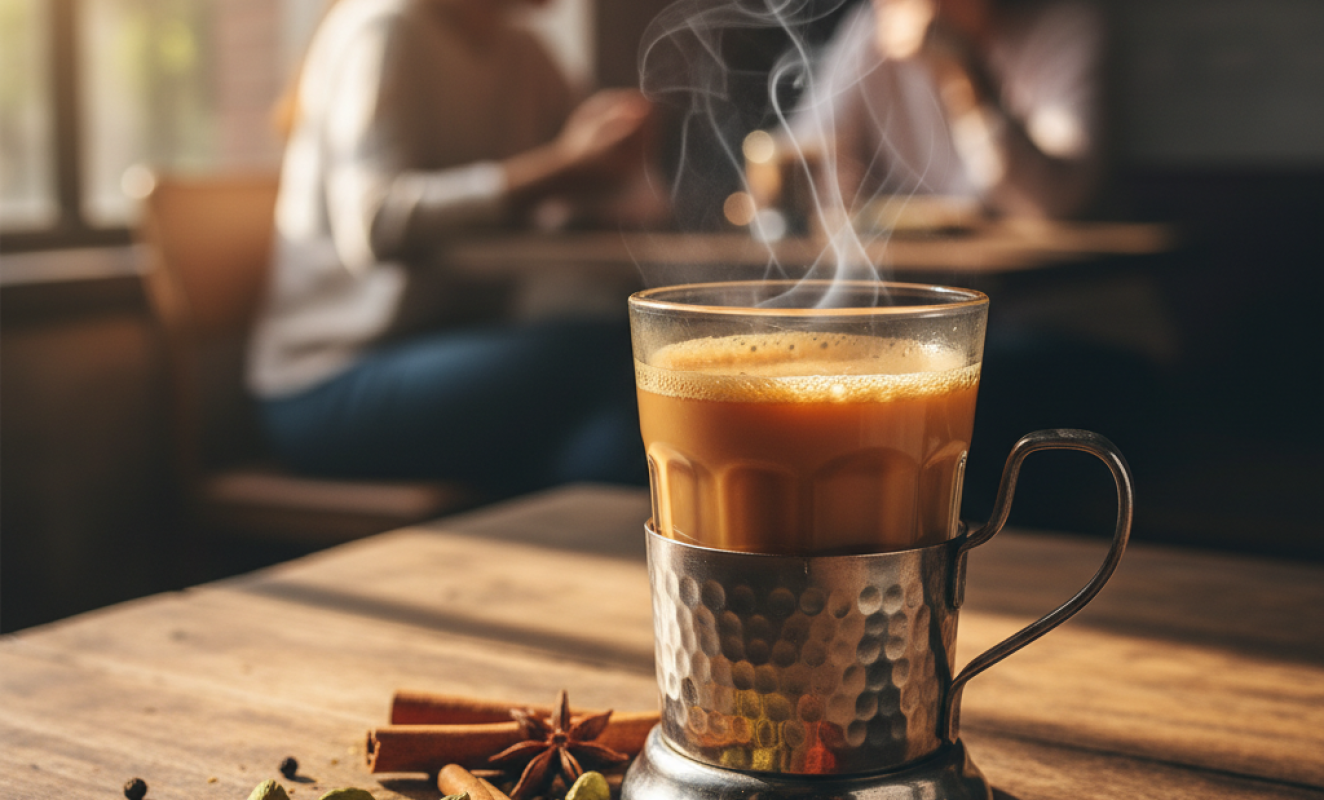
The Cup That Started Every Conversation
If you have ever typed “indian food near me” into your phone and ended up somewhere that handed you a teabag in lukewarm water at the end of your meal, you already understand — even if you could not quite name it — that something essential was missing. That something is chai. Not tea. Chai. And the difference between the two is the difference between a transaction and a tradition.
At 7 Spice Bistro, we have spent years watching guests wrap both hands around a small clay-style cup of masala chai and exhale. Not because they were cold. Because something in that sip — cardamom, ginger, the warmth of whole milk simmered low — told their nervous system that the meal was complete, that the moment was safe, that they were welcome. In 2026, when restaurant culture increasingly favours speed over ceremony, we believe that exhale matters more than ever.
This article is for anyone who loves Indian food and wants to understand why chai occupies such a specific, almost sacred place in the dining ritual — and why, at our tables in Brampton and beyond, we treat the chai service not as an afterthought but as the closing note of a very deliberate composition.
QUICK ANSWER
Masala chai is not simply a beverage served at the end of an Indian meal — it is a cultural anchor that signals hospitality, cleanses the palate of lingering spice, and invites guests to slow down and connect. At 7 Spice Bistro in Brampton, the chai ritual is treated as an integral part of the dining experience, brewed with whole spices and full-fat milk the way generations of Indian households have always done it.
What Is Masala Chai and Why Does It Matter in Indian Dining?
Masala chai is a spiced milk tea brewed with a combination of black tea leaves, warm whole milk, and a blend of aromatic spices — most commonly cardamom, ginger, cloves, cinnamon, and black pepper — simmered together until the flavours meld into something that is unmistakably more than the sum of its parts. In Indian dining culture, it serves as both a palate cleanser and a social signal that the meal has moved from sustenance into celebration.
The word “chai” itself simply means “tea” in Hindi — so when someone orders a “chai tea latte,” they are technically ordering a “tea tea latte.” This small linguistic quirk reveals how thoroughly chai has been absorbed into Western café culture, often stripped of the ritual and spice complexity that give it meaning in its original context. According to the Tea and Herbal Association of Canada, spiced chai blends have become one of the fastest-growing tea categories in Canada, yet the traditional stovetop preparation method — simmering loose-leaf tea with whole spices in milk — remains rare outside of authentic Indian restaurants and home kitchens.
What makes masala chai particularly significant in Indian dining is its timing and its temperature. It arrives after the main course, often after the dessert, and it is meant to be sipped slowly. The ginger and black pepper in the blend are not decorative — they are digestive aids, and their inclusion reflects a centuries-old Ayurvedic understanding of food as medicine. A well-made cup of masala chai does not just taste good; it helps your body process a rich, layered meal of curries, ghee, and slow-cooked proteins.
The Spice Architecture of a Proper Masala Blend
Not all masala blends are equal, and at 7 Spice Bistro, we take the composition of our chai seriously. Cardamom provides the floral, citrus-forward brightness that lifts the cup. Fresh ginger adds a clean heat that is different from the slow burn of chilli — it warms from the inside rather than the tongue. Cloves and cinnamon bring depth and a slight bitterness that balances the natural sweetness of full-fat milk. Black pepper is the quiet backbone: you do not always taste it directly, but the cup feels flat without it.
Every family in India — and across the Indian diaspora communities here in Brampton and Mississauga — has their own version of this blend. The ratio of spices, the strength of the tea, the sweetness of the milk: these are inherited preferences, passed from grandmothers to mothers to children over decades of morning rituals and afternoon breaks. When a guest at an authentic Indian restaurant recognises the chai as “close to home,” that is not a coincidence. That is craft.
Why Is Chai Considered a Palate Cleanser in Traditional Indian Meals?
Chai functions as a palate cleanser in traditional Indian dining because its spice profile — particularly ginger, cardamom, and black pepper — actively neutralises the lingering heat and fat from heavily spiced curries, helping the taste buds reset and the digestive system settle. It is not a passive ending; it is a physiologically purposeful one.
This stands in contrast to Western palate cleansers like sorbet or sparkling water, which work primarily through temperature or carbonation. Chai works through aromatic chemistry. The volatile oils in cardamom and ginger bind to the same receptors that spicy food activates, effectively “resetting” your perception of flavour. According to research published by the National Institutes of Health (NIH), ginger compounds including gingerol and shogaol have demonstrated measurable gastroprotective and digestive enzyme-stimulating properties, supporting the traditional Ayurvedic belief that ginger aids digestion after a rich meal.
There is also the social dimension. When chai arrives at the table, the pace of the meal changes. Conversations deepen. The shared act of holding a warm cup, of sipping rather than eating, of pausing — this is where meals become memories. We see it at our Brampton location regularly: a family that has been half-focused on food and children and phones will, when the chai arrives, suddenly draw closer together. The cups do that. The ritual does that.
“At 7 Spice Bistro, we have never treated chai as a menu item. We treat it as a moment — and moments are the reason people remember a meal long after the flavours have faded.”
Chai vs. Coffee: The Post-Meal Debate in the Indian Dining Context
In South Indian cuisine — and we celebrate this distinction openly — filter coffee often plays the post-meal role that masala chai fills in North Indian dining. The preparation rituals are different, the flavour profiles diverge, but the underlying cultural function is identical: both are served hot, both are made with milk, and both signal that the shared experience of eating together is transitioning into the shared experience of simply being together.
For guests exploring 7 Spice Bistro Mississauga vs. Brampton: How We Serve Two Communities with One Philosophy, this regional nuance matters. Our menu honours the breadth of Indian culinary geography, and our chai service reflects that same respect for regional identity.
How the Chai Ritual Reflects Broader Indian Hospitality Values
The chai ritual reflects the core Indian hospitality value of atithi devo bhava — “the guest is equivalent to God” — because offering a freshly brewed cup of chai to a visitor is one of the most immediate and personal acts of welcome in Indian culture. It communicates: I made this for you, specifically, right now.
This is not a metaphor. In most Indian households — including those of our team members and the families who dine with us in Brampton and Mississauga — you do not offer someone a glass of water and call it hospitality. You make chai. You simmer it properly. You do not hand them a mug and a teabag and walk away. The act of preparation is part of the gift. The time you spend making it is visible in the cup.
At an authentic Indian restaurant, this value should translate directly to the dining room. When a restaurant offers chai that has clearly been brewed fresh — where you can smell the cardamom before the cup reaches the table — it communicates something important about how that kitchen operates. It tells you that the team understands what Indian food actually is: not just a set of recipes, but a set of relationships. Relationships with ingredients, with guests, with time.
The families who visit us regularly — whether they are searching for Indian food in Brampton, driving across from Mississauga, or discovering us for the first time — often tell us in their reviews that the chai felt like the moment the restaurant became real to them. Not the appetisers, not the butter chicken (though we take considerable pride in our butter chicken — see our deep dive on The Butter Chicken Debate: Traditional Recipe vs. Modern Brampton Interpretations). The chai.
What “Seven Spice” Has to Do With It
Our name — 7 Spice Bistro — is not decorative. It reflects our belief that Indian cuisine is fundamentally a spice-based tradition, and that understanding spice is understanding the food. Chai is the most democratic expression of that belief. It is available in every home, at every income level, in every region of India. It uses the same spices — cardamom, ginger, cinnamon, cloves, pepper — that appear in the biryani, the curry, the marinade. Drinking a good cup of masala chai is, in a very literal sense, tasting the philosophy of the cuisine itself.
When guests search for the best Indian restaurant in Brampton or stumble across our menu online, we want them to understand before they even walk through the door that seven spice is not a branding exercise. It is a commitment. And nowhere is that commitment more quietly on display than in the chai we serve at the end of every meal.
How 7 Spice Bistro’s Chai Service Differs From What You Find Elsewhere
7 Spice Bistro’s chai service differs from what most restaurants offer because we brew our masala chai to order using whole spices and full-fat milk simmered together on the stove — not a powder, not a concentrate, not a machine. The result is a cup with genuine texture, layered aroma, and a warmth that pre-made chai products simply cannot replicate.
We are aware that this takes longer. We are aware that in a busy dining room, on a Friday evening in Brampton, “longer” is a real operational challenge. We do it anyway. Because we believe the people sitting at our tables — families celebrating birthdays, couples on anniversaries, friends catching up over hakka food and curry — deserve a chai that was made with the same attention as everything else they ate that evening.
We also offer our chai at the beginning of a meal for guests who want to start slowly. A cup of masala chai before an order of our seafood dishes, for example, is a wonderful way to warm the palate and settle into the experience. For anyone curious about how spice plays into the full arc of an Indian meal — from aperitif to digestif — we invite you to explore Seafood in Indian Cuisine: What Makes 7 Spice Bistro’s Fish & Shrimp Dishes Stand Out.
The Role of Chai in Catering and Group Dining
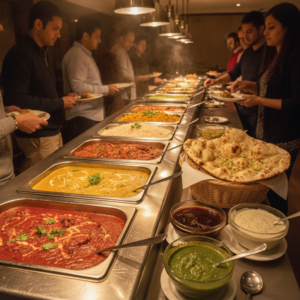
For larger gatherings — corporate events, family reunions, community celebrations across Brampton and Mississauga — chai service becomes an even more powerful tool for hospitality. A chai station, where guests can watch the brew being made and receive their cup warm from the pot, creates an immediate focal point of warmth and community that no dessert table can replicate. It invites people to gather, to linger, to talk. It turns a catered event into something that feels like a home.
This is one of the reasons our catering clients specifically request chai service as part of their packages. If you are planning a larger event in the Brampton or Mississauga area and want to understand how we bring the same warmth to off-site dining, visit Catering Your Brampton Event: Why Indian Food Impresses Corporate Teams and Family Reunions for a full overview of what that experience looks like.
Why Preserving the Chai Ritual Is an Act of Cultural Integrity
Preserving the chai ritual in a restaurant setting is an act of cultural integrity because it resists the homogenising pressure to simplify Indian dining into a set of dishes that are easy to mass-produce, and instead affirms that the experience around the food — its pacing, its warmth, its ceremony — is as meaningful as the food itself.
Indian cuisine is one of the most complex, regionally diverse, and historically rich food traditions in the world. It has also been one of the most frequently flattened and misrepresented in Western restaurant contexts. Many guests who grew up eating Indian food at home — whether in India, in Brampton, in Mississauga, or in the many Indian communities spread across Canada — carry a specific, personal benchmark for what authentic Indian dining feels like. The chai is often the test. Does it taste like someone made it? Does it taste like care?
According to Statistics Canada’s most recent census data, the South Asian population in the Peel Region — which encompasses both Brampton and Mississauga — represents one of the largest and fastest-growing South Asian communities outside of India itself. (Statistics Canada, 2021 Census.) For the restaurants serving this community, the responsibility is not just culinary. It is cultural. Every cup of chai we brew at 7 Spice Bistro is, in a small but genuine way, an act of respect for that community and for the tradition it carries.
We are proud to be part of the Indian dining landscape in this region. We are proud that guests who have been searching for a restaurant that feels like home — truly like home, not like a theme park approximation of home — find that in us. And we are proud that a humble cup of spiced tea is part of how we get there.
Come Experience the Chai Ritual for Yourself
Whether you are a lifelong chai lover or discovering the tradition for the first time, our table in Brampton is waiting. Come for the curry. Stay for the chai. Let our team show you what Indian hospitality truly tastes like.
✍️ Written by the 7 Spice Bistro Team
We are the chefs, hosts, and storytellers behind one of Brampton’s most beloved Indian dining destinations. Everything we write comes from the same place as everything we cook — a deep, genuine love for Indian food culture and the communities in Brampton and Mississauga we are honoured to serve.
Frequently Asked Questions
What makes masala chai different from regular tea?
Masala chai is brewed by simmering loose-leaf black tea together with whole spices — typically cardamom, ginger, cinnamon, cloves, and black pepper — directly in full-fat milk, rather than steeping a teabag in hot water and adding milk separately. This method creates a deeply integrated flavour that regular tea cannot replicate. The spices are not additions; they are part of the brew from the first moment of heat, which is why the aroma and depth of a properly made masala chai are so distinctive and warming.
How does chai function as a palate cleanser after a spicy Indian meal?
The aromatic compounds in masala chai — particularly gingerol in ginger and the volatile oils in cardamom — interact with the same sensory receptors that spicy food stimulates, effectively resetting the palate rather than simply washing it. The warmth of the milk also coats the stomach and soothes the digestive tract after a rich, complex meal. This is not folk tradition; it is chemistry, and it is why generations of Indian families have ended their meals this way, long before modern food science had the vocabulary to explain it.
Why does 7 Spice Bistro brew chai to order instead of using a concentrate?
We brew our masala chai to order because the difference between a freshly simmered cup and a reconstituted concentrate is immediately perceptible — in aroma, in texture, in the way the spice flavours unfold as the cup cools. A concentrate is a shortcut that works against everything a chai ritual is supposed to do. The ritual exists precisely because it involves time, attention, and intention. Removing those things removes the point. At 7 Spice Bistro, we believe that if we are going to serve chai, it should be chai worth remembering.
Can I request chai as part of a catered event or group booking at 7 Spice Bistro?
Absolutely — and we encourage it. Chai service is one of the most requested additions to our catering and group dining packages for events across Brampton and Mississauga. A live chai station, where guests watch the brew being made fresh, creates a warmth and focal point that transforms a catered meal into a genuine communal experience. Whether you are hosting a corporate team dinner, a family reunion, or a cultural celebration, chai is one of the most meaningful and memorable hospitality gestures we offer. Reach out to our team at 7spicebistro.com to discuss your event needs.
Related Articles
- Reading an Indian Menu Without Stress: A Warm Glossary for Brampton Diners
- The Truth About Spice Levels: How to Order Indian Food That's Perfect for Your Family
- The Spice Level Myth: Why Your Family's Heat Tolerance Isn't What You Think
- First Time Ordering from an Indian Restaurant? Your Warm Welcome Starts Here