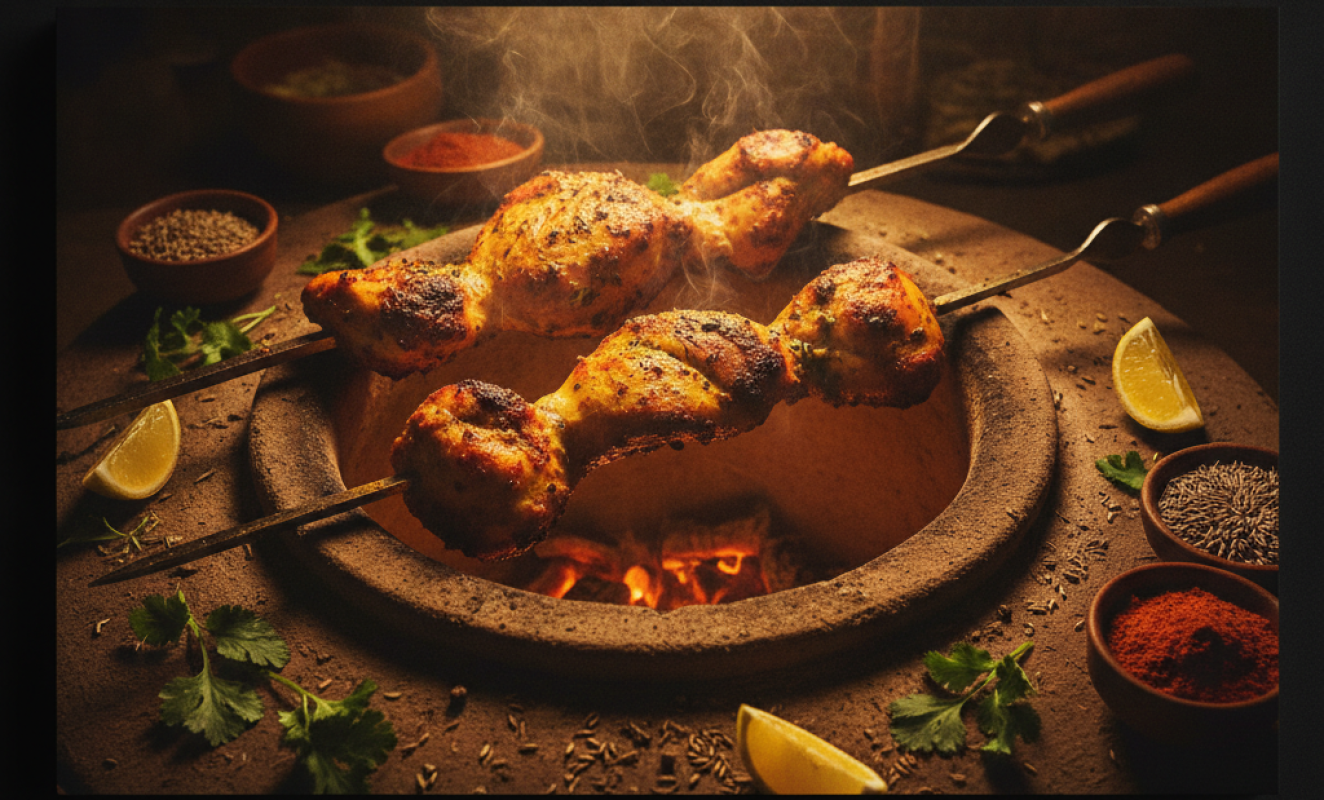
Every time someone searches “tandoori chicken near me” late on a Friday evening, there’s a hunger behind that search that goes deeper than a craving — it’s a search for something real, something smoky, something that tastes like it came from a kitchen with actual history behind it. In 2026, tandoori chicken remains one of the most searched Indian dishes in North America, and yet most people who love it couldn’t tell you why it tastes the way it does, or why a poorly made version feels so flat compared to the genuine article. At 7 Spice Bistro, we’ve spent seven years perfecting this dish in Brampton, and we think you deserve to understand exactly what makes it extraordinary.
QUICK ANSWER
Tandoori chicken gets its signature smoky char, deep colour, and impossibly tender texture from a two-stage process: an acidic yogurt-spice marinade that chemically transforms the meat, followed by high-heat cooking in a clay tandoor oven that can reach temperatures above 480°C (900°F). The result is a dish with crisp, caramelized edges, juicy interior, and a flavour profile no conventional oven or grill can fully replicate.
What Is Tandoori Chicken, and Where Did It Actually Come From?
Tandoori chicken is one of the best Indian dishes in the world precisely because it is ancient and modern at the same time. The technique is ancient — tandoor-style clay ovens have been used across South Asia, Central Asia, and the Middle East for thousands of years. But the dish as we know it today has a more specific, surprisingly recent origin story rooted in the Punjab region of undivided India.
The story most food historians tell traces tandoori chicken’s popularization to Kundan Lal Gujral, who opened a restaurant called Moti Mahal in Peshawar (now Pakistan) in the 1920s. His innovation was adapting the tandoor — traditionally used for bread like naan and roti — to cook whole marinated chicken at ferocious heat. When partition happened in 1947 and millions of Punjabis migrated, they brought their culinary traditions with them. Moti Mahal relocated to Delhi, and within a generation, tandoori chicken had become a national symbol of Indian food. It was served to dignitaries, embraced by the Indian diaspora, and eventually travelled with immigrant communities to places like Brampton, where it found new kitchens and new devotees.
The Punjabi roots of the dish are critical to understanding its flavour. Amritsari cooking — the cooking of the holy city of Amritsar, at the heart of Punjab — is bold, generous, and unafraid of char. That same philosophy is baked into every piece of tandoori chicken: confidence in spice, confidence in heat, and a refusal to apologize for intensity. At our kitchen in Brampton, that Punjabi spirit informs how we approach the marinade, the timing, and the fire.
“Tandoori chicken is not just a recipe — it is a culinary philosophy carried across generations and across borders, arriving in Brampton with every family that packed their spice box and their memories together.”
Understanding this history is not just academic — it explains why the dish resists shortcuts. You can’t rush a marinade that’s doing genuine chemical work. You can’t fake the char that only comes from real high heat. And you can’t replicate the depth that comes from recipes refined over decades. The best tandoori chicken near you is the one made by people who understand where it came from.
How Does the Marinade Actually Work? The Chemistry Behind the Char
The marinade is where tandoori chicken begins, and it’s far more sophisticated than it looks. A proper tandoori marinade has two distinct phases that work together to transform raw chicken into something extraordinary — and each phase has a clear scientific purpose.
Phase One: The Acid Tenderiser
The first marinade — often called the “kachchi” or raw marinade — typically involves lemon juice or raw papaya paste. The lemon juice provides citric acid, while raw papaya contains an enzyme called papain, a natural protease. Proteases break down the long protein chains in muscle fibre, physically loosening the structure of the meat. This is why properly marinated tandoori chicken tears apart so effortlessly — the enzyme has already done mechanical work at the molecular level. This first stage usually lasts between 30 minutes and two hours. Skipping it is one of the most common mistakes made by restaurants cutting corners, and the result is chicken that is technically cooked but texturally disappointing.
Phase Two: The Yogurt Spice Coat
The second marinade is the one most people recognize — a thick, rust-red coating of full-fat yogurt and spices. The yogurt serves multiple functions simultaneously. Its lactic acid continues the tenderising work begun by the first marinade, while its fat content acts as a carrier for fat-soluble flavour compounds in the spices. Whole spices — cumin, coriander, cloves, cardamom — are dry-roasted and ground fresh, unlocking volatile aromatic oils that embed themselves in the yogurt matrix and transfer directly into the meat during the long soak.
The spice blend in a tandoori marinade is a study in balance. Kashmiri red chilli is the primary colouring agent — it provides a vivid, brick-red hue without excessive heat, allowing the cook to build colour without burning the palate. Garam masala adds warmth and complexity. Turmeric contributes its earthy undertone and that golden glow. Ginger and garlic paste — always freshly made in a serious kitchen — bring pungency and depth. Every element has a role. Nothing is decorative.
This second marinade typically rests overnight — a minimum of eight hours, ideally twelve or more. During that time, the spice-fat-acid system continues working, and the chicken develops a surface coating that will behave very specifically under extreme heat. When it hits the tandoor wall, the yogurt coating caramelises rapidly, the spices bloom, and the Maillard reaction creates those characteristic charred patches that carry so much of the dish’s flavour. You cannot rush this. The best tandoori chicken brampton diners love is the chicken that was marinated the night before.
Why Does a Clay Oven Make Such a Difference? The Physics of the Tandoor
The tandoor is irreplaceable — no conventional oven, grill, or broiler can replicate what it does, because it combines three distinct cooking mechanisms simultaneously. This is the single most important thing to understand about why authentic tandoori chicken tastes the way it does.
A traditional tandoor is a cylindrical clay oven, narrower at the top than at the base, fired with charcoal or wood at the bottom. When fully lit, the clay walls absorb and radiate intense heat from all directions — surface temperatures regularly exceed 480°C. Food skewered and lowered into the tandoor is simultaneously subjected to:
Radiant heat from the glowing clay walls, which penetrates the surface and begins cooking the meat immediately from all sides. This is the primary heat source and is far more intense than any conventional oven element.
Convective heat from the superheated air trapped inside the narrow cylindrical chamber, which continuously circulates around the food, cooking it evenly without the need to turn or rotate.
Radiant heat from the live fire below, which provides a degree of direct thermal energy and — critically — produces smoke from the charcoal and from fat dripping off the chicken. That smoke rises through the chamber and infuses the meat with a flavour compound called guaiacol, which is the specific molecular signature of woodsmoke and the reason tandoori chicken has that distinctive campfire-meets-spice aroma.
Because the cooking time is so short — often just eight to twelve minutes at these temperatures — the chicken cooks fast enough to retain significant internal moisture. The exterior chars. The interior stays tender. This is the paradox that makes tandoori chicken so compelling: it is simultaneously crisp and juicy, smoky and clean, intensely spiced on the surface and subtly flavoured within. No other cooking method achieves this combination. When people search for the best tandoori chicken near me, what they’re really searching for is this specific combination of physics and craft — a combination that depends entirely on the equipment and the expertise of the cook using it.
“Three types of heat, one clay chamber, twelve minutes — and the result is a dish that no kitchen shortcut has ever successfully imitated.”
What Makes Regional Variations of Tandoori Chicken So Different from Each Other?
Regional variation is what keeps Indian food endlessly interesting, and tandoori chicken is no exception. While the dish has Punjabi roots, it has been adopted and adapted across the subcontinent, and each region has left its own mark on the marinade, the cut, and the accompaniments.
Punjabi-style tandoori chicken — the original — prioritizes boldness. The marinade is heavy on Kashmiri chilli, mustard oil is often used in place of or alongside yogurt, and the spice blend is assertive. This is the version that arrived in Brampton with the Punjabi diaspora and remains the reference point for most diners who grew up eating Indian food.
Awadhi-influenced versions from Lucknow tend to be more restrained and aromatic — less chilli, more whole spice, a more delicate char. The cooking style of the Nawabs of Awadh prized subtlety over power, and that philosophy extends to their interpretation of tandoori cooking.
Dhaba-style — the roadside truck-stop cooking of rural Punjab and Haryana — is the opposite of subtle. Heavy smoke, generous ghee, robust spice, and a char that borders on aggressive. If you’ve ever eaten at a dhaba along the Grand Trunk Road and found yourself unable to stop eating despite being full, you understand why this style has its passionate advocates.
At 7 Spice Bistro, our approach is rooted in the Punjabi tradition that most of our Brampton community grew up with, but we draw on a broader understanding of Indian food to bring nuance to the spice balance. The goal is always a marinade that’s confident without being one-dimensional, and a cook that honours the fire rather than fighting it. We’d encourage you to explore our full approach to Indian food — including how dishes like biryani and tandoori items sit alongside each other on a well-designed menu — in our guide to Biryani in Brampton: Chicken, Veg, and Everything In Between.
How to Know If the Tandoori Chicken You’re Eating Is Actually Authentic
Authentic tandoori chicken has specific, identifiable characteristics — and once you know what to look for, you’ll never be fooled by a pale imitation again.
The Colour Should Not Be Fluorescent
This is the most common red flag. The vivid, almost neon-orange colour that appears in many westernized versions comes from artificial food colouring, not from proper use of Kashmiri chilli and spice. Authentic tandoori chicken is a deep, brick-red to russet brown, with darkened char marks at the edges and tips. The colour should look like it came from a fire, not a dye bottle. If your chicken looks like it was painted with highlighter, that’s a shortcut, not a tradition.
The Texture Should Have Contrast
Properly cooked tandoori chicken has a surface that’s slightly crisp and caramelised, with a visible coating of spiced yogurt that has set and charred in places, while the meat underneath remains tender and pulls cleanly from the bone. If the surface is uniformly soft, the chicken was likely cooked in a conventional oven at lower temperatures. If the whole piece is dry and tough, the marinade didn’t do its work. Contrast — surface versus interior — is the hallmark of the real thing.
The Smoke Aroma Should Be Present
You should smell it before you taste it. Authentic tandoori chicken carries a faint but unmistakable woodsmoke quality — not overpowering, but present. It’s the signature of live fire cooking. If the plate arrives smelling only of spices and nothing else, the tandoor wasn’t part of the process. At our restaurant in Brampton, that aroma is one of the first things guests notice when their plate arrives, and it’s one of the things they mention most often in 7 Spice Bistro conversations with friends they’re recommending us to.
The Accompaniments Tell the Story Too
Traditional tandoori chicken is served with lemon wedges, raw onion rings, and green chutney — not because these are decorative, but because they serve a purpose. The acid from the lemon brightens the richness of the spice coating. The raw onion cleanses the palate between bites. The green chutney — made from coriander, mint, ginger, and green chilli — provides a fresh, herbaceous counterpoint to the deep, smoky meat. If a restaurant serves your tandoori chicken with a dollop of random sauce and nothing else, they’ve missed the context. The full picture matters. It’s worth reading about how this same philosophy of context and balance applies to the broader world of Indian food in our guide to Downtown Brampton Restaurants: A Diner’s Guide to the Neighbourhood’s Best Eats.
For those who love exploring the full range of what Indian food can do, tandoori chicken is a perfect gateway because it demonstrates the cuisine’s core principles so clearly: respect for the ingredient, patience with process, and confidence in spice. These same principles define every dish we serve — from our Amritsari kulcha to our rich, slow-cooked curries. If you’ve been searching for the best Indian dishes in the area, we’d suggest starting with something cooked in fire, because fire is where this tradition began.
We’re also proud to be a destination for those exploring the intersection of Indian food and other cuisines — our Hakka Chinese menu brings another layer of depth and fusion history to the table, and our catering service makes it possible to bring authentic tandoori cooking to your events, weddings, and corporate gatherings across Brampton and the surrounding region. If you’re planning an event and wondering whether the best tandoori chicken Brampton has to offer can come to you — yes, it absolutely can.
The next time you find yourself searching for Indian food near me or scrolling through options wondering what to order, remember what you’ve read here. Ask whether the marinade was done overnight. Ask whether there’s a real tandoor in that kitchen. Ask whether the colour came from spice or a bottle. Those questions will lead you toward the real thing every time.
Ready to Taste the Real Thing?
Seven years of authentic Indian cooking experience, a kitchen that takes its fire seriously, and a menu built for people who know the difference — that’s what’s waiting for you at 7 Spice Bistro in Brampton. Whether you’re dining in, ordering for delivery, or planning a catered event, we’d love to be the answer to your next search for great Indian food.
✍️ Written by the Team at 7 Spice Bistro
With over seven years of authentic Indian cooking experience in Brampton, the team at 7 Spice Bistro brings deep culinary knowledge, genuine passion, and Punjabi-rooted expertise to every dish we serve. We write to share what we know — so our guests can taste with understanding.
Frequently Asked Questions
How long should tandoori chicken be marinated for the best results?
For genuinely authentic results, tandoori chicken should go through two marinade phases — a short acid marinade of 30 to 60 minutes with lemon juice or raw papaya paste, followed by a yogurt-spice marinade that rests for at least eight hours, ideally overnight. Rushing either stage produces chicken that lacks the depth of flavour and the tender, pull-apart texture that defines the dish at its best. At 7 Spice Bistro in Brampton, we never cut corners on the marinade — it’s simply too important.
What makes a tandoor oven different from a regular grill or oven?
A tandoor combines radiant heat from clay walls, convective heat from superheated circulating air, and live-fire smoke from charcoal below — all simultaneously. This triple-heat environment cooks food at temperatures exceeding 480°C, creating an exterior char and smoke infusion that no conventional oven or backyard grill can replicate. The smoke itself contributes a distinct flavour compound (guaiacol) that is the molecular signature of authentic tandoori cooking.
Why does tandoori chicken vary so much between restaurants?
The variation comes down to three factors: marinade quality and time, spice sourcing and blending, and cooking equipment. Restaurants that use artificial food colouring, skip the double-marinade process, or cook in conventional ovens rather than real tandoors will produce a dish that shares only the name with the authentic version. The spice blend alone — whether it uses freshly ground whole spices or pre-mixed powder — makes an enormous difference to the final flavour. Sourcing and patience are what separate good tandoori chicken from great tandoori chicken.
Can I order tandoori chicken as part of a catering package from 7 Spice Bistro?
Absolutely. Our catering service is one of the most popular offerings at 7 Spice Bistro, and tandoori dishes are consistently among the top requests for weddings, corporate events, and family celebrations across Brampton and the wider region. We bring the same kitchen standards to our catering as we do to every dine-in plate — full overnight marinade, proper spice blends, and cooking methods that honour the dish’s tradition. Visit our website or contact us directly to discuss a custom catering menu for your event.