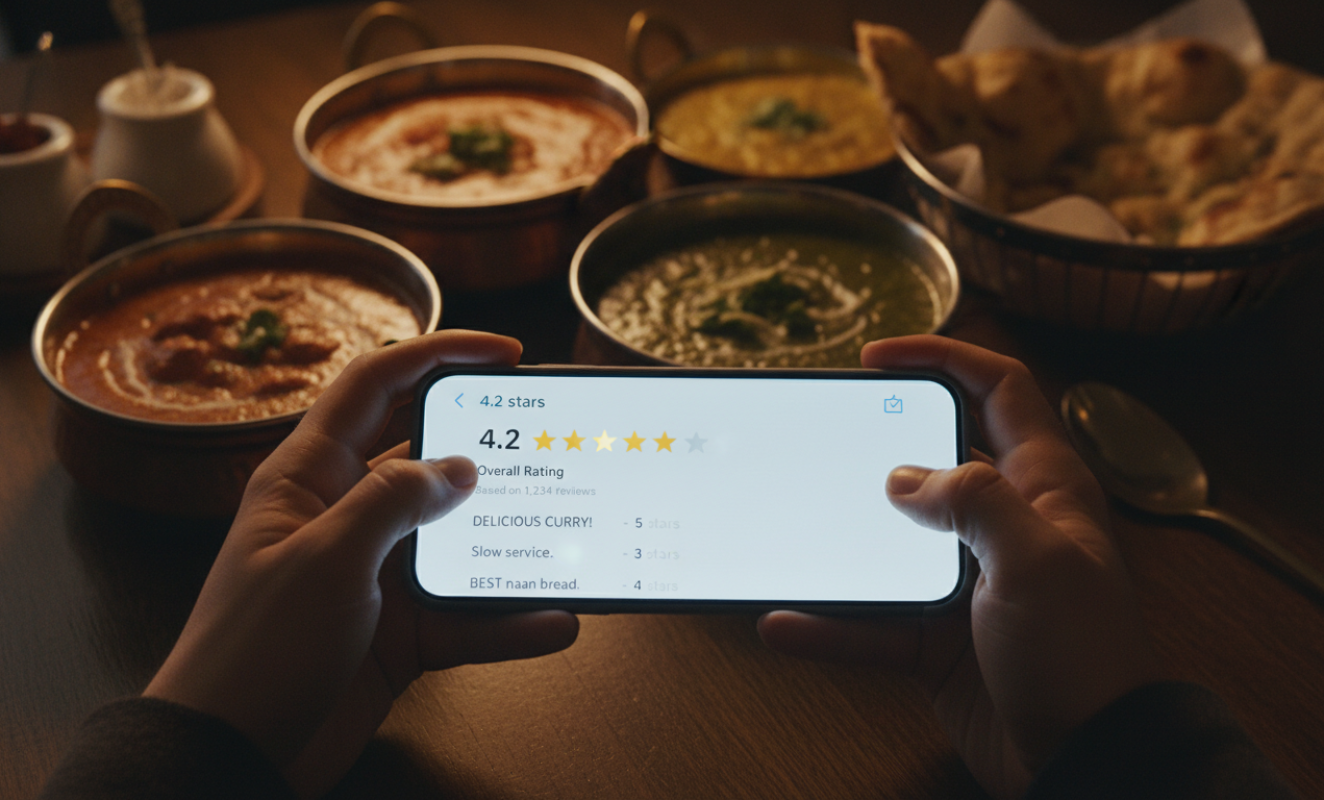
When you search for top rated indian restaurants near me, you are handed hundreds of results, stars, and snippets — and most of them tell you very little about whether the food is actually worth your time. A 4.7-star average sounds impressive until you read the reviews and realize half of them praise the parking lot and the other half mention a dish that is not even on the current menu. At 7 Spice Bistro, we have spent years listening to what Brampton diners genuinely value, and we have noticed a clear pattern: the reviews that reflect real quality read very differently from the ones that simply fill space. This guide decodes those signals so your next search actually leads you somewhere worthwhile.
Quick Answer
The most reliable five-star reviews for Indian restaurants mention specific dishes by name, describe the spice balance or cooking technique, and comment on consistency across multiple visits. Generic phrases like “great food, great service” tell you almost nothing. Look for reviews that read like they were written by someone who actually eats Indian food regularly — those are the ones worth trusting.
What Does “Authentic” Actually Mean in a Restaurant Review?
The word “authentic” in a review means something specific only when the reviewer demonstrates they know what they are comparing to. Authentic Indian cuisine is not a single cuisine — it is a family of regional traditions, each with its own spice profiles, cooking methods, and ingredient combinations. A reviewer who calls a dish authentic because it reminded them of food they ate in Punjab is making a meaningful claim. A reviewer who calls something authentic because “it tasted Indian” is essentially saying nothing.
When you are searching for the best indian restaurant near me and reading through reviews, pay close attention to whether the writer references a specific regional style. Mentions of Punjabi dals, South Indian lentil preparations, or the particular char on a tandoor-cooked bread signal that the reviewer has a frame of reference. Those reviews carry weight.
At 7 Spice Bistro, we cook from a foundation of seven-plus years of authentic Indian cooking experience in Brampton. When our guests use the word authentic in their reviews, they are usually pointing to something specific: the layering of spices, the texture of a slow-cooked curry, or the way our bread comes out of the tandoor. That specificity is what separates a signal from noise.
Regional Specificity Is the Clearest Marker of a Knowledgeable Review
India has dozens of distinct culinary traditions. A review that says “the curry was really good” is far less useful than one that says “the dal makhani had that slow-cooked richness you only get when it has been simmering for hours.” The second reviewer is describing a technique. They know what they are eating. Those are the voices worth following when you are choosing where to spend your evening.
How to Spot Genuine Quality in a Five-Star Review
Genuine quality reviews share a handful of consistent traits regardless of the restaurant being reviewed. They name dishes. They describe flavours in some detail. They mention returning, or say they would. They often note something that surprised them — a technique they had not seen elsewhere, a dish that exceeded expectations, or a flavour combination that worked better than they anticipated.
Generic five-star reviews, by contrast, tend to run short and vague. “Amazing food. Will definitely come back.” That sentence pattern is so common on restaurant listing pages that it has become meaningless. It is not necessarily fake — plenty of happy diners just are not writers — but it gives you nothing to work with when you are trying to decide where to eat.
A review that describes the spice balance of a specific dish tells you far more about a restaurant’s kitchen than a paragraph of unqualified superlatives ever could.
When hunting for good indian restaurants near me, filter your reading toward reviews that include at least one of these elements: a named dish, a comparison to a previous experience, a comment on value relative to portion size, or a note about consistency. Those four signals, taken together, paint a reliable picture.
What One-Star Reviews Actually Reveal
One-star reviews deserve the same critical reading as five-star ones. A one-star review that describes a specific problem — a dish arriving cold, an order that was wrong twice — is useful information. A one-star review that says “overrated, don’t bother” with no supporting detail is not. The restaurant’s response to negative reviews also matters: a thoughtful, non-defensive reply that acknowledges the concern signals a team that takes quality seriously.
Also look at the ratio of detailed negative reviews to detailed positive ones. A restaurant that has 200 specific, enthusiastic reviews and three vague complaints is a very different picture from one with 50 glowing one-liners and 20 angry paragraphs. Volume alone does not tell the story; the nature of the content does.
Why Menu Depth Matters More Than Menu Length
Menu depth — the ability to do several things well — is a stronger quality signal than a menu that runs to eight pages. Some of the most respected Indian restaurants in the country have focused menus that rotate seasonally. A large menu, particularly one that spans multiple unrelated cuisines without explanation, can sometimes indicate that nothing on it is being made with real care.
Our menu at 7 Spice Bistro spans both traditional Indian cuisine and Hakka Chinese food — a combination that reflects the genuine culinary history of the Indo-Chinese community rather than a random attempt to cover every demographic. If you want to understand why that combination makes cultural and culinary sense, our piece on Chinese Food vs. Hakka Food: What’s Actually Different and Why It Matters explains it clearly.
When reading reviews with menu depth in mind, look for comments that mention ordering the same dish repeatedly because it is always consistent, or that describe surprise at how well a seemingly simple dish was executed. Consistency and execution on straightforward dishes are the marks of a kitchen that genuinely knows what it is doing.
Vegetarian Options as a Proxy for Kitchen Skill
The quality of a restaurant’s vegetarian menu is a reliable indicator of overall kitchen skill. Building flavour without meat requires a deeper command of spice, timing, and technique. When reviewers specifically praise vegetarian dishes, that is a strong signal that the kitchen is not coasting on protein to do the heavy lifting.
At 7 Spice Bistro, our vegetarian offerings are not an afterthought — they sit at the centre of what traditional Indian cooking has always done best. Reviewers who single out our vegetarian preparations are recognizing something real: that cooking vegetables with the same care as any other dish takes genuine skill and intention.
What Reviews Tell You About Value — and What They Don’t
Value is one of the most subjective elements in any restaurant review, and it is also one of the most commonly misread. A reviewer who calls a restaurant expensive without mentioning portion size, ingredient quality, or how the price compares to similar restaurants in the area is not giving you useful information about value. They are giving you information about their personal expectations.
The most useful value assessments in reviews are comparative: “for what you get, the price is fair” or “portions are generous enough for two people to share comfortably.” Those assessments anchor the price to something tangible. If you are looking for the best indian food near me without overspending, look for reviews that describe what a family of four ordered and what it cost them, rather than a single diner complaining that a main course felt steep.
Budget-conscious dining in Brampton and Mississauga does not mean compromising on quality. It means finding a kitchen that respects both its ingredients and its customers enough to price things honestly. That is the standard we hold ourselves to, and it is the standard that tends to generate the kind of detailed, returning-customer reviews that actually mean something. For a broader look at how diners evaluate quality, our article Your Top Questions About Best Food, Answered covers this in more depth.
Catering Reviews Deserve Separate Attention
If you are researching a restaurant for catering rather than a dine-in experience, filter specifically for catering reviews. A restaurant that excels in its dining room does not automatically translate well to large-format service. Catering requires logistics, timing, and the ability to maintain food quality across larger quantities — skills that are distinct from daily kitchen operations.
Our catering service has built its reputation in Brampton on exactly that consistency. Reviews that mention our catering tend to focus on how the food arrived — temperature, presentation, and portion accuracy — rather than just the flavour. When all three elements appear in the same review, that is a catering team worth calling.
How to Use Your Research to Make a Confident Decision
Once you have read through reviews critically, the decision process becomes simpler. You are looking for a pattern rather than a single data point. Three detailed, specific reviews from different types of diners — a family, a solo visitor, someone who ordered takeout — carry more weight than thirty vague five-star ratings.
Cross-reference what you find on listing platforms with the restaurant’s own presence. A well-maintained website with clear menu information, honest descriptions, and a consistent voice is a reasonable signal that the same care carries into the kitchen. You can get a clear sense of that at 7 Spice Bistro before you ever walk through the door.
Also pay attention to review recency. A restaurant that earned strong reviews two years ago and has since gone quiet may have changed ownership, kitchen staff, or both. The most reliable signal is a stream of specific, positive reviews within the last several months — that tells you the current team is still performing at the level that built the reputation.
Searching for an indian restaurant brampton or anywhere else with this framework will not eliminate every bad meal — nothing will — but it will raise your hit rate considerably. And once you find a kitchen that consistently earns the right kind of reviews, the kind with names and details and genuine enthusiasm, hold onto it. Good restaurants are worth returning to.
For those who enjoy exploring the broader world of Indo-Chinese cooking, we also recommend reading about Best Noodles in Brampton: Why Indo-Chinese Beats Every Other Version on the Menu — it gives useful context for understanding why Hakka cuisine occupies a unique place on any serious food menu. And if you have ever wondered how rating systems translate to real dining experiences, 5-Star Indian Dining: What That Rating Actually Means and What to Look is worth your time.
Ready to Experience What a Strong Review Actually Looks Like?
Come and form your own opinion. Our dine-in service, catering, and full Indian and Hakka menu are waiting for you in Brampton. Whether you are a first-time visitor or a returning regular, we aim to be the kind of restaurant people write specific reviews about — because the food earns it.
About the Author
The 7 Spice Bistro Team brings over seven years of authentic Indian and Hakka cooking experience to Brampton’s dining scene. We write from the kitchen outward — sharing what we know about food, flavour, and what genuine quality actually tastes like.
Frequently Asked Questions
How can I tell if an Indian restaurant review is genuinely trustworthy?
Trustworthy reviews name specific dishes, describe flavours or textures in some detail, and usually mention more than one visit or compare the experience to similar restaurants. Reviews that contain only vague praise or unqualified superlatives without supporting detail give you very little to act on. Look for reviewers who demonstrate familiarity with Indian food — they are the ones whose opinions are most likely to match your own experience when you arrive.
What should I look for when searching for the best Indian restaurant near me?
Beyond star ratings, look for review recency, the ratio of specific to vague reviews, and how the restaurant responds to criticism. A restaurant that answers complaints with care and without defensiveness is usually one that takes its standards seriously. Also check whether the restaurant offers a coherent menu identity — a kitchen focused on what it does well is more likely to do it consistently than one trying to cover every cuisine at once.
Why do some highly rated Indian restaurants disappoint in person?
High ratings built on vague reviews are fragile because they do not reflect genuine, specific satisfaction. When a restaurant’s rating rests on a large volume of short, undescribed five-star posts, it may be boosted by one-time visitors or promotional activity rather than by consistently excellent food. Restaurants with strong ratings built from detailed, returning-customer reviews tend to deliver more reliable experiences because the rating reflects actual cooking quality rather than general goodwill.
Can I use online reviews to evaluate catering quality for an event?
Yes, but filter specifically for catering reviews rather than applying dine-in feedback to a catering decision. Good catering reviews will mention on-time delivery, food temperature, presentation on arrival, and accuracy of the order at scale. Those details reflect the logistical competence that large-format service requires. If a restaurant has strong catering-specific reviews alongside its dine-in ratings, that is a genuinely reliable indicator that the team can handle both formats well.
Written by the 7 Spice Bistro Team
Our team brings deep expertise — Indian and Hakka Cuisine in Brampton.