The Ingredient That Confuses Even Passionate Home Cooks
The coriander confusion: fresh vs. ground—how one ingredient changes your entire dish is something we talk about in our kitchen almost every single week — and honestly, it never gets old. Whether you’re a seasoned home cook in Brampton who grew up watching your nani grind whole coriander seeds on a stone mortar, or a curious newcomer to Indian food just starting to explore what makes a curry sing, this one ingredient has a way of humbling everyone at the stove. In 2026, as Indian cuisine continues its well-deserved rise in global food culture, understanding coriander — in all its forms — is arguably the single most useful piece of culinary knowledge you can carry into any Indian kitchen.
At 7 Spice Bistro, we’ve built our reputation as a beloved Indian restaurant in Brampton and Mississauga on exactly this kind of attention to detail. The difference between a flat-tasting dal and one that makes you close your eyes on the first spoonful? Often, it comes down to whether the right form of coriander was used at the right moment. We want to share that knowledge with you today — not to show off, but because we genuinely believe that understanding your food makes you love it more.
QUICK ANSWER
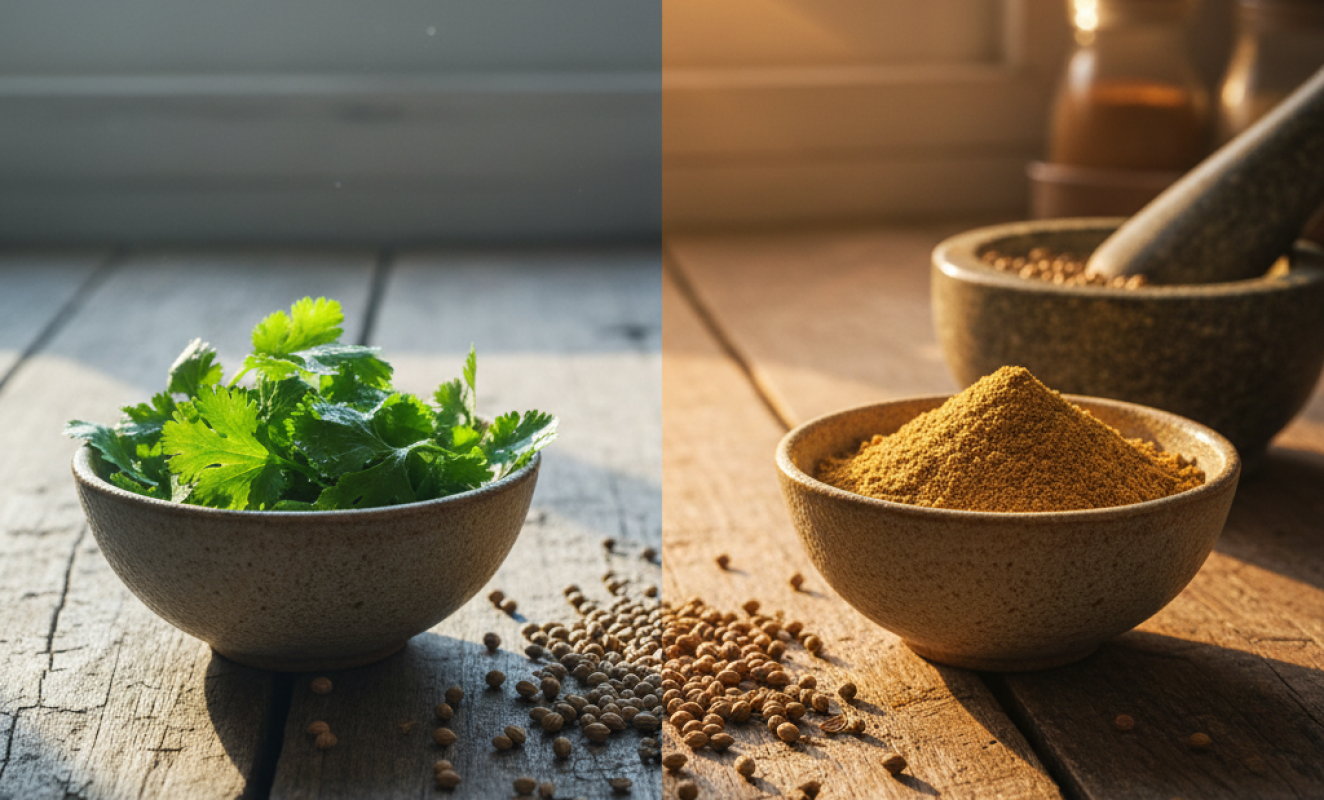
Fresh coriander (cilantro leaves and stems) delivers bright, citrusy, herbaceous flavour added at the end of cooking. Ground coriander (dried, powdered seeds) provides warm, earthy, nutty depth built into a dish from the start. They are not interchangeable — using the wrong form at the wrong stage can flatten or overwhelm your entire dish. At 7 Spice Bistro, we use both forms strategically in almost every recipe on our menu.
What Exactly Is the Difference Between Fresh and Ground Coriander?
Fresh and ground coriander come from the same plant — Coriandrum sativum — but they behave like two entirely different ingredients once they hit heat. Fresh coriander, known widely as cilantro, refers to the soft green leaves and tender stems of the plant. Ground coriander refers to the dried, roasted seeds of that same plant, milled into a fine powder. The flavour compounds are dramatically different between the two, which is why substituting one for the other is almost always a mistake.
According to the BBC Good Food ingredient glossary, fresh coriander leaves contain linalool and other aldehydes that produce a bright, soapy-citrus aroma, while coriander seeds contain a completely different volatile oil profile dominated by linalool in a drier, more resinous form — resulting in warm, spiced, almost nutty notes entirely absent in the fresh herb. This is why the same plant can smell floral and green in leaf form and earthy and toasty in seed form.
At 7 Spice Bistro, our kitchen team thinks of these two forms as playing different instruments in the same orchestra. Ground coriander is the bass line — it lays down warmth and body early in the cooking process. Fresh coriander is the high note — it arrives at the end to lift everything and give the dish its final, vibrant identity. Remove either one and you hear the silence immediately.
The Flavour Science Behind the Confusion
One reason home cooks — and even experienced ones — get confused is that coriander in all its forms tends to blend seamlessly into the background of a dish. It doesn’t shout the way cumin does or sting the way chili does. Ground coriander in particular is what food scientists call a “supporting spice” — it rounds and softens sharper flavours like turmeric, chili, and garam masala, creating cohesion across a spice blend. According to the Food Chemistry journal, coriander seed contains over 40 distinct volatile aromatic compounds, making it one of the most chemically complex spices used in South Asian cooking — which explains why its absence, even when subtle, can collapse an entire flavour profile.
Fresh coriander, meanwhile, is volatile in a different way — literally. Its aromatic oils evaporate within minutes of heat exposure, which is exactly why you always add it raw at the very end. Cook fresh coriander into a sauce and you lose almost everything that makes it special. This is a lesson our team at 7 Spice Bistro applies to every single dish that comes out of our kitchen — in Brampton and at our 7 Spice Bistro Mississauga vs. Brampton: How We Serve Two Communities with One Philosophy location as well.
How Does 7 Spice Bistro Actually Use Both Forms on the Menu?
At 7 Spice Bistro, nearly every dish on our menu engages coriander in at least one form — and many of our most popular dishes use both forms in separate stages of preparation. Here’s how that plays out across our kitchen in a way that makes every plate feel alive and layered.
Ground Coriander: The Foundation Layer
We use ground coriander — almost always freshly toasted and ground in-house from whole seeds — as part of the base spice mixture for our gravies, marinades, and slow-cooked dishes. It goes in early, usually with the onion-tomato masala base, where it has time to bloom in hot oil and release its earthy warmth. In dishes like our lamb rogan josh, our chicken tikka masala, and our various lentil preparations, ground coriander is absolutely non-negotiable. It creates the backbone of the sauce — the layer that you taste in the background of every bite, the thing that makes you feel satisfied and grounded rather than just stimulated by heat and spice.
For anyone searching for authentic Indian food in Brampton or curious about what separates a restaurant-quality curry from a home attempt, this is often the answer: professional kitchens like ours toast and grind coriander seeds fresh, rather than relying on pre-ground powder that may be months old and has lost most of its aromatic complexity. Freshly ground spices are a non-negotiable standard for us — it’s one of the reasons 7 Spice Bistro reviews consistently mention the depth of flavour in our gravies.
Fresh Coriander: The Finishing Touch
Fresh coriander — in our kitchen, it’s always the leaves and the upper tender stems together — arrives at the very end of cooking and is never rushed. We scatter it generously over finished dishes right before they leave the pass, and we also use it raw in chutneys, raitas, and our signature green sauces. Our house coriander-mint chutney, which accompanies several starters on the 7 Spice Bistro menu, is built entirely on fresh coriander — raw, vibrant, and full of that unmistakable bright green punch that makes samosas and seekh kebabs come alive.
There’s also a textural role that fresh coriander plays. Those little feathery leaves add a gentle visual lift to a finished plate and a slight chew that contrasts beautifully with the smooth, saucy base of a curry. For families dining with us in Brampton or Mississauga, that pop of green on a plate of butter chicken or our Hakka-influenced noodle dishes is often the first thing that makes the meal feel cared for and intentional — and it is.
“Ground coriander builds the soul of a dish. Fresh coriander gives it its smile. You need both — and you need to understand when each belongs.” — 7 Spice Bistro Kitchen Team
Why Does This Matter for Indian Food and Hakka Cuisine Specifically?
Coriander’s role is especially significant in Indian and Hakka cuisines because both traditions rely heavily on layered spicing — where multiple spices interact at different temperatures and stages to create a flavour that is more than the sum of its parts. Indian food, in particular, is not a cuisine that you can simplify down to one or two hero spices. It is an architecture of flavour, and coriander — both forms — is part of the structural steel.
When families and food lovers across Brampton and Mississauga come to us searching for the best Indian restaurant in Brampton, we know that what they’re really looking for is that feeling of authenticity — the food that tastes like it was made with knowledge, care, and the right ingredients at the right moments. Coriander confusion, when resolved, is one of the keys to achieving that. It’s not exotic knowledge — it’s foundational.
Hakka food — a beloved Chinese-Indian fusion cuisine that forms a significant part of our menu at 7 Spice Bistro — also makes interesting use of coriander. In our Hakka-style dishes, fresh coriander often bridges the Chinese and Indian influences, lending an herbal brightness that connects the soy-ginger base to the masala undertones. It is a small ingredient doing significant cultural work, and our team treats it with the respect it deserves.
For those of you who love exploring both Indian food near me searches and Hakka food adventures, this dual-cuisine context is part of what makes dining at 7 Spice Bistro a genuinely unique experience in the Brampton and Mississauga food landscape. We’re not just an Indian restaurant — we are a celebration of the way food evolves when cultures meet.
You might also enjoy reading our deep dive into The Butter Chicken Debate: Traditional Recipe vs. Modern Brampton Interpretations, where we explore how coriander interacts with cream-based gravies in one of our most iconic dishes.
How Can You Use This Knowledge in Your Own Kitchen?
You don’t need to be a professional chef to use coriander the way we do. You just need a few clear principles, and the willingness to pay attention to when and how you’re adding it. Here are the practical takeaways our kitchen team would share with any home cook in Brampton, Mississauga, or anywhere else chasing that restaurant-quality result.
The Golden Rules for Home Cooks
1. Never substitute one for the other. Fresh coriander cannot replace ground in a masala base — you’ll lose earthiness and body. Ground coriander cannot replace fresh as a garnish — you’ll get a dusty, flat finish instead of brightness. Treat them as separate ingredients that happen to share a plant.
2. Toast your whole coriander seeds before grinding. Dry-toast whole coriander seeds in a pan over medium heat for two to three minutes until fragrant, then grind them fresh. The difference between freshly toasted ground coriander and a six-month-old jar from the back of your cupboard is night and day. This single step can transform your home cooking.
3. Add fresh coriander at the very last moment. Turn off the heat. Plate your dish. Then add fresh coriander. The residual warmth of the food will release its aroma beautifully without destroying it. If you stir it into a bubbling curry, you’ll lose everything within thirty seconds.
4. Use the stems too. Fresh coriander stems — especially the thinner upper portions — carry tremendous flavour and are perfect for blending into chutneys or chopping finely into marinades. Don’t discard them. The full herb is the full flavour.
5. Don’t be shy with quantity. Many home cooks under-use fresh coriander as a garnish, adding just a few timid leaves. At 7 Spice Bistro, we are generous — a full handful, loosely scattered, transforms the visual and aromatic experience of the entire plate. Be bold.
And if there are nights when you’d rather let us do the work — when you’re too tired to toast and grind and chop and layer — that’s exactly what we’re here for. As your local Indian restaurant near you in Brampton, we put this level of care into every single plate we serve. You’ll taste the difference — even if you can’t always name it.
We’re also proud to bring this same kitchen philosophy to events and gatherings across the region. If you’re planning something special, check out Catering Your Brampton Event: Why Indian Food Impresses Corporate Teams and Family Reunions to see how we bring our spice expertise to your table, wherever that table may be.
The Bigger Picture: Why Spice Knowledge Is an Act of Cultural Respect
Understanding coriander isn’t just about making better food. It’s about respecting the culinary intelligence embedded in Indian cooking traditions that go back thousands of years. Every layering technique, every stage-by-stage spice addition, every decision about when to add fresh versus dried herbs — these are not arbitrary choices. They were developed over generations by people who understood, through direct sensory experience and cultural transmission, exactly how each ingredient behaves.
When we at 7 Spice Bistro serve our community in Brampton and Mississauga, we carry that tradition forward while also embracing the modern techniques and diverse palates that make our dining room such a vibrant, welcoming place. Whether you’re a family who grew up eating Indian food at home, someone who’s searching for the best Indian restaurant in Brampton for the first time, or a food enthusiast who found us while looking for an Indian food truck near you — we want every bite to feel like a conversation with something deeper than just dinner.
Coriander — in all its fresh, ground, whole-seed, and chutney glory — is part of that conversation. And now that you know the difference, we hope you’ll taste it everywhere.
Ready to Taste the Difference Yourself?
Come experience authentic Indian and Hakka cuisine crafted with the kind of spice knowledge you’ve just been reading about. Our team at 7 Spice Bistro in Brampton would love to cook for you — whether you’re dining in, ordering takeout, or planning a catered event for your family or team.
✍️ Written by the 7 Spice Bistro Team — We’re the cooks, hosts, and spice enthusiasts behind Brampton and Mississauga’s favourite Indian and Hakka dining experience. Every article we write comes straight from our kitchen — real knowledge, real food, real community.
Frequently Asked Questions
How do I know when to use fresh coriander versus ground coriander in Indian cooking?
Use ground coriander at the start of cooking — it goes into your oil with other dry spices to build the base of your sauce or marinade, where it has time to bloom and release its earthy, nutty depth. Use fresh coriander (cilantro leaves and stems) at the very end, added raw after the heat is off, to deliver bright, citrusy, herbal freshness that lifts the entire dish. The two forms are not interchangeable, and using each at the right stage is one of the most important techniques in authentic Indian cooking.
What makes 7 Spice Bistro’s spice preparation different from most Indian restaurants?
At 7 Spice Bistro, we toast and grind whole coriander seeds fresh in-house rather than relying on pre-ground commercial spice powders that may have lost much of their aromatic complexity. This commitment to freshly prepared spices is one of the core reasons our gravies, marinades, and chutneys have the depth and layered flavour that our guests in Brampton and Mississauga consistently mention in their reviews. It’s a small step that makes an enormous difference on the plate.
Why does my home curry taste flat even when I follow the recipe exactly?
The most common culprit is old, pre-ground spices — including ground coriander — that have lost their volatile aromatic oils through age and improper storage. Ground spices begin losing potency within weeks of being ground, and most home pantry jars are months or even years old. Try toasting whole coriander seeds and grinding them fresh before your next cook, and also make sure you’re adding fresh coriander leaves only at the very end off heat. These two adjustments alone can dramatically transform a flat-tasting curry into something restaurant-quality.
Can I visit 7 Spice Bistro if I’ve never tried authentic Indian food before?
Absolutely — and we genuinely hope you do. 7 Spice Bistro is designed to be welcoming to everyone, whether you’re a lifelong lover of Indian food or someone ordering butter chicken for the very first time. Our team is always happy to guide you through the menu, explain spice levels honestly, and help you find dishes that match your comfort and curiosity. We serve families, food explorers, and everyone in between across our Brampton and Mississauga locations — come exactly as you are, and we’ll take care of the rest.