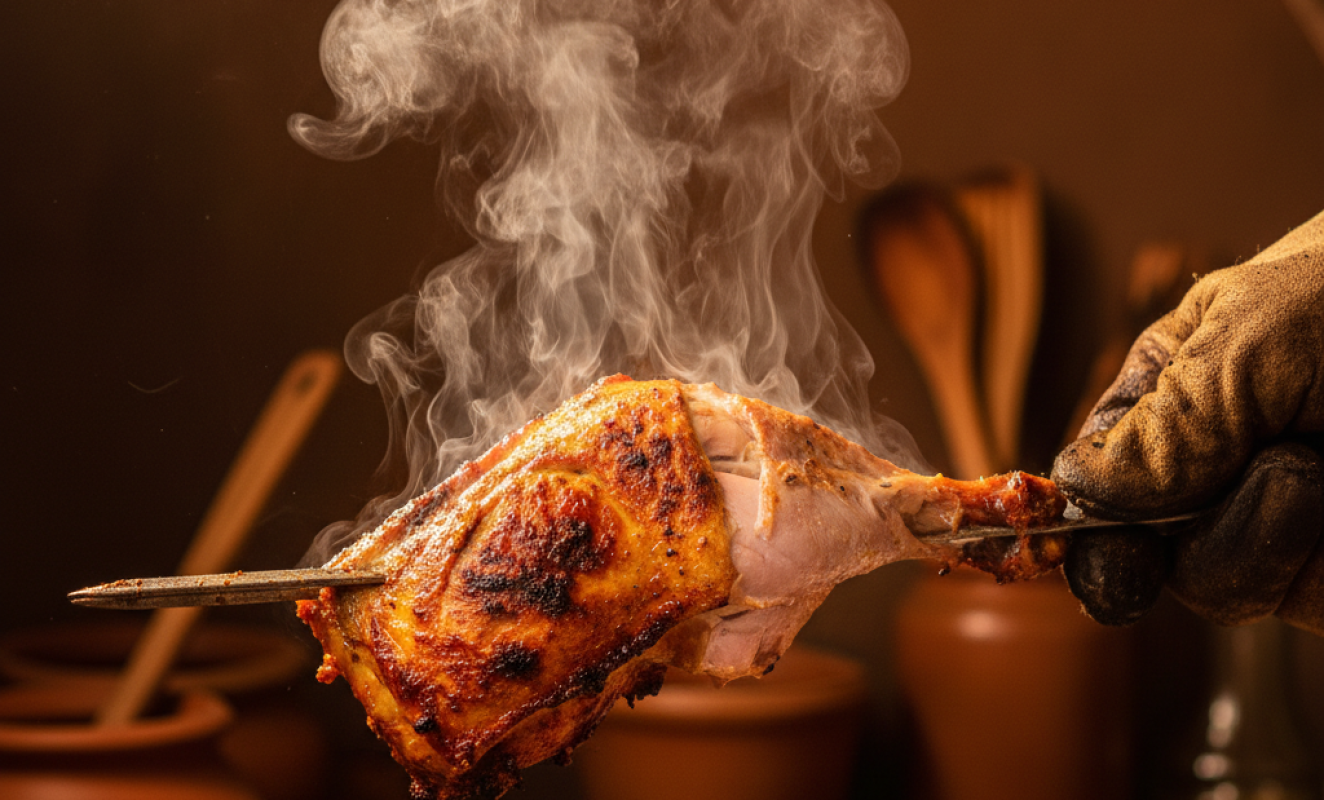
Why Everyone Searching “Tandoori Chicken Near Me” Deserves a Real Answer About What They’re Actually Getting
If you’ve ever typed tandoori chicken near me into your phone and ended up disappointed by dry, pale, oddly flavoured results from a restaurant claiming authenticity, you’re not alone — and there’s a very specific scientific reason that keeps happening. In 2026, more diners across Brampton and Mississauga are asking sharper questions about what separates genuinely great tandoori chicken from an imitation, and the answer almost always comes back to one thing: temperature control inside the tandoor itself. At 7 Spice Bistro, we’ve spent years studying, refining, and obsessing over this exact question, and we want to share what we’ve learned — because great Indian food deserves a well-informed audience.
QUICK ANSWER
Tandoori chicken achieves its signature combination of charred exterior and juicy interior because a properly managed clay tandoor oven operates between 450°C and 480°C (840°F–900°F), creating intense radiant heat, convective airflow, and live-fire smokiness simultaneously. Without precise temperature control at each of these three heat transfer levels, the result is either burnt and dry or soft and under-coloured — never the real thing.
This article is a genuine technical deep-dive. We’re not just telling you that our chicken tastes good — we’re going to explain exactly why the physics of a traditional tandoor, when respected properly, produces results that no conventional oven, grill, or air fryer can replicate. Whether you’re a curious home cook, a food enthusiast in Brampton or Mississauga, or simply someone who wants to understand what they’re eating, this one’s for you.
What Actually Happens Inside a Tandoor at Full Temperature?
A tandoor oven is not simply a very hot oven. It is a multi-physics cooking environment that combines three distinct forms of heat transfer in a single vessel — and that combination is precisely what makes tandoori chicken irreplaceable.
According to the Journal of Food Engineering, clay-walled cooking vessels create a unique thermal mass effect where walls absorb heat over long pre-heating periods and then radiate it back inward at extremely consistent temperatures — a thermal stability that metal ovens structurally cannot match. This is the foundation of everything that follows.
The Three Heat Transfer Mechanisms Working in Concert
Radiant heat from the clay walls — which have been pre-heated for 45 to 90 minutes before the first piece of chicken is lowered in — strikes the marinated surface of the meat directly and begins the Maillard reaction almost instantly. The Maillard reaction is the chemical browning process responsible for the flavour compounds in that distinctive char: it only initiates at temperatures above 140°C, and it accelerates dramatically as surface temperatures climb toward 180°C and beyond. At full tandoor temperatures, this reaction happens in seconds rather than minutes, which is critical to flavour concentration.
Convective heat moves through the interior of the tandoor as hot air rises from the live charcoal or wood fire at the base. Because the tandoor’s cylindrical shape narrows at the top, this convective column is actually accelerated — meaning the hot air velocity around the suspended chicken is higher than in a standard oven, which strips surface moisture rapidly and contributes to that lightly crisp, almost smoky skin without the meat needing extended cooking time that would dry out the interior.
Smoke and live fire provide the third layer. As marinade drips from the chicken — a yogurt and spice base that is itself engineered to contribute flavour compounds when it burns — it hits the coals below and vaporises back upward through the meat. This is not incidental; it is the mechanism that deposits the smoky, slightly earthy undertone that no oven-roasted chicken can replicate. The marinade is not just a flavour carrier before cooking. It is an active participant in the cooking chemistry itself.
“The tandoor doesn’t cook chicken — it transforms it. The clay walls, the live fire, the dripping marinade and the rising smoke are all part of a single choreographed chemical reaction that takes about eight to twelve minutes to complete correctly. Interrupt any part of it and you have a different dish entirely.”
Why Does Temperature Control Make or Break Tandoori Chicken?
Temperature control is the single variable that separates exceptional tandoori chicken from the mediocre versions you’ve likely encountered at some point. The window for perfection is surprisingly narrow, and it requires both technical knowledge and real-time attention from a skilled tandoor cook.
According to the Food and Agriculture Organization of the United Nations, traditional clay tandoors operated with charcoal or wood fuel reach internal temperatures between 400°C and 500°C during peak operation. Within that range, the margin for ideal results is roughly 450°C to 480°C — a 30-degree window. Below 450°C, the Maillard browning slows, surface moisture doesn’t evaporate fast enough, and the chicken steams more than it roasts, resulting in that pale, soft texture that feels like a letdown. Above 480°C without careful management, the exterior chars before the interior has reached the safe and juicy 74°C internal temperature required for perfectly cooked poultry.
The Preheat Phase Is Non-Negotiable
At 7 Spice Bistro, our team begins heating the tandoor well before service opens. This is not convenience — it’s a structural requirement. A clay tandoor that hasn’t been properly pre-heated has cold spots in its walls where the thermal mass hasn’t saturated yet. Cold spots mean uneven radiant heat, which means some sections of the chicken cook faster than others. The result is the familiar problem of one side beautifully charred while the adjacent section is still pink and under-cooked near the bone. Proper pre-heating eliminates this entirely by ensuring the walls radiate heat uniformly from every angle.
Load Management: Why You Can’t Just Fill the Tandoor
Here’s a detail that almost no restaurant talks about publicly: the number of pieces loaded into a tandoor at once has a direct effect on cooking quality. Every piece of cold, marinated chicken that enters the tandoor draws thermal energy from the walls as it heats up. Load too many pieces simultaneously and the wall temperature drops, the convective dynamics shift, and you’re no longer cooking at the ideal range. Our kitchen manages load sizes deliberately, even during peak dinner service in Brampton, because the physics don’t pause for a busy Friday night.
This is also why tandoori chicken from a restaurant that’s genuinely busy but properly managed will often taste better than from one that’s half-empty — the tandoor is being used and maintained at operational temperature continuously rather than sitting partially cooled between infrequent orders.
How Does the Marinade Chemistry Interact With Tandoor Heat?
The marinade is not decoration. It is a precision-engineered cooking medium, and its interaction with tandoor temperatures is one of the most fascinating parts of the entire process.
A traditional tandoori marinade has three functional components: an acid agent, a fat carrier, and a spice matrix. The acid — almost always yogurt, sometimes with lemon juice added — begins a gentle protein denaturing process during the marination period (typically six to twenty-four hours). This pre-denaturing is what allows the chicken to cook through so quickly in the high-heat environment without becoming tough. The fat component in the yogurt acts as a heat conductor at the surface level, helping flavour compounds from the spice matrix penetrate the outer muscle layers rather than simply sitting on top.
What the Spice Matrix Actually Does at 480°C
The spice matrix — typically including Kashmiri red chilli for colour, cumin, coriander, garam masala, ginger, and garlic — undergoes what food scientists call pyrolysis when it makes contact with temperatures above 300°C. Pyrolysis is not burning; it’s the controlled thermal decomposition of organic compounds into new flavour molecules. This is the mechanism behind the “charred spice” note that you get from genuinely great tandoori chicken — flavour compounds that simply do not exist in the raw spices are created in the moment of contact with intense heat. At 7 Spice Bistro, our spice blends are formulated specifically with this thermal transformation in mind, not just for flavour in the raw state.
The red colour traditionally associated with tandoori chicken comes from Kashmiri red chilli powder — a variety prized for its deep colour and mild heat. Restaurants that use artificial food colouring to achieve the red hue are bypassing the real flavour contribution that Kashmiri chilli provides, which is a meaningful sacrifice. Our kitchen in Brampton uses genuine Kashmiri chilli, and the colour you see on the plate is entirely from the spice.
If you’re interested in how we apply these same principles of precision cooking to other dishes, our article on The Butter Chicken Debate: Traditional Recipe vs. Modern Brampton Interpretations explores how tandoor-cooked chicken becomes the starting point for one of our most requested dishes — and why that foundation matters enormously.
What Separates Authentic Tandoori Chicken From Oven-Roasted Imitations?
Authentic tandoori chicken differs from oven-roasted versions in three measurable ways: surface texture, moisture retention, and smoke flavour — all of which are direct consequences of tandoor physics that conventional kitchen equipment cannot reproduce.
Conventional ovens — even professional-grade convection ovens — max out at around 260°C to 290°C. At these temperatures, the Maillard reaction still occurs, but slowly, and over a longer period. Longer cooking time means more moisture loss from the interior of the chicken. By the time an oven-roasted piece achieves acceptable surface colour, it has often lost 15–20% more moisture than the same piece cooked in a tandoor for a fraction of the time. The result is drier, less flavourful meat — and no amount of basting or sauce correction fully compensates for that structural moisture loss.
The Smoke Variable That Cannot Be Faked
Liquid smoke additives and smoked paprika are popular attempts to replicate the smoke flavour of a live-fire tandoor. They produce a one-dimensional smokiness that sits on the surface of the meat rather than being integrated through the cooking process. In a working tandoor, the smoke interaction happens continuously over the entire cook time as marinade drips, vaporises, and rises back through the chicken. The result is a smoke character that is distributed through multiple layers of the meat — something you can literally taste in different ways as you work through a piece.
Families across Mississauga and Brampton who visit us regularly often tell us that they tried to make tandoori chicken at home and couldn’t figure out why it tasted so different. This is why. The equipment isn’t a technicality — it’s the entire mechanism of the dish.
At 7 Spice Bistro, we also bring this same commitment to live-fire, authentic technique to our seafood preparations. Our article on Seafood in Indian Cuisine: What Makes 7 Spice Bistro’s Fish & Shrimp Dishes Stand Out details how high-heat cooking applied to seafood with Indian spice profiles creates results that challenge expectations in the best possible way.
A Practical Comparison: Tandoor vs. Alternative Methods
| Cooking Method | Peak Temperature | Maillard Speed | Smoke Integration | Moisture Retention |
|---|---|---|---|---|
| Traditional Clay Tandoor | 450°C – 480°C | Seconds | Deep, continuous, layered | High (short cook time) |
| Commercial Convection Oven | 260°C – 290°C | Minutes | None (unless additive used) | Lower (extended cook time) |
| Outdoor Charcoal Grill | 230°C – 350°C (surface) | Minutes | Surface only, uneven | Moderate |
| Broiler / Salamander | 300°C – 320°C (element) | Minutes | None | Low (top-heat only, dries surface) |
How 7 Spice Bistro Applies These Principles in a Real Brampton Kitchen
Understanding the science is one thing. Executing it consistently across hundreds of covers per week in a busy Brampton restaurant is something else entirely, and we want to be transparent about how we approach that challenge.
Our tandoor is a traditional clay vessel — not a gas-fired simulation, not a modern “tandoor-style” metal unit. The clay walls are the entire point. Our team treats the preheat cycle as an absolute non-negotiable regardless of how the morning schedule looks. The charcoal selection matters too: we use hardwood charcoal that burns hotter and longer than standard briquettes, with minimal ash production, which keeps the fire bed clean and the convective airflow inside the tandoor consistent throughout service.
Our marination protocol involves a minimum twelve-hour soak for our tandoori chicken. We’ve tested shorter periods extensively, and while even a four-hour marinade produces acceptable results, the protein denaturing and spice penetration that occurs between hours eight and twelve makes a difference that diners notice without being told to look for it. In taste testing sessions with our team, twelve-hour marinated chicken was consistently identified as having more integrated flavour — less like “spiced chicken” and more like the spices had genuinely become part of the meat itself.
Serving communities across both Brampton and Mississauga means our kitchens operate at high volume during peak periods. We’ve designed our production workflow specifically to avoid the load-management problems described earlier — staggering tandoor loads and maintaining consistent coal management so that temperature never drops below our target range, even during the busiest service windows. If you’re curious about how we serve both communities with the same standard, our team has written about that directly at 7 Spice Bistro Mississauga vs. Brampton: How We Serve Two Communities with One Philosophy.
“Temperature consistency isn’t a performance standard we meet on good nights. It’s a structural commitment built into every decision we make about equipment, fuel, workflow, and marination timing — because we know what the physics demand.”
We’re proud to be part of the Indian food community in Brampton and to serve guests who genuinely want to understand what’s on their plate. The more informed our diners are, the more they can appreciate the real difference that commitment to authentic technique makes — and the more they hold every restaurant they visit to a higher standard. We think that’s a good thing for the whole community.
Ready to Taste the Science?
Everything we’ve described in this article is waiting for you at 7 Spice Bistro. Come experience the real difference that proper tandoor temperature control makes — in Brampton or Mississauga, your table is ready.
✍️ Written by the 7 Spice Bistro Kitchen & Content Team
Our team of chefs and food storytellers has spent years working with traditional Indian cooking techniques across our Brampton and Mississauga kitchens. We write about what we actually cook, because we believe great food deserves an honest explanation.
Frequently Asked Questions
How hot does a real tandoor oven need to be for authentic tandoori chicken?
A properly operated clay tandoor should reach between 450°C and 480°C (roughly 840°F to 900°F) for optimal tandoori chicken results. Below 450°C, the surface browning slows significantly and the chicken tends to steam rather than roast, losing the char and smoke complexity that defines the dish. Above 480°C without careful management, the exterior can over-char before the interior reaches the safe internal temperature of 74°C. This narrow operating window is why skilled tandoor management is genuinely a specialised culinary skill.
What makes the marinade so important to tandoori chicken’s final flavour?
The marinade serves three distinct functions: the yogurt acid begins denaturing proteins before cooking (which protects moisture and speeds cook time), the fat carries spice compounds into the outer muscle layers, and the spice matrix undergoes pyrolysis at tandoor temperatures — creating entirely new flavour molecules that don’t exist in the raw spices. This means the marinade is not just a pre-cook flavour application; it is an active chemical participant in the cooking process itself, contributing flavour compounds that are only created in the moment of contact with extreme heat.
Why can’t a regular oven or grill replicate real tandoori chicken?
Standard ovens and grills cannot replicate authentic tandoori chicken because they lack the combination of extreme temperature, clay thermal mass, and continuous live-fire smoke interaction that a tandoor provides. A conventional oven peaks at around 260°C to 290°C — roughly half the temperature of a working tandoor — which means much longer cook times, greater moisture loss, and no smoke flavour at all. The clay walls of a tandoor also radiate heat from all directions simultaneously, cooking the chicken evenly in a way that neither a grill (one directional) nor an oven (circulating air only) can match.
Can I tell if a restaurant is using a real tandoor before I order?
Yes — there are a few reliable indicators. Genuine tandoori chicken has a slightly irregular char pattern (because the meat hangs vertically near the clay walls and the heat isn’t perfectly uniform), a smoke aroma that you can detect from across the table, and a surface texture that’s firm and slightly crisp without being dry. Oven-roasted imitations tend to have more uniform colouring (often from food dye rather than natural spice reduction), a softer surface, and no discernible smoke note. You can also simply ask whether the restaurant uses a traditional clay tandoor — any kitchen that does will be happy to tell you, because it represents a real investment in equipment and technique.