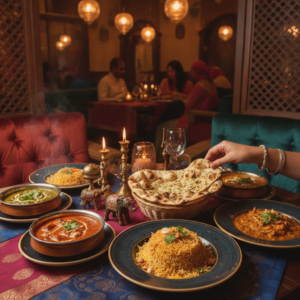
When you search “indian food near me” and get dozens of results staring back at you, the real challenge isn’t finding an Indian restaurant — it’s figuring out which ones are genuinely worth your time, your money, and your appetite. In 2026, the Indian restaurant scene across Brampton and Mississauga has grown enormously, and while that’s exciting, it also means more noise to cut through. Not every kitchen that hangs a tandoor photo on its wall actually uses one. Not every menu that lists “butter chicken” is building it from scratch with whole spices and a proper makhani base. The difference between a shortcut kitchen and a truly skilled one shows up in ways that are absolutely detectable — if you know what to look for.
At 7 Spice Bistro, we’ve spent seven years cooking authentic Indian cuisine in Brampton, and we’ve heard from guests who were burned by imitation before they found us. This guide is our honest, practical answer to the question diners deserve help with: How do you actually know if a kitchen is the real thing?
⚡ QUICK ANSWER
A truly authentic Indian kitchen shows itself through menu depth, visible spice work, regional variety, from-scratch cooking methods, and staff who can actually explain what’s on the plate. If a restaurant checks all five boxes, you’re in the right place.
What Does “Authentic Indian Cuisine” Actually Mean?
Authentic Indian cuisine is not a single dish or a single flavour profile — it is a living, regional, deeply layered culinary tradition that varies dramatically from Punjab to Kerala, from Gujarat to West Bengal. A restaurant serving genuine Indian food will reflect that complexity, not flatten it into three sauces and a pile of rice.
The word “authentic” gets thrown around loosely in the restaurant world, but here’s what it genuinely means in practice: dishes built from whole or freshly ground spices rather than pre-mixed commercial powder blends; proteins and vegetables cooked with technique rather than just heat; and recipes that honour regional origin rather than chasing a generic “Indian food” aesthetic.
India has over 28 states, each with its own cuisine identity. A kitchen that serves only the five most famous dishes is telling you something: they’ve built a menu around what sells, not around what they actually know how to cook. Depth — a wide-ranging, well-explained menu with regional specialties — is one of the first markers of a kitchen with real culinary knowledge behind it.
“Authentic Indian cooking isn’t about heat or colour — it’s about the layering of spice, the patience of technique, and the honesty of the ingredients. When those three things come together, the dish tells you everything.”
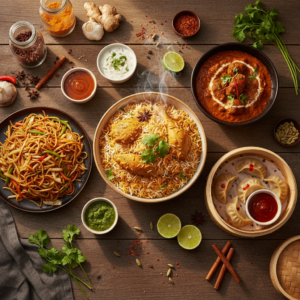
At 7 Spice Bistro, our menu spans traditional Indian preparations alongside Hakka Chinese dishes — a culinary crossover that is itself a genuine cultural tradition rooted in the Chinese-Indian community. That breadth isn’t accidental. It reflects the range of cooking our team has genuinely mastered over years of practice in Brampton kitchens.
How to Read a Menu Like an Expert (Before You Even Taste Anything)
The menu is your most powerful pre-visit screening tool. A well-constructed Indian restaurant menu will tell you within minutes whether the kitchen has depth or is operating on shortcuts.
Look for regional specificity
Does the menu mention where dishes originate? Dishes like Chettinad Chicken, Amritsari Fish, Hyderabadi Biryani, or Rajasthani Dal Baati signal that the kitchen is drawing from specific culinary traditions rather than a generic playbook. Generic menus list dishes by ingredient (Chicken Curry, Lamb Curry, Prawn Curry) without any regional or preparation context. That vagueness often masks the fact that all three are made with the same base sauce.
Check how spices are described
Authentic menus often reference actual spice components — fenugreek, kasuri methi, ajwain, dried red chillies, cardamom, star anise. If the only spice descriptor on an entire menu is “spicy” or “mild,” that’s a red flag. A kitchen that knows its craft is proud of what goes into each dish, and that pride surfaces in how dishes are written and described.
Vegetarian options should be substantive, not an afterthought
Indian cuisine has one of the world’s richest vegetarian culinary traditions. A restaurant with authentic cooking knowledge will offer a robust vegetarian section — not just paneer in three different sauces, but dal preparations, stuffed breads, vegetable-forward curries with distinct regional identities, and appetisers that stand on their own. Shallow vegetarian menus often indicate a kitchen that treats plant-based cooking as secondary, which runs counter to the soul of Indian culinary tradition.
For a deeper dive into one of India’s most beloved vegetarian ingredients, our guide on Paneer 101: Every Dish, Every Style, and Why Indian Cheese Deserves a Spot on Your Table walks through how paneer is used across regions — a useful lens for evaluating any kitchen’s approach.
Why Cooking Technique Is the Real Tell
Technique is the single most reliable indicator of an authentic kitchen. You can source beautiful ingredients, write a sophisticated menu, and still produce food that tastes flat if the underlying cooking methods are wrong.
The tandoor question
If a restaurant advertises tandoori dishes, ask whether they use a working clay tandoor. When people search “tandoori chicken near me” or the “best chicken balti near me,” they’re often hoping for the real thing — that char, that smoky depth, that slightly blistered bread that only comes from a proper clay oven fired to the right temperature. An oven-roasted chicken dressed with tandoori spices is not the same dish. It can be good, but it is not tandoori. A kitchen that uses a genuine tandoor will usually say so, because it’s a genuine point of pride.
The tarka and the bhunao
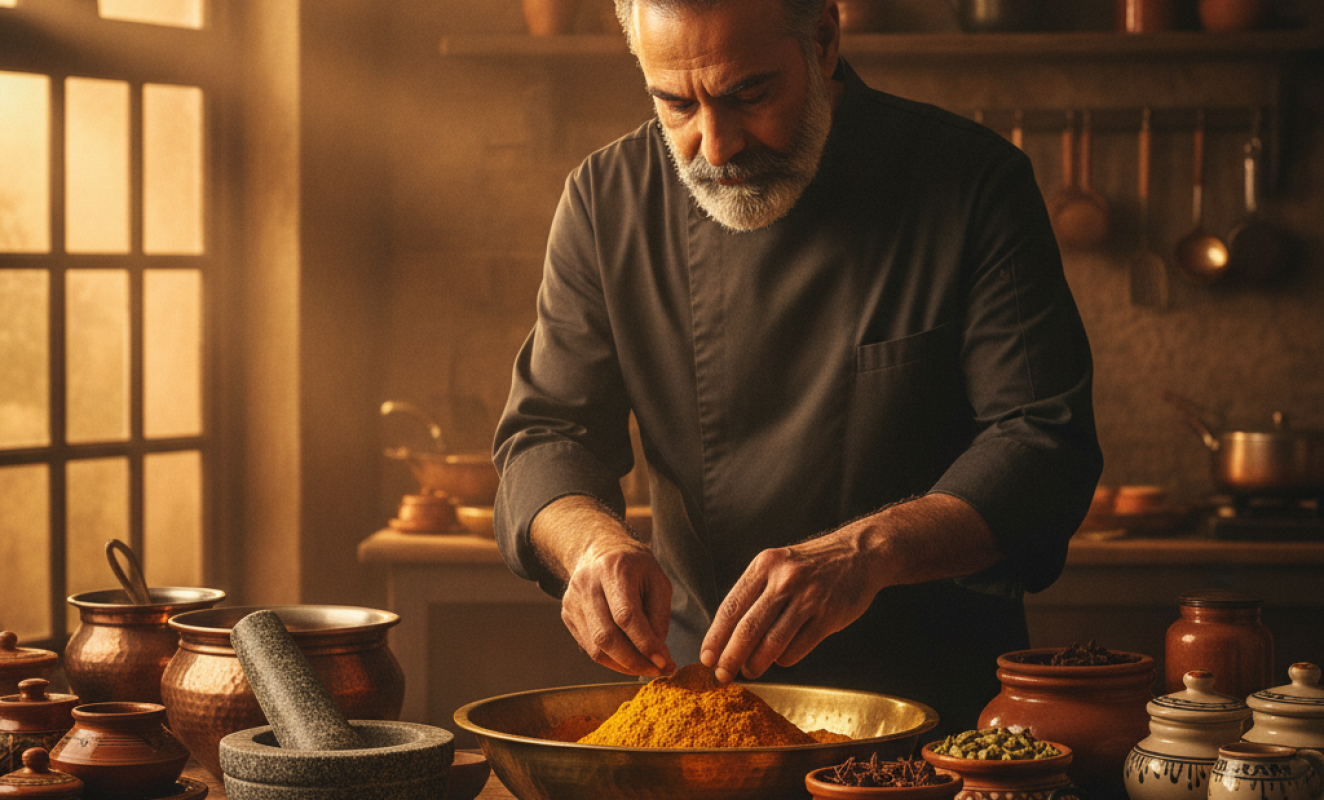
Two foundational techniques separate authentic Indian cooking from approximations: the tarka (tempering whole spices in hot oil or ghee to bloom their aromatic compounds) and the bhunao (the process of continuously working spice pastes into fat over high heat until oil separates). Both require attention, patience, and understanding. The result — a layered, complex, deeply savoury base — cannot be replicated with powder and water. When you taste a curry and wonder why it hits so differently from what you’ve had elsewhere, these techniques are usually the reason.
Bread tells you a lot
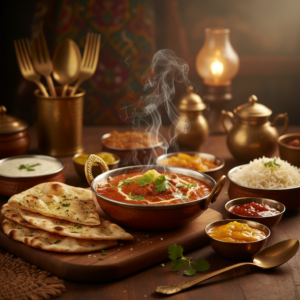
Indian bread — naan, roti, paratha, puri — should be made fresh, to order. A reheated or pre-made naan that arrives with an even, identical texture every single time is machine-made or thawed. Real naan has variance: slight char bubbles, an uneven surface, a pull when you tear it. These are signs of a kitchen making bread by hand. Bread quality is one of the easiest things to assess, and one of the most overlooked.
Where to Find the Best Indian Food Near Me in Brampton and Mississauga
The best Indian food near you, in Brampton and across the greater Mississauga area, comes from kitchens that have been cooking consistently for years — not operations that launched a trendy menu overnight. Longevity matters in this cuisine because mastery takes time. Seven years of practice in a Brampton kitchen is not incidental; it produces a different level of dish than a kitchen that’s been open eighteen months.
When you’re evaluating restaurants near me indian style results, look past the star ratings alone. Read the reviews for specifics: do people mention particular dishes? Do they describe the spices, the texture of the bread, the depth of the curry? Specific praise is more reliable than generic five-star enthusiasm. If the top review says “food was great, will come back,” that tells you nothing. If it says “the lamb rogan josh had the most perfectly balanced Kashmiri spice profile I’ve had outside of a home kitchen,” you’re reading a reliable signal.
Brampton has one of the most vibrant South Asian communities in Canada, which means the bar for Indian cooking here is genuinely high. Local diners know what authentic tastes like — many of them grew up eating it at home. That community standard pushes kitchens like ours to stay sharp, stay honest, and never cut corners on the cooking.
For a curated look at how the dining scene across Brampton’s neighbourhoods compares, the guide Top Restaurants in Brampton Right Now: A Neighbourhood-by-Neighbourhood Breakdown is worth a read — it’ll help you orient yourself in the city’s food landscape.
The Complete Checklist: Signs You’ve Found the Best Indian Cuisine
Here is our practical, condensed checklist — the markers we’d use ourselves to assess any Indian kitchen before sitting down to eat. Run through these before you commit to a table, and you’ll rarely be disappointed.
| What to Check | Green Flag | Red Flag |
|---|---|---|
| Menu Depth | Regional dishes named and described with spice or origin context | Five-item menu with generic names and no descriptions |
| Bread Quality | Slightly uneven, hand-made, fresh to order with visible char | Perfectly uniform, pre-made texture, arrives without warmth |
| Spice Knowledge | Staff can explain spice profiles; menu references actual spices | “Hot or mild?” is the only spice conversation on offer |
| Vegetarian Range | Substantive, varied vegetarian section with distinct dishes | Two paneer dishes added as an obligation, not a celebration |
| Cooking Method | Evidence of tandoor use, fresh masala, oil-separated gravies | Thin, watery sauces with uniform colour across all dishes |
| Review Specificity | Reviewers name dishes and describe flavour and texture in detail | Reviews are entirely generic: “great food, nice service” |
| Kitchen Longevity | Established restaurant with consistent presence in the community | Recently opened with a rapidly changing menu and no history |
We’re confident that 7 Spice Bistro checks every box on that list — and we’d encourage you to hold us to it. Seven years of cooking in Brampton, a menu that spans traditional Indian dishes and authentic Hakka Chinese cuisine, comprehensive vegetarian options, and a team that can walk you through every dish we make: that’s not a marketing claim, it’s a cooking record.
If you want to go even deeper on what separates a genuinely skilled Indian kitchen from an imitation, our full breakdown at Authentic Indian Cuisine: 8 Hallmarks That Tell You a Restaurant Is the Real Deal covers the topic with granular detail that even experienced food lovers find useful.
What Great Service Looks Like in a Genuine Indian Restaurant
An authentic dining experience isn’t only about what comes out of the kitchen — it’s about what happens at the table, too. Staff at a genuinely skilled Indian restaurant can do more than take your order. They can recommend dishes based on your preference for heat, texture, or protein; they can explain what a dish is, where it’s from, and how it’s cooked; and they can suggest pairings that actually make sense rather than defaulting to “everything goes with butter chicken.”
Service knowledge is particularly relevant when it comes to less-familiar dishes. If you’re new to Indian cuisine, or new to a particular region’s cooking, a knowledgeable server is the difference between an adventure and an overwhelming list of unfamiliar names. We train our team at 7 Spice Bistro to be that guide — not in a formal or stiff way, but in the way a friend who loves food would talk you through a menu they know inside out.
Budget-friendly pricing matters too — and it matters that it doesn’t come at the expense of quality. One of the persistent myths about Indian restaurants is that you have to choose between affordable and excellent. At 7 Spice Bistro, we’ve worked hard to make sure families dining in Brampton don’t face that trade-off. Great food, at prices that make a regular dinner out feel like a reasonable decision, not a splurge.
Beyond dine-in, we also offer catering services for events of all sizes — from family gatherings to corporate lunches. If you’re planning an event in Brampton or Mississauga and want Indian cuisine that represents the real thing rather than a buffet approximation, our catering team brings the same cooking standards to every off-site event we take on.
Ready to Experience Authentic Indian Cuisine in Brampton?
Whether you’re dining in, ordering for delivery, or planning catering for your next event, the 7 Spice Bistro team is ready to show you what seven years of authentic Indian cooking in Brampton actually tastes like. Browse our full menu, check our reviews, or get in touch — we’d love to cook for you.
✍️ Written by the 7 Spice Bistro Team
With seven years of authentic Indian and Hakka cooking experience in Brampton, the 7 Spice Bistro team writes from a place of genuine culinary knowledge and community passion. Our goal is to help diners across Brampton and Mississauga find food that’s honest, flavourful, and worth every visit.
Frequently Asked Questions
How can I tell if an Indian restaurant is using real spices or premixed blends?
The clearest indicator is the complexity and variance of flavour across dishes. If every curry tastes like a variation of the same profile, the kitchen is likely relying on a single commercial spice blend. Authentic cooking layers individual spices at different stages of cooking — a process that produces depth, nuance, and distinctly different flavour profiles across the menu. You can also ask your server directly: a confident kitchen won’t hesitate to tell you what goes into a dish.
What dishes should I order to test whether a kitchen truly knows Indian cuisine?
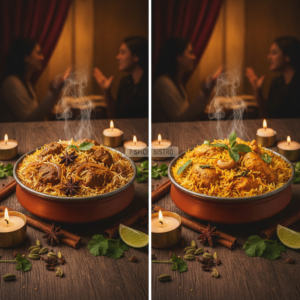
Order something that can’t be masked by sauce volume — dal makhani, a plain paratha, or a biryani are all excellent tests. Dal makhani requires slow cooking and spice patience; a paratha shows bread-making technique; and a biryani reveals whether rice, protein, and aromatics have been cooked together with care or simply assembled. These dishes expose the kitchen’s true skill level more honestly than a heavily sauced curry ever will.
Why does Indian food taste so different from restaurant to restaurant, even for the same dish?
Because Indian cooking is built on technique and proportionality — the sequence in which spices are added, the ratio of fat to spice paste, the cooking time at each stage, and the quality of base ingredients all have an enormous impact on the final dish. Two kitchens making butter chicken from the same ingredient list will produce measurably different results based purely on method. This is why experience and genuine mastery of the cuisine matters so much, and why a kitchen with a long track record consistently outperforms one that is still figuring things out.
Can I trust online reviews to find the best Indian restaurant near me?
Yes — but read for specificity, not just star count. Reviews that name dishes, describe textures, and reference spice levels are written by people who genuinely engaged with the food. Generic praise (“amazing, will be back”) tells you little about whether the kitchen is actually skilled or simply adequate. Look for patterns in specific praise: if multiple reviewers independently call out the same dish as exceptional, that’s a reliable signal. At 7 Spice Bistro, our reviews consistently reference specific dishes and flavour experiences — and we’re proud of that kind of feedback, because it reflects real cooking.